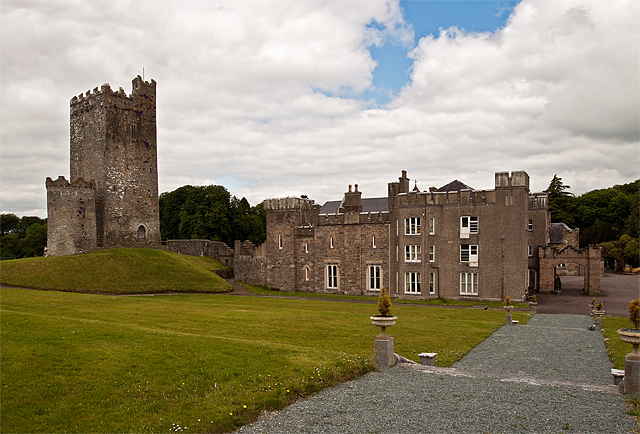
Dromagh Castle
Dromagh Castle is located in the north of the townland of Dromagh, within County Cork, Ireland. This historic site originated as a fortified residence and has undergone significant architectural and ownership changes over the centuries, reflecting the turbulent history of the region.
Early construction and original features
The castle was likely constructed around 1582 by Art O Caoimh, an important ancestor of the O'Keeffe family. Initially, it was built as a tower house, a common type of fortified residence in Ireland during the late medieval and early modern periods. The original structure reportedly consisted of a five-storey tower house centrally positioned within a bawn—a defensive walled enclosure typical of Irish castles of the era.
Dromagh Castle was notable for its defensive features, including two moats: one surrounding the tower house inside the bawn and another encircling the bawn itself. These moats served as significant protective measures against attackers but have since been filled in over time, erasing some of the castle's original defensive landscape.
Historical significance and sieges
The castle served as the principal seat of the O'Keeffe family, a Gaelic Irish clan with longstanding regional influence. During the mid-17th century, Dromagh Castle became a site of conflict amid the Cromwellian conquest of Ireland. In 1652, Oliver Cromwell's forces captured the castle, and the defenders were executed, marking a violent chapter in its history.
Local tradition recounts that a considerable group of defenders escaped capture by fleeing through a secret tunnel that connected the castle to a nearby farm. This tunnel is part of the castle's lore, illustrating the desperate measures taken during sieges. Following the Jacobite wars, the O'Keeffe family lost possession of the castle, reflecting the broader political and social upheavals of the time.
18th-century remodeling and later ownership
By the mid-18th century, the castle was occupied by the Philpot family. Subsequently, it passed into the hands of the Leader family, who undertook significant remodeling efforts. They transformed the medieval tower house and bawn into a more comfortable country house with associated outbuildings, reflecting changing tastes and residential needs.
The remodeling included the addition of two gateways, the installation of crenelations (battlement-style parapets), and the construction or enhancement of the upper parts of the corner towers. These features combined elements of both defensive architecture and aesthetic design, typical of 18th-century country estates that incorporated medieval motifs.
20th-century events and current status
During the Irish War of Independence around 1920-1921, Dromagh Castle was deliberately burned by local Volunteers, an act reflecting the political tensions and conflicts of the period. The fire caused significant damage, leaving the castle in a state that has required preservation efforts.
Today, Dromagh Castle remains part of a working farm and is private property, limiting public access. Despite this, the castle is recognized for its historical and architectural significance, representing a layered history from its origins as a fortified tower house to its transformation into a country residence.
Architectural features and layout
The castle's original tower house would have been a vertically oriented stone structure with narrow windows and thick walls designed for defense. The surrounding bawn wall provided an additional layer of protection, enclosing the courtyard and ancillary buildings.
The filled-in moats once added to the castle's defensibility, creating water barriers that deterred attackers. The later addition of crenelated battlements and corner towers during the 18th-century remodeling introduced a romanticized medieval appearance, blending function with aesthetic appeal.
Cultural and heritage importance
Dromagh Castle stands as a testament to the complex history of County Cork and the broader region of Ireland, illustrating the transition from Gaelic lordship to English control and later gentrification of former defensive sites into country estates. Its association with the O'Keeffe family and its role in significant historical events such as the Cromwellian conquest and the Irish War of Independence add layers of cultural significance.
Although not generally open to the public, the castle remains an important heritage site for historians, architects, and those interested in Ireland's medieval and post-medieval past.
Frequently asked questions (FAQ)
- When was Dromagh Castle originally built and by whom?
- Dromagh Castle was likely built around 1582 by Art O Caoimh, an ancestor of the O'Keeffe family, as a fortified tower house.
- What are the key architectural features of Dromagh Castle?
- The castle originally featured a five-storey tower house within a bawn, surrounded by two moats, later remodeled with crenelations and corner towers in the 18th century.
- Is Dromagh Castle open to the public for visits?
- Dromagh Castle is private property and part of a working farm, so it is not freely accessible to the public without permission from the owners.
- What historical events affected Dromagh Castle?
- The castle was captured by Oliver Cromwell's forces in 1652, and it was burned during the Irish War of Independence around 1920-1921.
- Who owned Dromagh Castle after the O'Keeffe family?
- After the O'Keeffes lost the castle post-Jacobite period, it was occupied by the Philpot family in the 18th century and later remodeled by the Leader family.
Information
Current owner
Private owner
Loading map...
Visitor reviews
No reviews yet. Been here? Write the first review and help other travelers!
Write the first reviewVisited this castle? Share your experience
Your review helps other travelers and adds first-hand knowledge to our encyclopedia.