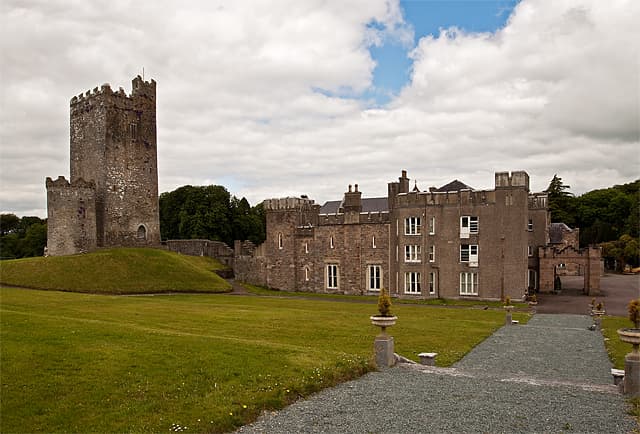
Drishane Castle
Drishane Castle stands as a notable example of a MacCarthy tower house and is recognized as a National Monument in County Cork, Ireland. This castle complex comprises two distinct structures: the original medieval tower house and an adjacent 18th-century house, reflecting the evolution of Irish aristocratic residences from the post-medieval period into the 18th century. The site is situated approximately 2.2 km northeast of Millstreet, positioned on the south bank of the Munster Blackwater River, an area rich in historical significance and natural beauty.
Historical background and ownership
The MacCarthy clan, a prominent Gaelic Irish family, originally constructed the tower house as a fortified residence during the late medieval period. Tower houses were a common form of fortified dwelling in Ireland from the 15th to 17th centuries, serving both defensive and domestic purposes. Although the exact date of construction of the Drishane tower house is not precisely documented, its architectural features align with typical late medieval Irish tower houses.
In the 18th century, the adjacent house was built, representing a shift from purely defensive architecture to more comfortable and stylistically refined residences. This transition reflects broader social and political changes in Ireland during the post-Renaissance era, when the need for military fortification diminished and aesthetic considerations gained importance.
Architectural features of the tower house
The original Drishane tower house is a classic example of a hill castle, designed to command views of the surrounding landscape and provide defensive advantages. Tower houses typically feature thick stone walls, narrow windows for archery defense, and a vertical layout spanning multiple floors. The Drishane tower house includes a rectangular plan with corner turrets and battlements, characteristic of MacCarthy fortifications.
Inside, the tower house would have contained a great hall, private chambers, and storage areas. The thick walls often incorporated mural passages and staircases, allowing defenders to move safely between floors during an attack. The presence of a bawn or defensive courtyard is common in such complexes, though specific details about Drishane’s bawn remain limited.
The 18th-century house and estate development
The adjacent 18th-century house at Drishane Castle marks a significant architectural and functional evolution. Built during the Georgian period, this residence likely features elements typical of the era, such as symmetrical façades, sash windows, and classical proportions. This house would have served as the primary residence for the estate owners, emphasizing comfort and style over defense.
The development of the estate around the castle reflects the changing social status and lifestyle of the Irish gentry in the 18th century. Gardens, parklands, and ancillary buildings would have been added to support the estate’s agricultural and domestic functions, although detailed records of these features at Drishane are scarce.
Location and landscape context
Drishane Castle’s location on the south bank of the Munster Blackwater places it within a historically strategic and fertile region of County Cork. The river provided vital transportation routes and resources, enhancing the castle’s importance. The nearby town of Millstreet lies 2.2 km to the southwest, offering access to local markets and services.
The castle’s elevated position as a hill castle allowed for surveillance of the surrounding countryside, which was essential for defense and control during the turbulent medieval and early modern periods in Ireland.
Current status and preservation
Today, Drishane Castle’s tower house remains a significant National Monument, reflecting its cultural and historical importance. The condition of the tower house is generally described as partially preserved, with some restoration efforts undertaken to stabilize the structure and prevent further decay. The adjacent 18th-century house is better preserved and continues to illustrate the architectural transition from medieval fortification to Georgian residence.
Visitors to the site can appreciate the contrast between the rugged medieval tower and the elegant 18th-century house, offering insights into Ireland’s architectural and social history across several centuries.
Visiting information and accessibility
While Drishane Castle is recognized as a National Monument, public access may be limited due to preservation concerns and private ownership. Visitors interested in exploring the site should check local resources for access permissions and guided tours. The castle’s proximity to Millstreet makes it accessible for day trips, with the surrounding countryside providing opportunities for walking and historical exploration.
Architectural significance and cultural heritage
Drishane Castle exemplifies the typical evolution of Irish noble residences from fortified tower houses to comfortable Georgian estates. It illustrates the adaptation of architecture to changing political, social, and technological contexts in Ireland from the late medieval period through the post-Renaissance era.
The castle’s association with the MacCarthy clan adds to its historical value, linking it to one of the most influential Gaelic families in Munster. As a National Monument, Drishane Castle contributes to the understanding of Ireland’s feudal past and the development of its rural aristocracy.
Frequently asked questions (FAQ)
- What is the historical significance of Drishane Castle?
- Drishane Castle is historically significant as a MacCarthy tower house and an example of Irish fortified residences evolving into Georgian estates. It reflects the architectural and social changes in County Cork from the late medieval period through the 18th century.
- Can I visit Drishane Castle?
- Public access to Drishane Castle may be limited due to preservation efforts and private ownership. Visitors should check local information for access permissions and possible guided tours.
- Where is Drishane Castle located?
- Drishane Castle is located approximately 2.2 km northeast of Millstreet, on the south bank of the Munster Blackwater River in County Cork, Ireland.
- What architectural features does the tower house have?
- The tower house features thick stone walls, narrow windows, a rectangular plan with corner turrets, and battlements typical of MacCarthy fortifications. Inside, it includes a great hall, private chambers, and mural staircases.
- What is the condition of Drishane Castle today?
- The tower house is partially preserved with some restoration to prevent decay, while the adjacent 18th-century house is better maintained, illustrating the transition from medieval fortification to Georgian residence.
Photo gallery

Information
Loading map...
Visitor reviews
No reviews yet. Been here? Write the first review and help other travelers!
Write the first reviewVisited this castle? Share your experience
Your review helps other travelers and adds first-hand knowledge to our encyclopedia.



