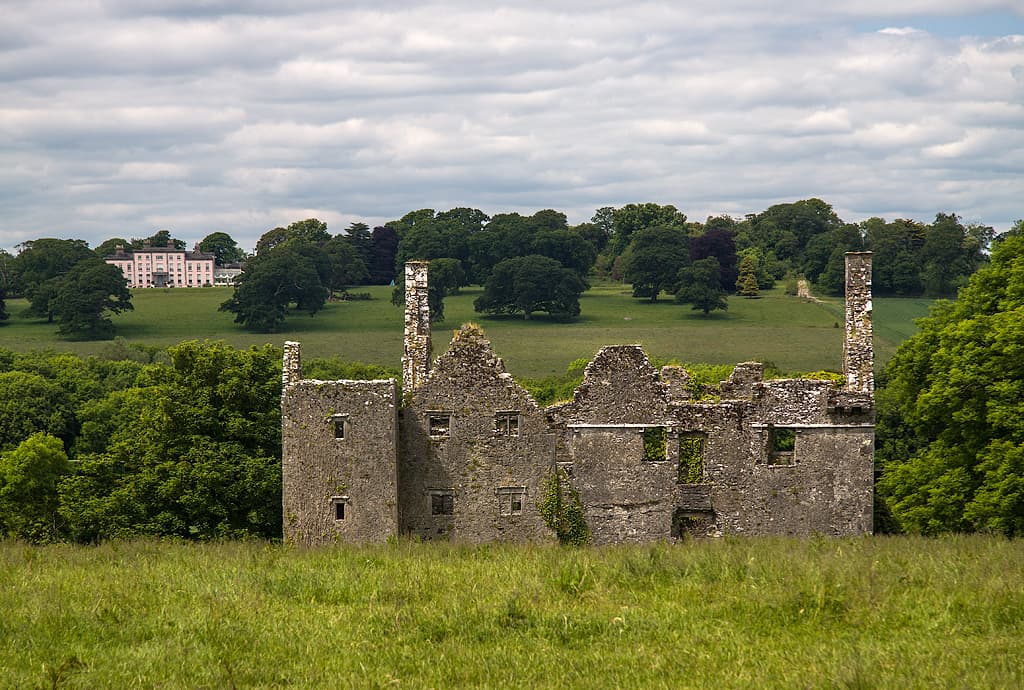
Dromaneen Castle
Dromaneen Castle stands as a significant 17th-century fortified house ruin located in County Cork, Ireland. It served as one of the principal strongholds of the ancient O’Callaghan clan, a family of considerable influence in the region. The castle represents a transition from medieval defensive structures to more comfortable, yet still defensible, residences characteristic of the Renaissance period in Ireland.
The architectural evolution of Dromaneen Castle
The current ruins of Dromaneen Castle reflect the remains of a Jacobean mansion built circa 1610 by Caher O’Callaghan. This construction replaced an earlier fortification, believed to have been a tower house, a common form of medieval Irish castle characterized by a tall, narrow stone structure designed primarily for defense. The shift to a fortified house in the early 17th century illustrates the changing needs of Irish nobility, who sought greater domestic comfort while maintaining defensive capabilities amid ongoing conflicts.
The castle's design would have included typical features of fortified houses of the period, such as thick stone walls, narrow windows for defense, and possibly a bawn or enclosed courtyard. The Jacobean style incorporated elements of Renaissance architecture, including more elaborate stonework and larger windows than earlier medieval castles, reflecting a blend of functionality and emerging aesthetic trends.
Historical significance and events
Dromaneen Castle was a central seat for the O’Callaghan clan, one of the prominent Gaelic families in Munster. Its strategic location on a hill provided both a defensive advantage and a commanding view of the surrounding lands. The castle is historically notable for hosting the Papal Nuncio Giovanni Battista Rinuccini in 1642. Rinuccini was a key figure during the Irish Confederate Wars, representing the Papacy's interests and supporting the Catholic Confederation in Ireland.
Unfortunately, the castle's active use was cut short during the turbulent mid-17th century. In 1652, during the Cromwellian conquest of Ireland, Dromaneen Castle was destroyed. The castle was not defended at this time, and it subsequently fell into ruin. After its destruction, the property was occupied by Sir Richard Herrill and later by a member of the Tynte family of Youghal. Eventually, ownership passed to Sir Richard Kyrle, reflecting the widespread transfer of lands following the Cromwellian settlements.
Architectural features and current condition
Today, the remains of Dromaneen Castle reveal the footprint of a fortified house rather than a traditional medieval castle. The surviving walls and structural elements indicate the building's original layout and defensive features. Although in ruins, the site provides valuable insight into the architectural and social changes occurring in Ireland during the early 17th century.
The castle's hilltop location classifies it as a hill castle, a common choice for medieval and Renaissance fortifications due to the natural defensive advantages offered by elevated terrain. The structure's design reflects the Renaissance architectural period, with Jacobean influences evident in the masonry and layout.
Legacy and cultural importance
Dromaneen Castle is recognized as a National Monument in Ireland, signifying its importance in the nation's heritage. It stands as a testament to the complex history of Irish clans, colonial conflicts, and architectural evolution. The castle's association with the O’Callaghan clan and its role during the Irish Confederate Wars highlight its historical relevance beyond its architectural value.
Visitors to the site can appreciate the castle's commanding position in the landscape and reflect on the turbulent history that shaped the region. Although the castle is in ruins, it remains a symbol of the resilience and adaptation of Irish noble families during a period of significant political and social change.
Frequently asked questions (FAQ)
- When was Dromaneen Castle built and by whom?
- Dromaneen Castle was built around 1610 by Caher O’Callaghan as a Jacobean mansion replacing an older tower house.
- What historical events took place at Dromaneen Castle?
- The castle hosted Papal Nuncio Giovanni Battista Rinuccini in 1642 during the Irish Confederate Wars and was destroyed in 1652 during the Cromwellian conquest.
- What architectural style characterizes Dromaneen Castle?
- Dromaneen Castle reflects the Renaissance period with Jacobean influences typical of early 17th-century fortified houses in Ireland.
- What is the current condition of Dromaneen Castle?
- The castle is currently in ruins, with surviving walls indicating its original fortified house layout on a hilltop location.
- Is Dromaneen Castle accessible to visitors?
- As a National Monument, Dromaneen Castle is protected, but specific visitor access and hours should be confirmed locally due to its ruinous state.
Photo gallery

Information
Current owner
State
Loading map...
Visitor reviews
No reviews yet. Been here? Write the first review and help other travelers!
Write the first reviewVisited this castle? Share your experience
Your review helps other travelers and adds first-hand knowledge to our encyclopedia.



