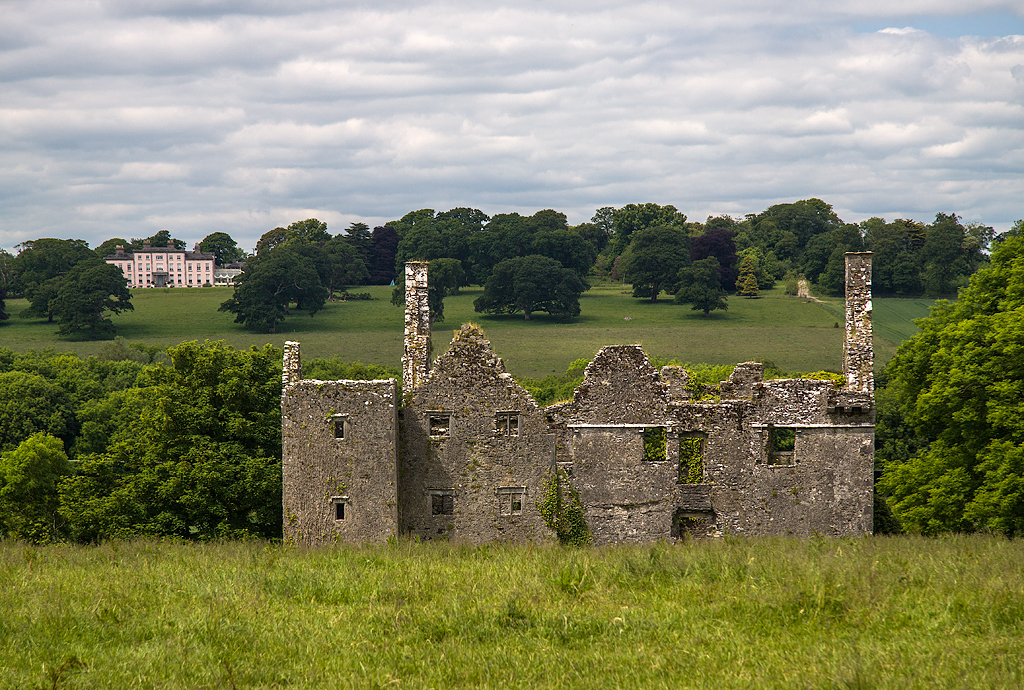
Lohort Castle
Lohort Castle is a historic tower located in County Cork, Ireland, within the expansive Castlelohort Demesne. The castle's origins date back to the late 15th century, when it was initially constructed around 1496 by Donogh Og McDonagh McCarthy, a member of the prominent McCarthy family. This original structure was a typical example of a rectangular tower house common in Ireland during the late medieval period, designed primarily for defense and residence.
Early history and military significance
During the turbulent period of the Irish Confederate Wars in the mid-17th century, Lohort Castle played a notable role. In 1647, it was captured by Irish rebel forces, reflecting the widespread unrest and factional conflict of the time. Subsequently, in 1650, the castle was retaken by a Cromwellian force after a bombardment, demonstrating its strategic importance in the region. These events underscore the castle's military relevance during a critical era of Irish history.
18th-century rebuilding and ownership changes
By the 18th century, the castle underwent significant transformation. In the 1740s, Sir John Percival, Earl of Egmont, commissioned a major rebuilding of the castle to serve as a residence for his estate agent. This reconstruction likely introduced Post-Renaissance architectural elements, reflecting the tastes and styles of the period, though the castle retained much of its original tower house form. The rebuild would have modernized the living quarters while preserving defensive features.
Later in the 18th century, Sir Timothy O'Brien, baronet, acquired the property, marking another phase in the castle’s ownership. The O'Brien family was influential in Irish society, and their acquisition of Lohort Castle indicates its continued prominence as a landed estate.
20th-century decline and damage
In the early 20th century, Lohort Castle fell into disuse and was unoccupied for a time. During the Irish War of Independence and subsequent Civil War, the castle was taken over by crown forces, which made it a target for the Irish Republican Army (IRA). In 1922, the IRA burned the castle, causing significant damage. This act was part of a broader pattern of attacks on symbols of British authority and landed power during this turbulent period.
Architectural features and current state
The castle today is characterized by its rectangular tower standing prominently within a large demesne. The tower is situated on a small moated island, a defensive feature typical of Irish tower houses, enhancing its security and isolation. To the east, approximately 75 meters away, is an entrance building that historically controlled access to the demesne.
Visitors to the site can freely access the castle grounds, which offer a glimpse of the estate's scale and layout. However, the tower itself remains closed to the public, preserving its interior from visitor access. Despite this, the castle's exterior appears well-preserved and intact, retaining much of its historic character and charm.
Cultural and heritage significance
Lohort Castle represents a layered history of Irish architecture and conflict, from its medieval origins through its 18th-century rebuilding to its 20th-century decline. Its survival as a physical structure offers valuable insight into the evolution of Irish tower houses and the socio-political upheavals that shaped the region. The castle remains an important heritage site within County Cork, attracting interest for its historical associations and distinctive architectural features.
Frequently asked questions (FAQ)
- How do I visit Lohort Castle and its grounds?
- The grounds of Lohort Castle are freely accessible to visitors, allowing for exploration of the estate's exterior. However, the tower itself is closed to the public and cannot be entered.
- What is the historical significance of Lohort Castle?
- Lohort Castle was originally built in 1496 and played a role in the Irish Confederate Wars. It was rebuilt in the 1740s and later burned by the IRA in 1922, reflecting Ireland's turbulent history.
- Can I tour the interior of Lohort Castle?
- No, the interior of Lohort Castle is not open to visitors, as the tower remains closed despite the grounds being accessible.
- When was Lohort Castle rebuilt and by whom?
- The castle was rebuilt in the 1740s by Sir John Percival, Earl of Egmont, to serve as a residence for his agent, introducing 18th-century architectural features.
- Why was Lohort Castle burned in 1922?
- Lohort Castle was burned by the IRA in 1922 because it was occupied by crown forces, making it a target during the Irish War of Independence and Civil War.
Information
Loading map...
Visitor reviews
No reviews yet. Been here? Write the first review and help other travelers!
Write the first reviewVisited this castle? Share your experience
Your review helps other travelers and adds first-hand knowledge to our encyclopedia.