Doubravská hora Castle
Doubravská hora Castle is a historically significant hill castle located on a prominent hill at the eastern edge of the town of Teplice in the Czech Republic. This castle, built during the late medieval period, exemplifies the evolution of fortification architecture from the 15th century through the early modern era, reflecting the turbulent history of the Bohemian region. Its strategic location provided commanding views over the surrounding landscape, making it a valuable military and noble residence.
Early construction and noble origins
The current structure of Doubravská hora Castle was erected beginning shortly after 1478 following royal approval by King Vladislaus II Jagiellon. The castle was commissioned by Jan Ilburk of Vřesovice, grandson of the notable Hussite military leader Jakoubek of Vřesovice. This construction replaced an older fortification that had previously occupied the site, marking a new phase in the castle's history. By 1483, the new castle was completed, establishing a fortified residence for the Vřesovice family.
Jan Ilburk's son, Vilém of Vřesovice, succeeded him as lord of the castle in 1488. In 1507, Vilém secured hereditary rights to the castle and its associated villages through royal confirmation, ensuring the family's control for several decades. The castle's ownership later passed through several prominent noble houses, including the Rožmberk family, the Habsburg Emperor Rudolf II, the Lobkowicz family, and Bohuslav Kaplíř of Sulevice.
Military upgrades and the bastion fortifications
From the late 16th century, specifically starting in 1590, the castle came under the administration of the lords of Vchynice, who managed the larger Teplice estate. Recognizing the increasing importance of artillery in warfare, the Vchynice family initiated significant military upgrades to the castle's defenses. These included the construction of star-shaped bastion fortifications, a pioneering design in military architecture intended to resist cannon fire and provide overlapping fields of artillery coverage.
The reconstruction introduced rounded bastions within the inner enclosure and expanded the outer defenses with a system of casemated walls. These walls incorporated thick, vaulted chambers that housed artillery pieces, with vertical retaining walls and sloped outer faces designed to deflect incoming fire. The northeastern side of the castle features some of the most prominent surviving bastions from this period. Despite setbacks due to the exile of Vilém Vchynský in 1624, the fortifications were completed by 1626.
Sieges and destruction during the thirty years’ war
Doubravská hora Castle played a notable role during the Thirty Years’ War, enduring multiple sieges and changing hands between opposing forces. Initially occupied by imperial troops under Pertold of Waldstein, the castle withstood a seven-week siege before succumbing to enemy forces. Imperial troops reoccupied the fortress from 1632 to 1639. In 1634, the castle survived a prolonged twelve-week siege before being captured by Swedish forces in 1639.
Following the Swedish withdrawal, the castle's military significance diminished. Between 1644 and 1655, under the orders of Gottfried von Salhausen, the district commander of Litoměřice, the castle’s defenses were deliberately dismantled to prevent future military use. This demolition left only the underground cellars and casemates intact and functional.
Post-military transformation and 19th-century developments
In 1791, the surviving casemates were converted into living quarters by Josef Ritschel, the estate watchman. This adaptation marked the transition of the castle from a military fortress to a residential and leisure site. By the 19th century, the ruins had become a popular attraction linked to the nearby spa town of Teplice.
A restaurant was established in 1855 on the foundations of the former knights’ hall, catering to visitors. Later, in 1884, under the ownership of Edmund Clary-Aldringen, architect Bedřich Ohmann designed a romantic Neo-English style extension. This renovation included new dining rooms and the refurbishment of the western tower as a scenic lookout point. Unfortunately, the restaurant was destroyed by fire in 1896 and has remained closed since.
Architectural features and surviving remains
The original castle featured an oval-shaped central enclosure surrounded by defensive walls, a moat, and outer earthworks. These earthworks were later replaced by the sophisticated star-shaped bastion system, reflecting advances in military architecture designed to counter artillery threats. The exact layout of the original outer bailey remains uncertain due to extensive later modifications.
The core castle buildings were constructed against the perimeter walls, but archaeological understanding of these interior structures is limited because of disturbance from 19th-century construction activities. Notable surviving architectural elements include niches of two windows and a vaulted corner oriel, showcasing the craftsmanship of the original medieval builders.
Military defenses once included seven battery towers designed to house artillery. The inner enclosure's rounded bastions and the later star-shaped bastions incorporated casemated walls with vaulted chambers for gun placements. Additional outer defensive earthworks were added in 1632 during renewed military tensions, particularly evident in the northeastern fortifications.
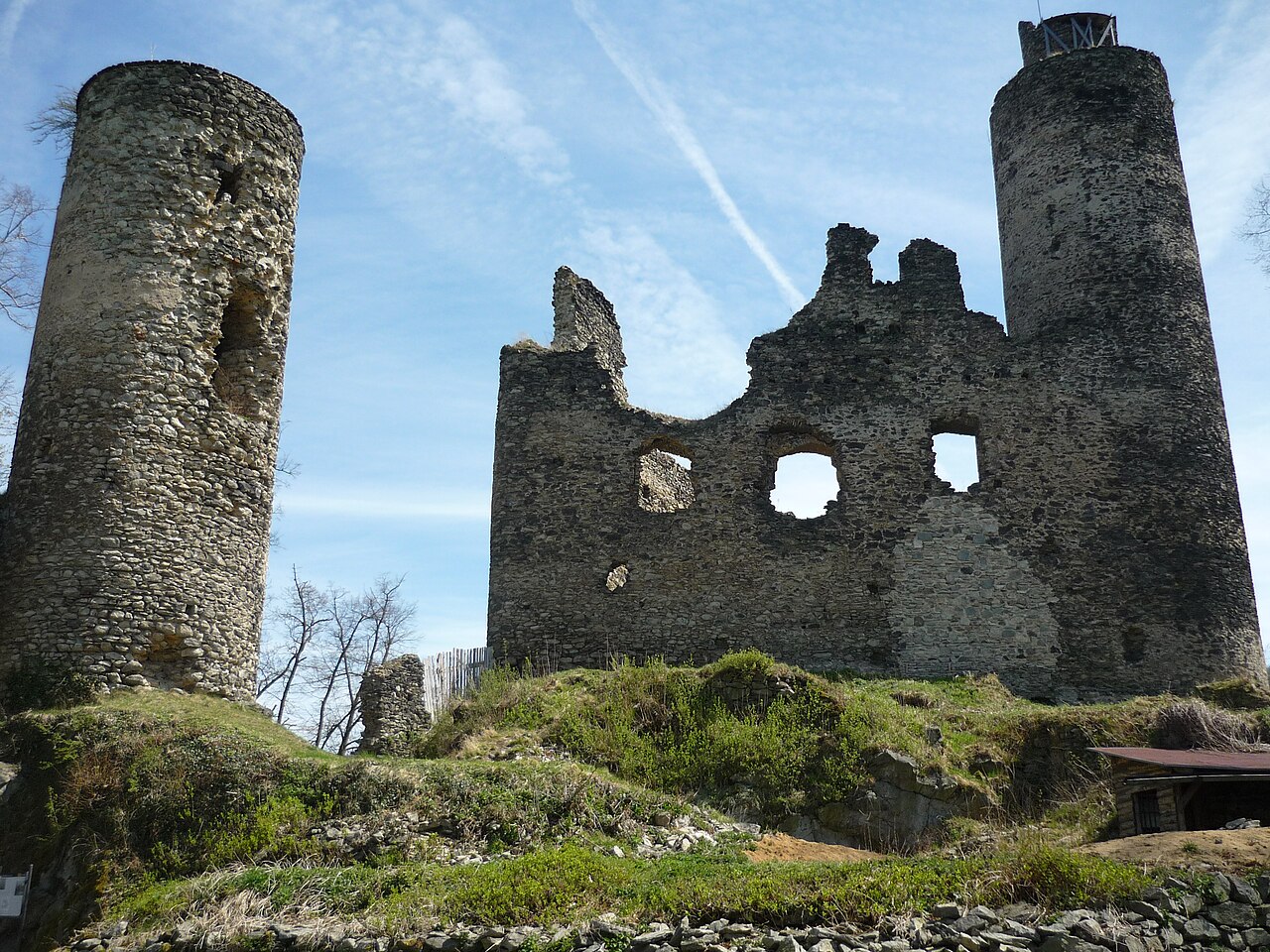
Remnants such as cannon towers, angular bastions, casemates, and underground passageways survive well, illustrating the castle's layered defensive evolution. The western tower, partially rebuilt in the 19th century and roofed, served as a lookout point, symbolizing the castle's shift from military use to leisure and tourism.
Today, Doubravská hora Castle stands as a testament to centuries of architectural and military history. Its surviving underground casemates and cellars connect the medieval fortress to its later adaptations, while the bastion fortifications highlight the castle's role in early modern warfare. Managed by the Association of Multipurpose Sports and Activities, the site continues to serve as a cultural and historical landmark in the Teplice region.
Cultural significance and preservation efforts
Since 1966, the ruins have been under the stewardship of preservation organizations, including Svazarm, which undertook restoration work in the 1980s. These efforts have helped stabilize the remaining structures and maintain the site for public engagement and educational purposes.
Today, the castle is valued not only for its military and architectural history but also as a recreational and community space. The main building houses headquarters and supports amateur radio activities, blending heritage preservation with modern uses. Doubravská hora Castle remains an important symbol of the region's medieval past and its adaptation through centuries of political and military change.
Frequently asked questions (FAQ)
- What is the historical significance of Doubravská hora Castle?
- Doubravská hora Castle, located in Czechia, dates back to the 13th century and played a crucial role in the region's defense against invasions. Its strategic position allowed it to oversee trade routes, making it an important site for both military and economic activities throughout history.
- When was Doubravská hora Castle built?
- The castle was originally constructed in the early 1200s, with significant modifications and expansions occurring in the subsequent centuries. Its architecture reflects various styles, showcasing its evolution through different periods of Czech history.
- Can I visit Doubravská hora Castle?
- Yes, Doubravská hora Castle is open to visitors year-round, allowing you to explore its rich history and stunning architecture. Guided tours are available, providing insightful information about the castle's past and its significance in the region.
- What are the opening hours for Doubravská hora Castle?
- The castle typically opens at 9 AM and closes at 5 PM, but hours may vary seasonally. It is advisable to check the official website or contact the visitor center for the most up-to-date information before planning your visit.
- Is it possible to access Doubravská hora Castle by public transport?
- Yes, Doubravská hora Castle is accessible by public transport, with several bus routes connecting nearby towns and cities. Additionally, information on local transport options can be found at the visitor center to help you plan your journey.
- What are the ticket prices for visiting Doubravská hora Castle?
- Ticket prices for Doubravská hora Castle are quite affordable, typically ranging from 50 to 100 CZK for adults, with discounts available for students and seniors. Children under a certain age may enter for free, making it a great family destination.
- When is the best time to visit Doubravská hora Castle?
- The best time to visit Doubravská hora Castle is during the spring and fall months when the weather is mild and the surrounding landscape is beautiful. However, summer offers the most events and activities, making it a vibrant time to experience the castle.
- What nearby attractions should I visit while at Doubravská hora Castle?
- While visiting Doubravská hora Castle, consider exploring the picturesque town of Plzeň, known for its brewery and historical sites. Additionally, the scenic nature trails surrounding the castle provide excellent opportunities for hiking and enjoying the local flora and fauna.
Information
Website
Visit websiteSources & official resources
Verify the information above using these authoritative references.
Loading map...
Visitor reviews
No reviews yet. Been here? Write the first review and help other travelers!
Write the first reviewVisited this castle? Share your experience
Your review helps other travelers and adds first-hand knowledge to our encyclopedia.