Doornenburg Castle
Doornenburg Castle is a remarkable example of a medieval fortress located in the province of Gelderland in the Netherlands. Its origins trace back to the 9th century, making it one of the oldest castles in the region with a rich historical tapestry spanning several centuries. The castle has witnessed significant historical events and has been home to numerous noble families, reflecting the evolving architectural styles and defensive needs of its time.
The early history and origins
The earliest mentions of the site known as Doronburc date from the 9th century. The first documented lord associated with the castle was Willem van Doornick, who appears in records from 1295. This period marks the castle's emergence as a significant feudal stronghold in the region. According to traditional accounts, Gijsbrecht van Amstel, implicated in the assassination of Count Floris V of Holland in 1296, sought refuge at Doornenburg Castle. However, this story likely originated in the 16th century after the Van Amstel family inherited the castle, and its historical accuracy remains debated.
Architectural features and defensive design
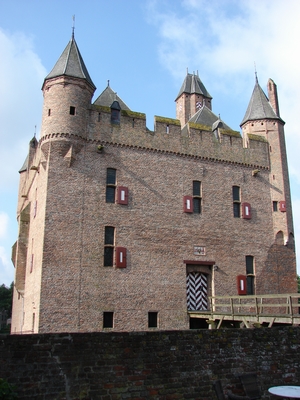
Doornenburg Castle is classified as a water castle, a type of fortress surrounded by moats and water defenses, which were typical of Dutch castles built to utilize the low-lying, water-rich landscape of the region. The castle's design includes robust curtain walls, corner towers, and a fortified gatehouse, all constructed to maximize defense against sieges. Remarkably, the castle is known never to have been taken by siege, a testament to its formidable defensive capabilities.
The castle complex includes an outer bailey and a main fortified enclosure. The outer bailey housed auxiliary buildings and served as a buffer zone. The main castle features a central keep or donjon, which served as the last line of defense and the lord's residence. The architecture reflects typical medieval military construction with thick stone walls, narrow windows for archers, and battlements for defenders.
Historical significance and noble ownership
Throughout its history, Doornenburg Castle was inhabited by a succession of noble families, including the Van Doornick, Van Bylandt, Van Homoet, Van Voorst, Van Amstel, Van Heemskerk, and Van Bemmel families. These families played important roles in the regional politics and military affairs of Gelderland and the broader Dutch territories.
During the Dutch Revolt (the Eighty Years' War, 1568-1648), the castle's lordship aligned with the changing political landscape of the Gelderland States without resistance, indicating a strategic choice to preserve the castle and its holdings during turbulent times.
Decline and restoration efforts
The castle's last resident was Maria Clara von Delwig, Baroness of Bemmel, who died in 1847. By then, ownership had passed to the Van der Heijden family through inheritance. However, the Van der Heijdens did not reside in the castle, leading to its serious decline and disrepair throughout the 19th century.
In 1936, textile industrialist J.H. van Heek from Enschede founded the Foundation for the Preservation of Doornenburg Castle and acquired the property from Baron A.E.C.C. Van der Heijden. Restoration work began in 1937 and was completed by 1941, reviving the castle's structural integrity and historical character.
Impact of World War II and subsequent restoration
The castle's restoration was soon tested during the Second World War. Located on the front lines in the Betuwe region, Doornenburg Castle was used as headquarters by German forces. In January and March 1945, the British Air Force bombed the castle, causing significant damage, especially to the outer bailey buildings and the main fortress. The second bombing left the castle in a state of severe disrepair.
Following the war, Van Heek and the foundation undertook a comprehensive restoration effort from 1947 to 1966, with support from the government and private donors. This restoration restored Doornenburg Castle to its former robust condition, preserving its medieval character and architectural features. The foundation benefited from the experience of the earlier restoration and the continuity of skilled builders who had worked on the castle before the war.
Doornenburg Castle today and cultural significance
Today, Doornenburg Castle stands as a well-preserved medieval water castle and a significant cultural heritage site in the Netherlands. It is part of the Liberation Route Europe, commemorating its role and the region's experiences during World War II. Visitors can explore the castle's impressive fortifications, courtyards, and historical interiors, gaining insight into medieval life and Dutch history.
The castle's layered history, from its early medieval origins through noble ownership and wartime trials, makes it a fascinating destination for historians, architecture enthusiasts, and tourists alike. Its survival through centuries of conflict and neglect, followed by dedicated restoration, highlights the importance of preserving historical monuments for future generations.
Frequently asked questions (FAQ)
- When was Doornenburg Castle originally built?
- Doornenburg Castle dates back to the 9th century, with the first documented lord appearing in 1295.
- What type of castle is Doornenburg?
- Doornenburg Castle is a water castle, featuring moats and water defenses typical of Dutch medieval fortresses.
- Has Doornenburg Castle ever been taken by siege?
- The castle is known never to have been taken by siege, underscoring its strong defensive design.
- What happened to Doornenburg Castle during World War II?
- During World War II, the castle was used as German headquarters and was heavily bombed by the British Air Force in 1945, causing significant damage.
- Who was responsible for the restoration of Doornenburg Castle?
- Textile industrialist J.H. van Heek founded the preservation foundation in 1936 and led restoration efforts before and after World War II.
Information
Current owner
Foundation for the Preservation of Doornenburg Castle
Loading map...
Visitor reviews
No reviews yet. Been here? Write the first review and help other travelers!
Write the first reviewVisited this castle? Share your experience
Your review helps other travelers and adds first-hand knowledge to our encyclopedia.