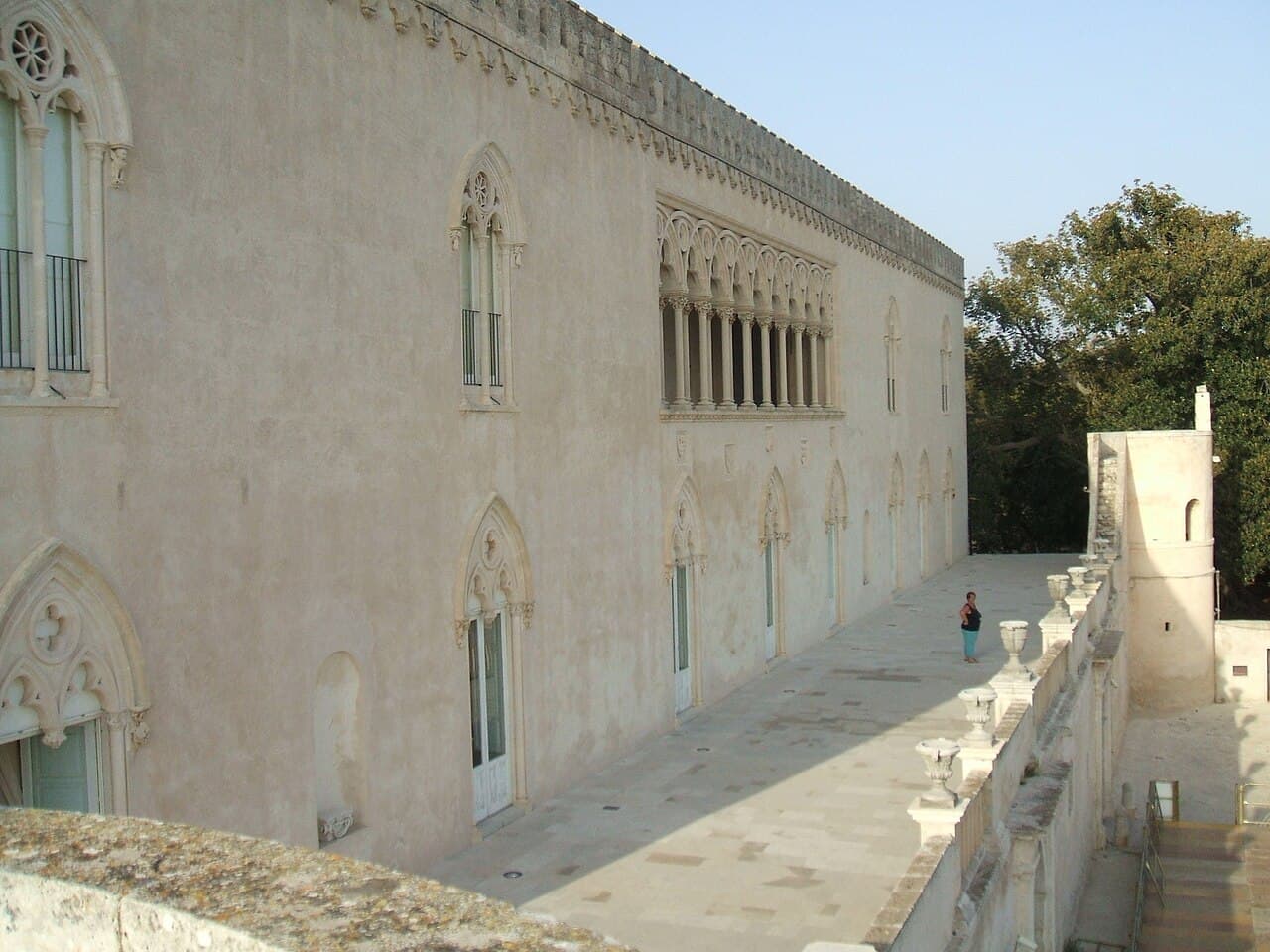
Donnafugata Castle
Donnafugata Castle, located near Ragusa in the southern region of Sicily, Italy, is a remarkable example of a noble residence that blends medieval origins with extensive 19th-century neo-Gothic and neo-Classical architectural transformations. Its history spans several centuries, beginning in the 14th century when the original fortress was established by the influential Chiaramonte family, counts of Modica. Over time, the castle evolved from a military stronghold into a grand aristocratic palace, reflecting the changing tastes and social functions of its owners.
Historical origins and early development
The earliest known construction of Donnafugata Castle dates back to the 14th century, commissioned by the Chiaramonte family, who played a significant role in Sicilian history. The castle was likely built on the foundations of an even older tower, possibly from the 13th century, although documentary evidence from that earlier period remains scarce. The castle's strategic location near Ragusa allowed it to serve as a defensive stronghold in the turbulent medieval landscape of Sicily.
Local legends connect the castle to notable historical figures such as Bernardo Cabrera and Queen Bianca of Navarra, but these stories are not fully substantiated by historical records. The castle's name, Donnafugata, meaning "woman on the run," is steeped in folklore. One popular tale recounts how Queen Bianca sought refuge within its walls to escape captivity. However, linguistic studies suggest the name more likely derives from the Arabic term ain as jafaiat ("source of health"), reflecting the area's abundant spring waters, a rare feature in the otherwise arid Sicilian landscape.
Ownership changes and architectural evolution
In 1648, the estate passed to Vincenzo Arezzo-La Rocca, who transformed the castle from a purely military fortress into a fortified farmhouse. This marked the beginning of its gradual transition toward a residential estate. The most significant architectural transformation occurred in the 19th century under Baron Corrado Arezzo (1824–1895), a scholar and politician who undertook extensive renovations to remodel the castle into the neo-Gothic style visible today.
Baron Corrado Arezzo added a prominent main facade featuring a loggia with elegant three-lobed arches, flanked by two imposing towers. The castle's interior was richly decorated with over 120 rooms, including a music room adorned with trompe-l'œil paintings, a grand hall displaying coats of arms of Sicilian noble families, and a mirror hall with elaborate stuccoes. The picture gallery contains neoclassical artworks attributed to followers of the Baroque master Luca Giordano. The bishop's apartment features exquisite Boulle furniture, highlighting the castle's aristocratic connections.
19th-century additions and decorative features
The castle's architectural style is a distinctive blend of neo-Gothic and neo-Classical elements, characteristic of 19th-century Romanticism. The use of local bituminous stone for the monumental staircase adds a regional touch to the grand entrance. The extensive park surrounding the castle, covering approximately eight hectares, was designed as a leisure and botanical space, featuring over 1,500 plant species, a circular temple, a coffee house, and artificial grottoes with fake stalactites.
A notable feature of the gardens is the dry-stone labyrinth, inspired by the famous Hampton Court maze in England. Originally, climbing rose bushes covered the labyrinth's walls, creating an immersive and secretive experience for visitors. Baron Corrado also installed mechanical "pranks" within the park, such as a sprinkler triggered by sitting in a particular spot and a chapel mechanism that released a stuffed monk figure. Although these features are currently inactive, restoration efforts aim to revive them.
Cultural significance and modern restoration
Throughout its history, Donnafugata Castle has served not only as a noble residence but also as a cultural landmark. It has been featured in various film and television productions, enhancing its reputation as a "house of memory" that commemorates the lives of notable residents like Baron Corrado Arezzo de Spuches and Viscount Combe de Lestrade.
After a period of neglect, the castle was acquired by the municipality of Ragusa in 1982. Comprehensive restoration efforts were undertaken to preserve its architectural integrity and the surrounding park. Today, the castle is a well-preserved monument that offers visitors a glimpse into the aristocratic lifestyle of Sicily's past, combined with the romantic allure of 19th-century architectural revival.
Unique features and visitor experience
One unusual aspect of Donnafugata Castle is its own railway station, located less than 400 meters away. This station was established thanks to Baron Corrado Arezzo de Spuches' political influence and continues to serve the area, providing convenient access for visitors traveling by regional train.
The castle's extensive interiors, with about twenty rooms open to the public, showcase original furnishings and decorations that enrich the visitor experience. Highlights include the music room's trompe-l'œil artworks, the grand hall's heraldic displays, and the bishop's apartment's luxurious furniture. The park's combination of botanical variety and playful mechanical devices offers a unique blend of nature and historical curiosity.
The name Donnafugata: legends and linguistic roots
The origin of the name Donnafugata has inspired numerous legends and scholarly interpretations. The most famous legend involves Queen Bianca of Navarra, who purportedly fled captivity at the castle during the 15th century. Another tale suggests the name comes from a tragic event involving a woman who suffocated, while yet another connects the name to the period when Queen Maria Carolina was placed under house arrest in the early 19th century.
Despite these stories, linguistic research favors an Arabic origin of the name, deriving from ain as jafaiat, meaning "source of health," a fitting description given the area's rich spring waters. This etymology reflects Sicily's layered cultural history, influenced by Arab presence during the Middle Ages.
Frequently asked questions (FAQ)
- How do I get to Donnafugata Castle?
- Donnafugata Castle is located about 15 kilometers from Ragusa, Sicily. Visitors can reach it by car or regional train, as the castle has its own nearby railway station established in the 19th century.
- What architectural styles are featured in Donnafugata Castle?
- The castle showcases a blend of late medieval origins with significant 19th-century neo-Gothic and neo-Classical renovations, reflecting Romantic architectural trends.
- When was Donnafugata Castle restored?
- The castle underwent comprehensive restoration after its acquisition by the municipality of Ragusa in 1982, preserving its historical and architectural features.
- Can I visit the interior rooms of Donnafugata Castle?
- Yes, about twenty rooms are accessible to the public, featuring original furnishings, trompe-l'œil paintings, a grand hall with coats of arms, and a mirror hall with elaborate stuccoes.
- What unique features does the castle's park include?
- The extensive park includes a dry-stone labyrinth inspired by Hampton Court, artificial grottoes, a circular temple, and mechanical pranks designed by Baron Corrado Arezzo.
Photo gallery

Information
Current owner
Municipality of Ragusa
Loading map...
Visitor reviews
No reviews yet. Been here? Write the first review and help other travelers!
Write the first reviewVisited this castle? Share your experience
Your review helps other travelers and adds first-hand knowledge to our encyclopedia.



