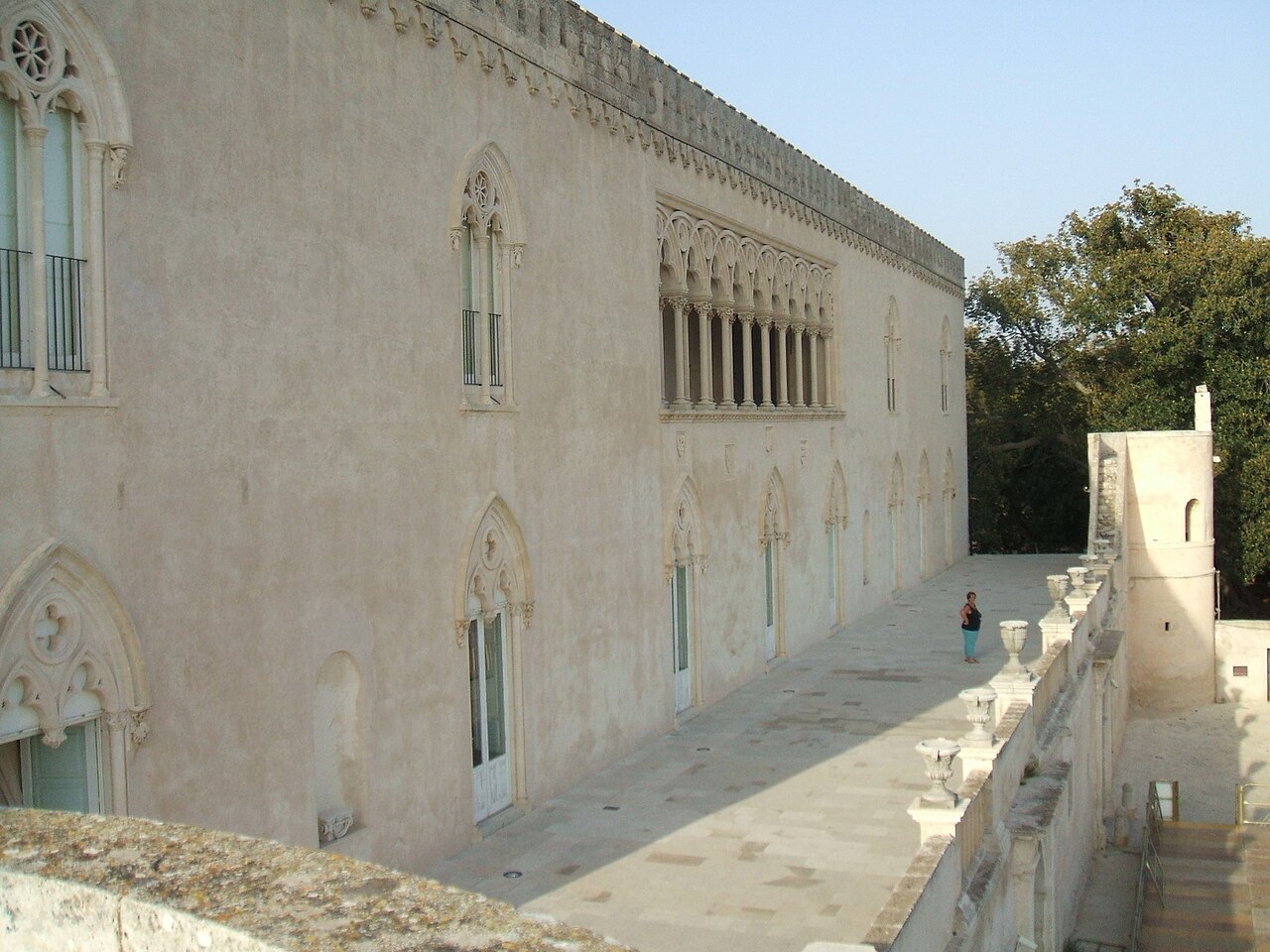
Castle of the Naselli d'Aragona
The Castle of the Naselli d'Aragona stands as a significant historical monument in Comiso, Sicily. Its origins likely date back to the 12th century, as supported by 13th-century documents referencing its existence. Over the centuries, it evolved from a medieval fortress into a noble residence, reflecting the region's turbulent history and architectural transitions. Despite suffering major damage during the 1693 earthquake, key elements of the castle remain, offering insights into medieval and early modern Sicilian architecture.
Early history and medieval origins
The castle's initial construction phase is traced back to the high medieval period, with its earliest mentions appearing in documents from the 13th century. Originally, it formed part of the defensive fortifications of Comiso, strategically positioned to oversee and protect the surrounding territory. The castle was equipped with a drawbridge that controlled access, enhancing its defensive capabilities against potential attacks.
In the late 14th century, ownership transferred from Federico Speciaro to the noble Cabrera family. Subsequently, in 1453, the castle came under the possession of Periconio Naselli, baron of Mastra, marking the beginning of the Naselli family's long association with the fortress. The family's prominence increased when Gaspare Naselli was granted the title of Count of Comiso in 1571 by Philip I of Sicily, further cementing the castle's role as a noble residence.
Architectural features and artistic elements
Early medieval baptistery
One of the castle's most remarkable surviving features is the octagonal baptistery dedicated to Saint Gregory the Great, dating from around the year 1000. This structure is notable for its rare Byzantine frescoes adorning the interior walls, reflecting the religious and artistic influences of the early medieval period in Sicily. Architecturally, the baptistery combines an eight-sided base with a cylindrical upper section topped by a finely shaped dome, exemplifying early Christian craftsmanship.
18th-century loggia and frescoes
The northern side of the castle features the Loggetta, an elegant architectural addition constructed in 1728. Designed by the Genoese architect Michelangelo Canepa, this element includes a Serlian trifora—a three-part arched window—that opens onto the castle's courtyard. The walls of the Loggetta are decorated with frescoes depicting natural landscapes and birds, showcasing the artistic tastes of the early 18th century and the castle's transformation from fortress to noble palace.
Medieval defensive elements and fountains
The castle retains two ogival (pointed) portals, one secured by a 15th-century iron-studded door, underscoring its medieval defensive function. Within the courtyard stands a sculpted fountain shaft carved from local stone, dating to around 1600, highlighting regional craftsmanship. Additionally, a small wall-embedded fountain attributed to the Gagini workshop or its school, dating to the 16th century, adds Renaissance artistic value to the site.
Impact of the 1693 earthquake and subsequent transformations
The 1693 earthquake devastated much of the castle, leaving primarily the tower intact. Restoration efforts in the early 18th century shifted the castle's function from a military fortress to a noble palace. This period saw enhancements such as the addition of the Loggetta and interior frescoes, reflecting contemporary architectural and artistic trends. The castle also hosted Viceroy Cristoforo Fernandez de Cordova and his entourage during this era, indicating its status as a prominent noble residence.
Later history and adaptive reuse
Following the Bourbon takeover, the castle experienced decline and partial abandonment. By the mid-19th century, parts of the structure were repurposed: a section was converted into a theater and later managed by local civic authorities, while the lower areas served as a district jail. In 2024, ownership transferred from the Nifosì family, descendants of the barons of Canalazzi, to the company Multifidi, marking a new phase in the castle's stewardship under cultural heritage oversight.
Archaeological significance and preservation
The castle's complex layout and surviving elements provide a layered historical narrative, from early Christian worship to medieval fortification and noble residence. The baptistery remains a rare example of early medieval religious architecture in Sicily, while the Renaissance and Baroque additions illustrate evolving artistic influences. The preservation of defensive features alongside ornamental elements offers valuable insights into the castle's multifaceted role across centuries.
Visitors today can appreciate the blend of architectural styles and historical phases, with the internal gardens featuring fountains from the 15th to 17th centuries that complement the surrounding greenery. The castle's ongoing preservation ensures that this emblem of Sicilian heritage continues to convey its historical and cultural significance.
Frequently asked questions (FAQ)
- When was the castle originally built?
- The Castle of the Naselli d'Aragona was likely constructed in the 12th century, with documentary evidence from the 13th century confirming its existence.
- What architectural styles are visible in the castle?
- The castle features a mix of styles including early medieval Byzantine frescoes in the baptistery, Gothic defensive elements, and Baroque additions such as the 18th-century loggia.
- Is the castle open to visitors?
- Visiting hours and ticket information vary; visitors should check locally for current access details as the castle is partially preserved and under private ownership.
- What is the significance of the baptistery?
- The octagonal baptistery dedicated to Saint Gregory the Great is a rare early medieval structure with Byzantine frescoes, representing early Christian art and architecture in Sicily.
- How did the 1693 earthquake affect the castle?
- The 1693 earthquake caused significant destruction, leaving mostly the tower standing. Subsequent restorations transformed the fortress into a noble palace with new architectural features.
Information
Current owner
Multifidi
Loading map...
Visitor reviews
No reviews yet. Been here? Write the first review and help other travelers!
Write the first reviewVisited this castle? Share your experience
Your review helps other travelers and adds first-hand knowledge to our encyclopedia.