Donegal Castle
Donegal Castle is a remarkable example of a late medieval Gaelic stronghold, located in the town of Donegal, County Donegal, Ireland. Situated on a strategic bend of the River Eske, near the mouth of Donegal Bay, the castle occupies a commanding position that reflects its historical importance as the seat of power for the O'Donnell clan, Lords of Tír Conaill. The name "Donegal" is believed to derive from the Irish "Dún na nGall," meaning "Fort of the Foreigner," possibly referencing a Viking fortification that once stood on the site before being destroyed in 1159.
Origins and historical significance
The castle was built in 1474 by Sir Hugh O'Donnell, the elder chief of the O'Donnell clan, who was one of the most powerful Gaelic leaders in Ireland during the late medieval period. The O'Donnells ruled the kingdom of Tír Conaill, maintaining their independence from English control for centuries. Donegal Castle served not only as a military stronghold but also as the clan's administrative center and residence, symbolizing their authority in the region.
Local tradition speaks of secret tunnels connecting the castle to a nearby Franciscan monastery founded by Hugh O'Donnell and his wife Nuala, though no archaeological evidence has confirmed their existence. In 1566, English Lord Deputy Sir Henry Sidney described Donegal Castle as the "largest and strongest fortress in Ireland," praising its excellent condition and strategic location near navigable waters, which facilitated trade and defense.
Architectural features and construction
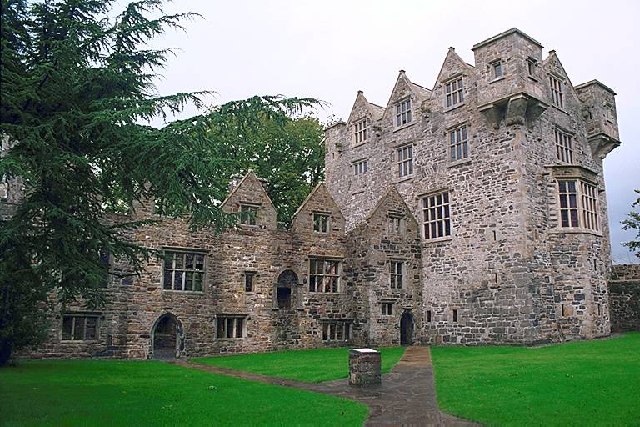
Donegal Castle consists primarily of a 15th-century rectangular keep, also known as a tower house or donjon, surrounded by a 17th-century boundary wall. The castle's stonework was constructed mainly from locally sourced limestone with some sandstone, materials typical of the region. The keep features thick defensive walls, narrow windows designed for archery, and battlements that provided protection for defenders.
The entrance to the castle is marked by a small gatehouse built in the 16th century, which mirrors the design of the main keep and served as a guardroom. This gatehouse is enclosed within the curtain wall, which has been partially rebuilt to preserve the castle's defensive perimeter.
Jacobean additions
After the Flight of the Earls in 1607, when the O'Donnell leaders fled Ireland, the castle was granted to Captain Basil Brooke, an English officer, in 1611. Brooke undertook significant restoration and remodeling work by 1623, adding Jacobean-style windows, gables, and a large manor-house wing attached to the original tower. These additions reflect the architectural tastes of the early 17th century and transformed the castle from a purely defensive fortress into a more comfortable residence.
Historical events and decline
Donegal Castle witnessed several turbulent episodes in Irish history. It was burned in 1589 and partially destroyed during the Nine Years' War (1594–1603), a conflict between Gaelic Irish chieftains and English rule. The deliberate damage inflicted by the departing O'Donnells in 1607 was intended to prevent the castle's use by opposing Gaelic clans.
During the Williamite Wars in the late 17th century, the castle was successfully defended against Jacobite forces, demonstrating its continued military value even after the Jacobean modifications. However, by the 18th century, the castle fell into disrepair and became largely ruinous.
Restoration and modern significance
In 1898, the then owner, the Earl of Arran, donated Donegal Castle to the Office of Public Works. Despite this, the castle remained largely in ruins for much of the 20th century. It was not until the early 1990s that extensive restoration work was undertaken, focusing on the keep. This restoration involved installing new roofs and floors designed in the style of the 15th century, using oak timber sourced from the Colebrooke Estate in County Fermanagh. The castle's exterior walls were finished with harling, a traditional roughcast plaster typical of Irish buildings, to protect the masonry.
Today, Donegal Castle stands as a well-preserved example of a Gaelic stronghold that was adapted through English ownership and later restoration. It remains open to the public and hosts cultural events, serving as a significant heritage site that illustrates the complex history of Gaelic Ireland and its interactions with English rule.
Architectural conservation
The restoration carefully conserved and partially rebuilt the castle's masonry and structural elements to reflect its historical appearance. The Jacobean manor-house wing, however, remains a ruin, preserving the contrast between the medieval and early modern periods. No inscriptions or archaeological artifacts such as tools or pottery have been documented at the site, but the castle's fabric itself tells the story of centuries of Irish history.
Visiting Donegal Castle
Donegal Castle is located on Tirchonaill Street in the town of Donegal, Northern Ireland. Visitors can explore the restored keep and surrounding grounds for a small fee. The castle offers a glimpse into the military architecture of the late medieval period, as well as the Jacobean adaptations that reflect changing tastes and functions.
The castle's picturesque setting on the River Eske and proximity to Donegal Bay make it a popular destination for tourists interested in Irish history, architecture, and scenic landscapes. Nearby attractions include the Franciscan Friary ruins and the vibrant town center of Donegal.
Notable visits
On 25 May 2016, Donegal Castle was visited by the Prince of Wales and the Duchess of Cornwall during an official trip to County Donegal, highlighting its cultural and historical importance in modern times.
Frequently asked questions (FAQ)
- What are the opening hours of Donegal Castle?
- Donegal Castle is typically open to visitors from 9:30 AM to 5:30 PM, with extended hours during the peak summer months. It is advisable to check the official website for any seasonal changes or special events that may affect these hours.
- How do I get to Donegal Castle?
- Donegal Castle is located in the town of Donegal, easily accessible by car or public transport. There are local bus services that connect to major cities, and parking is available nearby for those driving.
- When was Donegal Castle built?
- Donegal Castle was originally built in the 15th century by the O'Donnell clan, who were prominent in Irish history. The castle has undergone various renovations and restorations, with significant work completed in the late 19th century.
- Is it possible to take guided tours of Donegal Castle?
- Yes, guided tours are available, providing a deeper insight into the castle's rich history and architecture. These tours are led by knowledgeable staff who can answer questions and share fascinating stories about the castle.
- What is the historical significance of Donegal Castle?
- Donegal Castle is a symbol of the power of the O'Donnell family and played a crucial role in Irish history. It served as a political and military stronghold during the turbulent times of the 16th and 17th centuries.
- Can I bring children to Donegal Castle?
- Absolutely! Donegal Castle is family-friendly and welcomes visitors of all ages. There are facilities available for families, and children can enjoy exploring the castle's grounds and learning about its history.
- What are the ticket prices for visiting Donegal Castle?
- Ticket prices for Donegal Castle are generally affordable, with discounts available for children, students, and seniors. It's best to check the official website for the latest pricing and any promotional offers.
- What is the best time to visit Donegal Castle?
- The best time to visit Donegal Castle is during the spring and summer months when the weather is typically milder and the gardens are in full bloom. This period also coincides with various cultural events and festivals in the surrounding area.
- Are there any nearby attractions to visit after Donegal Castle?
- Yes, there are several attractions near Donegal Castle, including the picturesque Donegal Bay and the stunning Slieve League Cliffs. Visitors can also explore the charming town of Donegal, which offers shops, restaurants, and other historical sites.
Information
Sources & official resources
Verify the information above using these authoritative references.
Loading map...
Visitor reviews
No reviews yet. Been here? Write the first review and help other travelers!
Write the first reviewVisited this castle? Share your experience
Your review helps other travelers and adds first-hand knowledge to our encyclopedia.