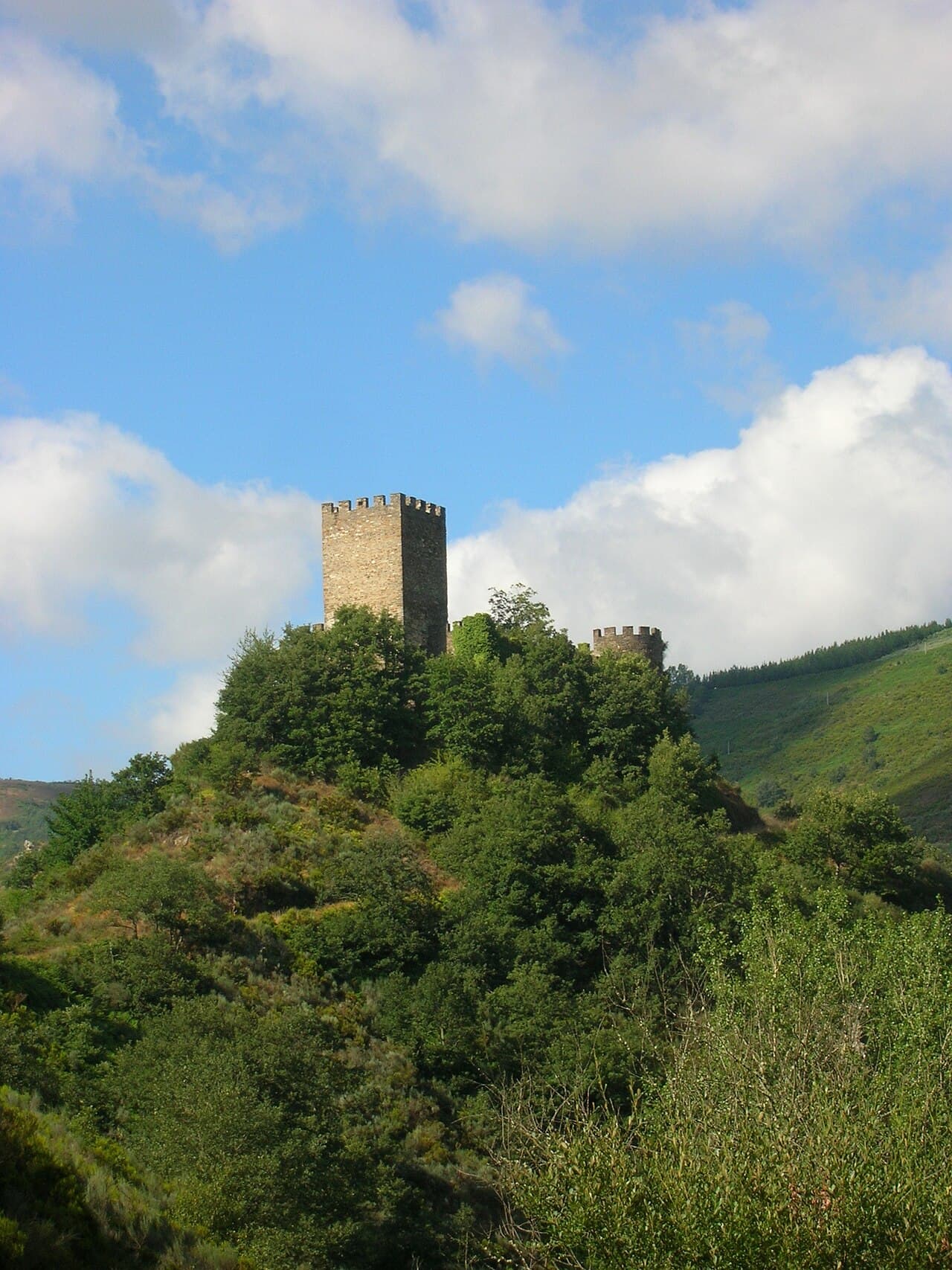
Doiras Castle
Doiras Castle stands as one of the most significant and well-preserved late medieval fortresses in the region of Galicia, Spain. This 15th-century hill castle was strategically constructed to control a vital passage along the historic Camino de Santiago pilgrimage route, following the ancient Roman road XIX that linked Astorga and Lugo. Its commanding position atop a high promontory overlooking the confluence of the Doiras and Cervantes rivers provided both defensive strength and surveillance over the surrounding territory.
Historical significance and origins
The castle’s origins trace back to the late 15th century, when it was built by the noble Osorio family, originally from the Kingdom of León. The founder, Diego Pérez Osorio y Guzmán, the first lord of Cervantes and Villacid, established the fortress as a key defensive stronghold to protect the region and secure control over the important route into Galicia. The castle’s role extended beyond military defense; it also symbolized the Osorio family’s rising influence and territorial authority during this period.
Through the centuries, the castle changed hands, passing in the 17th century to the Grajal de Campos family. This family later gained noble titles such as the Marquises of Alcañices in the 18th century and the Dukes of Sesto in the 19th century, reflecting their growing prominence. The last lord of the castle was José Osorio Silva, who died in 1909. By the early 20th century, the castle had fallen into a state of ruin.
Architectural features and layout
Doiras Castle is constructed primarily from slate masonry, skillfully adapted to the uneven terrain of its hilltop location. The fortress is organized around a roughly rectangular courtyard measuring approximately 25 by 21 meters. Its curtain walls are robust, with thicknesses ranging from one to one and a half meters, and heights averaging around eight meters, though the elevation varies due to the sloping ground.
The centerpiece of the castle is its imposing keep, or tower of homage, a rectangular structure measuring about 10 by 8 meters with walls two meters thick. Rising to nearly 14 meters, the keep features interior chambers that were once decorated with frescoes, though these have significantly deteriorated over time. The keep’s entrance is accessed via a raised walkway leading to a door situated approximately four meters above ground level, a defensive design intended to hinder attackers.
The castle’s main entrance is marked by a wooden gate standing about four meters tall, set beneath a semicircular arch opening into the central courtyard. The fortress overlooks the historic Ferrería de Fonquente, a traditional ironworking site, and forms a complex with a nearby church, which served as a private chapel for the castle’s owners, along with adjacent residential buildings that supported the castle community.
Restoration and preservation efforts
By the 20th century, Doiras Castle had suffered considerable neglect, with the interior accumulating debris and showing structural damage such as wall cracks caused by insufficient maintenance. In the 1940s, the castle was acquired by Emilio Martínez Baladrón, who initiated substantial restoration work that preserved much of the castle’s structural integrity and restored key elements of its appearance.
Recognition of the castle’s cultural and historical importance culminated in its designation as a Bien de Interés Cultural (a protected heritage site) in 1994. Ownership later transferred to the Fundación Xosé Soto de Fión in 2000, and in 2024, stewardship passed to the Cervantes town council with support from the provincial government of Lugo, ensuring continued preservation and public access.
Archaeological context and recent discoveries
Interest in the castle and its surrounding landscape was renewed in 2016 with the discovery of archaeological remains at O Teso do Castelo, located nearby. The finding of a 17th-century coin at this site suggests that Doiras Castle was part of a broader network of defensive and administrative control in the region during the early modern period. This discovery has expanded understanding of the castle’s ongoing strategic role beyond the medieval era.
Cultural and heritage significance
Doiras Castle remains a prominent symbol of Galicia’s medieval heritage and its historical role in regional defense and governance. Its well-preserved hill castle architecture, including the towering keep, thick curtain walls, and strategic location, offers valuable insights into late medieval military construction and noble residence design. The castle’s connection to important noble families and its proximity to historic pilgrimage routes further enhance its cultural significance.
Today, the castle and its associated structures, including the chapel and residential buildings, form a complex that attracts historians, archaeologists, and visitors interested in medieval fortifications and Galician history. Ongoing conservation efforts aim to maintain the site’s structural stability and promote its historical legacy for future generations.
Frequently asked questions (FAQ)
- What is the historical significance of Doiras Castle?
- Doiras Castle, located in Cervantes, Spain, dates back to the 12th century and is a remarkable example of medieval military architecture. It played a crucial role in the defense of the region during various conflicts, showcasing the strategic importance of this area throughout history.
- When was Doiras Castle built?
- Construction of Doiras Castle began in the early 12th century, around the year 1130. It was strategically built to oversee the surrounding lands and has since endured the test of time, making it a significant historical monument.
- Can I visit Doiras Castle?
- Yes, visitors are welcome to explore Doiras Castle. It is open to the public, allowing guests to experience its rich history and stunning architecture firsthand.
- What are the opening hours for Doiras Castle?
- Doiras Castle is typically open for visitors from 10 AM to 6 PM, but hours may vary depending on the season. It is advisable to check the official website or contact local tourism for the most accurate and current information before your visit.
- Is it possible to access Doiras Castle with limited mobility?
- While Doiras Castle offers a unique glimpse into history, the terrain may be challenging for individuals with limited mobility. Visitors should prepare for some uneven surfaces and inclines, and it's best to contact the site in advance for specific accessibility options.
- When is the best time to visit Doiras Castle?
- The best time to visit Doiras Castle is during the spring and early fall when the weather is mild and the landscape is particularly beautiful. These seasons also tend to attract fewer tourists, allowing for a more peaceful exploration of this historic site.
- What are some nearby attractions to Doiras Castle?
- Nearby attractions include the stunning landscapes of the Ancares Mountains and the picturesque village of Cervantes itself. Visitors can also explore local hiking trails and enjoy the natural beauty of the region, making it a great destination for outdoor enthusiasts.
- What are the ticket prices for Doiras Castle?
- Ticket prices for Doiras Castle are generally affordable, with adult tickets costing around €5. Discounts may be available for students, seniors, and groups, so be sure to inquire when purchasing your tickets.
Photo gallery

Information
Website
Visit websiteSources & official resources
Verify the information above using these authoritative references.
Loading map...
Visitor reviews
No reviews yet. Been here? Write the first review and help other travelers!
Write the first reviewVisited this castle? Share your experience
Your review helps other travelers and adds first-hand knowledge to our encyclopedia.



