Diósgyőr Castle
Diósgyőr Castle is a significant medieval fortress located in Miskolc, Northern Hungary, perched strategically on a rocky hill overlooking the Szinva stream valley. This hill castle is an important monument of Hungarian history and architecture, reflecting centuries of royal residence, military adaptation, and cultural heritage. Its partially restored state offers visitors a glimpse into medieval Gothic fortifications and the lifestyle of Hungarian nobility from the 14th century onward.
The origins of Diósgyőr Castle date back to the 12th century, when the earliest fortification was likely a timber and earthwork structure. This original castle was destroyed during the Mongol invasion of 1241–42, a catastrophic event that devastated much of Hungary's defensive network. In response, King Béla IV initiated a kingdom-wide reconstruction effort, replacing wooden castles with stone fortresses to better withstand future invasions. The stone castle that stands today largely originates from this post-Mongol rebuilding phase.
The castle's current form is predominantly late medieval Gothic, with records from 1316 referring to it as the "new castle," confirming its replacement of the earlier fortification. Its prominence rose under King Louis I of Hungary (1342–1382), also known as Louis the Great, who valued Diósgyőr for its strategic position near the route to Poland. He undertook extensive renovations and expansions, transforming it into a royal residence and a fortified stronghold.
Architectural features and layout
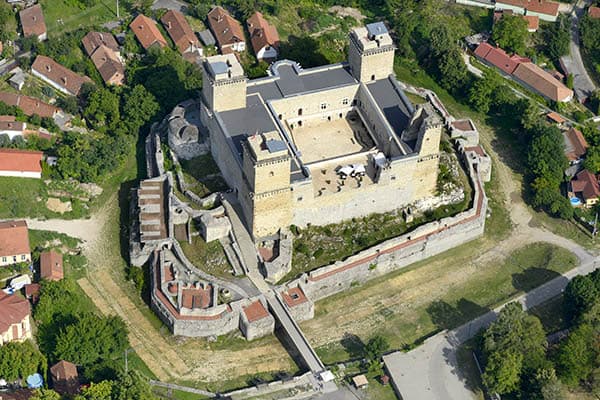
Diósgyőr Castle occupies an oval-shaped area approximately 40 by 35 meters. The original medieval layout centered on a rounded donjon (keep), surrounded by an irregular polygonal curtain wall. The entrance was originally on the northern side, accessed by a wooden bridge spanning a moat fed by natural warm springs, which not only enhanced defense but also supplied water to nearby baths.
During the reign of King Louis I, the castle was reconstructed around a rectangular courtyard enclosed by four corner towers, each topped with pointed roofs characteristic of Gothic architecture. The ground floor contained storerooms and service areas, while the upper floor housed residential chambers and a grand knights' hall measuring 25 by 13 meters. This hall, supported by three columns and designed as a two-nave space, is recognized as the largest knight's hall in Central Europe.
Defensive structures and military adaptations
The castle's defensive system was formidable for its time, featuring multiple rings of walls and a moat approximately four meters deep. The irregular polygonal shape of the outer walls and towers was inspired by ancient Roman military camps, providing layered protection against attackers.
16th-century fortifications
In the face of the growing Ottoman threat during the 16th century, the influential Gyarmati Balassa family undertook significant military upgrades. They replaced the original slender towers with massive bastions influenced by Italian Renaissance military architecture. Notably, a rondelle was constructed on the northwestern corner, while the main gate was moved to the western side, guarded by a pentagonal bastion and a smaller fortified outpost called the "hussar castle." These adaptations reflected advances in artillery and siege warfare.
Historical significance and royal connections
Diósgyőr Castle was a favored royal residence, especially during the reign of King Louis I. Its location near the road to Poland made it a key strategic and diplomatic site, reflecting Louis's dynastic ties through his mother, the Polish princess Elizabeth Łokietkówna. The castle was often granted as a wedding gift to Hungarian queens, a tradition that lasted until the mid-16th century.
The castle was the venue for the 1381 Peace Treaty of Turin, an important diplomatic event in which the Republic of Venice recognized the Anjou dynasty's claims. This treaty highlighted the castle's political importance during the late medieval period.
After the personal union between Hungary and Poland ended, Diósgyőr's prominence declined, becoming primarily a royal holiday residence. The last queen to own the castle was Queen Maria, wife of Louis II, who surrendered it in 1546 when the Transylvanian prince took control.
Occupation, decline, and restoration efforts
The Ottoman Empire occupied Diósgyőr Castle from 1598 to 1687. The castle's design was not suited for prolonged siege warfare, contributing to its fall during the Ottoman advances in Hungary. Following liberation from Turkish rule, the fortress gradually fell into ruin.
Interest in the castle's history and archaeology began in the early 20th century, with systematic excavations starting in the 1960s. Restoration efforts commenced in 1953 to stabilize the structure and prevent further decay. A major reconstruction took place between 2013 and 2014, restoring key features such as the knights' hall, queen's chambers, chapel, and battlements to their medieval appearance. This project aimed to revive the castle's historical atmosphere and improve visitor access.
A second phase of restoration began in 2021 under Hungary's National Castle Program, with plans to rebuild the third floor, palace wings, towers, moat, and outer defenses. Despite delays and public debate, this initiative reflects ongoing dedication to preserving Hungary's medieval heritage.
The castle today and its cultural role
Today, Diósgyőr Castle stands as a cultural landmark surrounded by modern residential areas but retains its historical context through nearby museums and monuments, including the Déryné House and a medieval Marian column near the local Catholic church. The castle hosts medieval-themed events, exhibitions, and a waxworks museum depicting life-sized scenes of medieval life and significant events such as the Peace Treaty of Turin.
The castle's warm springs, which once fed its moat, later supplied water to a public swimming pool until 2014. The four main towers vary in condition and public access: the northeastern tower houses the waxworks exhibition; the northwestern tower functions as a lookout and mint; the southeastern tower contains the queen's apartments but is generally closed to visitors; and the southwestern tower remains a ruin, preserved in its damaged state to maintain the castle's distinctive silhouette.
Diósgyőr Castle has been commemorated widely in Hungarian culture, appearing on banknotes and commemorative coins. Its blend of Gothic architecture, historical significance, and ongoing restoration efforts make it a compelling destination for those interested in medieval history and architecture.
Frequently asked questions (FAQ)
- How do I get to Diósgyőr Castle in Miskolc?
- Diósgyőr Castle is located in the northern part of Miskolc and can be reached by local bus or taxi from the city center. There is parking available nearby for visitors arriving by car.
- What are the opening hours of Diósgyőr Castle?
- The castle is generally open to visitors daily from 10:00 to 18:00, but hours may vary seasonally or during special events. It is advisable to check the official website before planning your visit.
- Is there an admission fee to enter Diósgyőr Castle?
- Yes, there is a modest admission fee to enter the castle and its exhibitions. Discounts are typically available for students, seniors, and groups. Children under a certain age may enter free.
- What architectural styles are represented in Diósgyőr Castle?
- Diósgyőr Castle primarily showcases <strong>Gothic architecture</strong> from the late medieval period, with later Renaissance military modifications such as bastions added in the 16th century.
- Can I explore the interior rooms of the castle?
- Visitors can explore several restored interior rooms, including the knights' hall, queen's chambers, and chapel. Some areas, like the southeastern tower, may be closed to the public for preservation reasons.
- Why is Diósgyőr Castle historically significant?
- Diósgyőr Castle was a royal residence and strategic fortress during the 14th century, hosting important events like the 1381 Peace Treaty of Turin. It also served as a wedding gift for Hungarian queens, highlighting its political and cultural importance.
- Are there any special events held at Diósgyőr Castle?
- Yes, the castle hosts medieval-themed festivals, historical reenactments, and exhibitions throughout the year, providing visitors with immersive experiences of medieval life and culture.
Photo gallery

Information
Sources & official resources
Verify the information above using these authoritative references.
Loading map...
Visitor reviews
No reviews yet. Been here? Write the first review and help other travelers!
Write the first reviewVisited this castle? Share your experience
Your review helps other travelers and adds first-hand knowledge to our encyclopedia.