Desenberg Castle
Desenberg Castle stands as a remarkable example of a high medieval hill castle strategically perched on a volcanic cone in Warburg, Germany. Its commanding position atop a 343.6-meter-high hill allowed for extensive visibility over the surrounding Warburger Börde region, making it a formidable defensive site throughout its history. The castle's origins are traced back to the 11th century, with earlier fortifications possibly dating to as early as 766 AD.
The castle was likely founded by the Counts of Northeim, who established it on their own lands. Through inheritance, ownership passed to Henry the Lion, Duke of Saxony, who entrusted the castle to his vassal Widukind von Schwalenberg. The stronghold soon became a focal point of regional power struggles. In 1168, during a rebellion against Henry the Lion, the duke besieged the castle, employing miners from Goslar to tunnel beneath the fortress and cut off its water supply, leading to Widukind's surrender.
Following Henry the Lion's fall from grace and outlawing in 1180, the castle was besieged and captured by Archbishop Philipp I of Cologne in 1181. It briefly came under the control of the Hohenstaufen kings Frederick I and Henry VI before returning to the Welf dynasty around 1200. A conflict involving the Abbot of Corvey and the Bishop of Paderborn led to an agreement to conquer and partially destroy the castle, though it was subsequently rebuilt, as evidenced by records of Alexander von Desenberg residing there in 1217.
Ownership and political significance
Under the rule of the Archbishopric of Cologne, the castle was granted as a fief to the von Spiegel family by 1256. The von Spiegel family established the castle as their seat of power and became notable figures in the region. Their coat of arms, featuring three mirrors, reflects a local legend of a "mirror knight" who reputedly defeated a dragon by reflecting its image in his shield. This legend underscores the castle's cultural significance beyond its military role.
Despite their noble status, the von Spiegel family gained a reputation as robber knights, which led to the castle's destruction by the Landgrave of Hesse-Kassel in 1380. During the Hessian-Paderborn Feud (1464–1471), the castle was besieged unsuccessfully by Landgrave Ludwig II of Lower Hesse in 1464. However, after switching allegiances, the von Spiegel family's stronghold was stormed and largely destroyed by Bishop Simon III of Paderborn in 1470. Subsequently, the family held the castle as a fief of the Bishopric of Paderborn but abandoned it in the mid-16th century, relocating to nearby knightly residences.
Architectural features and layout
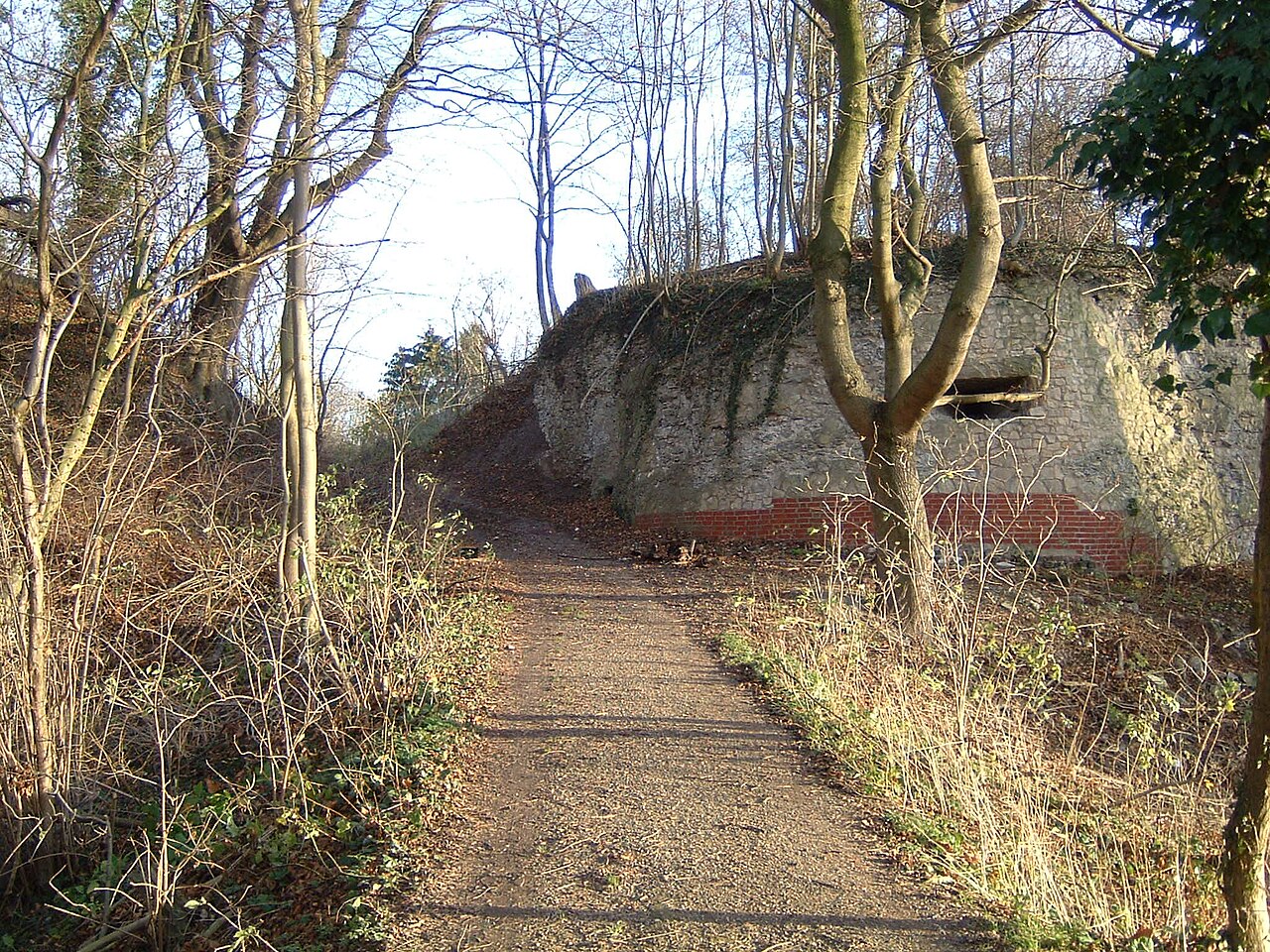
The castle's remains occupy the summit of a volcanic cone formed during the Tertiary geological period. The main fortified area covers approximately 1,050 square meters and is enclosed by a defensive ring wall about 1.45 meters thick. This wall was strengthened with buttresses and featured two semicircular towers that provided flanking defense. The original eastern gate has not survived.
A prominent feature is the bergfried, a central main tower standing 12 meters tall with a diameter of 6.7 meters and walls approximately 1.3 meters thick. Located slightly west of the castle's center, the bergfried originally had an elevated entrance, now replaced by a modern access point with a metal spiral staircase added in 1991. This tower offers panoramic views of the surrounding landscape.
Within the enclosure, foundations and a vaulted cellar remain of three multi-story buildings that once adjoined the ring wall. Archaeological excavations have also uncovered evidence of timber-framed structures, indicating a complex internal arrangement of wooden buildings supporting the castle's functions.
The fore-castle and economic buildings
The approach to the castle ascends gently to a fore-castle plateau below the main castle area. This fore-castle is enclosed on about four-fifths of its perimeter by an embankment terminating in a barrier wall, providing an additional layer of defense. To the south, an older embankment separates the fore-castle from the main hill.
Excavations revealed an economic building approximately 18 by 10 meters in size with a square tower on its northeast corner. These structures, founded on rubble deposits from the 12th and 13th centuries, were destroyed by fire in the 14th or 15th centuries. The fore-castle and its buildings likely supported the castle’s daily operations and defense.
Historical legacy and preservation
Despite falling into ruin after the von Spiegel family abandoned the site in the mid-16th century, legal obligations from a 1581 peace treaty required the family to maintain the upper castle buildings. This included re-roofing the bergfried and ensuring a gatekeeper resided on the premises, reflecting the castle's ongoing strategic and symbolic importance.
Today, the ruins of Desenberg Castle remain a significant cultural and historical landmark in the Warburg region. The site offers visitors a tangible connection to the medieval past, showcasing the architectural ingenuity and turbulent history of a hill castle that witnessed centuries of conflict, power shifts, and legend.
Frequently asked questions (FAQ)
- How do I get to Desenberg Castle in Warburg?
- Desenberg Castle is located on a hill near Warburg in North Rhine-Westphalia, Germany. Visitors can reach the site by car or local public transport to Warburg, followed by a hike up the hill to the castle ruins.
- What is the historical significance of Desenberg Castle?
- Desenberg Castle played a key role in regional medieval conflicts, including sieges by Henry the Lion and Archbishop Philipp I of Cologne. It was a seat of the von Spiegel family and witnessed important feudal struggles in the 12th to 15th centuries.
- Can I explore the ruins of Desenberg Castle?
- Yes, visitors can explore the ruins, including the bergfried tower with its panoramic views, the ring wall remains, and the fore-castle area. However, as the site is a ruin, caution is advised when walking around.
- When is the best time to visit Desenberg Castle?
- The best time to visit Desenberg Castle is during the warmer months from late spring to early autumn when the weather is suitable for hiking and outdoor exploration.
- Are there guided tours available at Desenberg Castle?
- Guided tours may be available through local tourist offices or historical societies in Warburg. Visitors are advised to check in advance for tour availability and schedules.
Information
Sources & official resources
Verify the information above using these authoritative references.
Loading map...
Visitor reviews
No reviews yet. Been here? Write the first review and help other travelers!
Write the first reviewVisited this castle? Share your experience
Your review helps other travelers and adds first-hand knowledge to our encyclopedia.