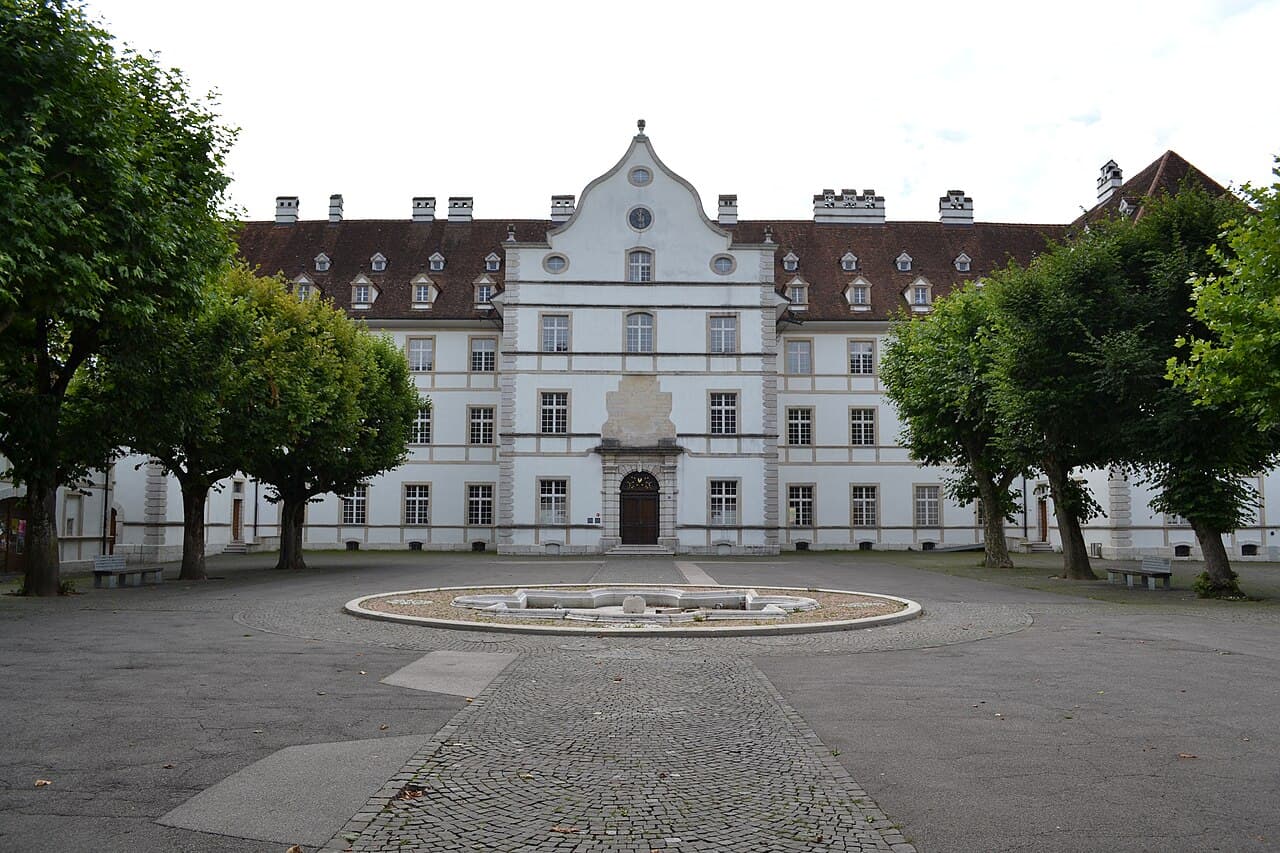
Delémont Castle
Delémont Castle, located in the historic old town of Delémont in the Canton of Jura, Switzerland, is a striking example of post-Renaissance baroque architecture. Constructed between 1716 and 1721, it was originally built as a summer residence for Prince-Bishop Jean-Conrad de Reinach. The castle was designed and completed under the direction of the architect Pierre Racine, whose work reflects the elegant and grand style typical of the early 18th century.
Architectural design and layout
The castle complex is situated on a hilltop overlooking the town, providing a commanding view of Delémont and its surroundings. The structure is a large baroque complex centered around a spacious courtyard and an extensive garden. The layout reflects the principles of baroque landscape design, emphasizing symmetry, order, and the integration of architecture with nature.
The castle building
The main building exhibits typical baroque features such as ornate façades, symmetrical windows, and decorative stonework. The use of large windows allows ample natural light into the interior, which was designed to serve as a comfortable summer residence. The castle's robust construction and hilltop position also gave it a defensive advantage, although its primary function was residential rather than military.
The baroque garden
The castle garden is a key highlight of the estate, having been carefully restored in 2003 according to the original baroque design. It is divided into eight large squares arranged symmetrically around a central fountain. The four squares adjacent to the water feature are laid out as lawns, providing green open spaces, while the squares on the eastern and western edges are paved with white limestone concrete slabs. This combination of soft landscaping and hardscape elements is characteristic of baroque garden design, which aimed to create a harmonious and visually striking environment.
Former orangery and synagogue
On the western side of the garden lies the former orangery, a building originally intended for housing citrus trees during winter. Interestingly, this structure was repurposed as a synagogue from 1880 to 1909, reflecting the diverse cultural history of Delémont and the adaptive reuse of castle buildings over time.
Historical significance and current use
Delémont Castle holds a prominent place in the local history as the residence of the Prince-Bishops, who wielded both religious and secular power in the region. The castle symbolizes the authority and prestige of the Prince-Bishopric during the early 18th century.
Today, the castle is a Swiss heritage site of national significance, recognized for its architectural and historical value. It has been adapted to serve the community as it currently houses the town's elementary schools. This modern use ensures the preservation and continued relevance of the castle within Delémont.
Preservation and cultural heritage
The restoration of the castle garden in 2003 highlights ongoing efforts to maintain the site's historical integrity. The garden's restoration was based on detailed research to replicate the original baroque layout, preserving the castle's aesthetic and cultural context.
The castle's well-preserved state, combined with its adaptive reuse, makes it an important example of how historic buildings can be integrated into contemporary urban life while respecting their heritage.
Visitor information
While Delémont Castle primarily functions as an educational facility, its status as a heritage site attracts interest from visitors interested in baroque architecture and Swiss history. The castle's location within the old town of Delémont makes it accessible for those exploring the region's cultural landmarks.
Frequently asked questions (FAQ)
- What is the historical significance of Delémont Castle?
- Delémont Castle was built as a summer residence for Prince-Bishop Jean-Conrad de Reinach between 1716 and 1721. It symbolizes the authority of the Prince-Bishopric and is a Swiss heritage site of national significance.
- Can I visit the castle gardens?
- Yes, the castle gardens were restored in 2003 to reflect the original baroque design. Visitors can explore the eight large squares arranged around a central fountain, featuring lawns and limestone concrete slabs.
- Is Delémont Castle open to the public?
- Delémont Castle currently houses elementary schools, so public access to the interior may be limited. However, the gardens and the castle's exterior can be viewed during visiting hours in the old town of Delémont.
- What architectural style is Delémont Castle?
- Delémont Castle is built in the post-Renaissance baroque style, characterized by symmetrical layouts, ornate façades, and integration with formal gardens.
- When was the castle garden restored?
- The castle garden was carefully restored in 2003 based on the original baroque garden design, preserving its historical layout and features.
Photo gallery

Information
Current owner
Municipality
Loading map...
Visitor reviews
No reviews yet. Been here? Write the first review and help other travelers!
Write the first reviewVisited this castle? Share your experience
Your review helps other travelers and adds first-hand knowledge to our encyclopedia.



