Człuchów
Człuchów Castle is a prominent example of a late medieval hill castle constructed by the Teutonic Order in the early 14th century, located in present-day Człuchów, Poland. Built between approximately 1308 and 1367, the castle served as a vital military and administrative center within the Teutonic State and later the Kingdom of Poland. Its strategic position on a raised isthmus flanked by two lakes provided natural defensive advantages that were significantly enhanced through extensive fortifications and architectural ingenuity.
The castle's site originally hosted an early medieval fortified settlement overlooking the future town of Człuchów. Recognizing its superior defensive qualities compared to neighboring strongholds, the Teutonic Knights established a substantial brick and stone fortress here, intended as the seat of a new komturstwo (commander's residence). This marked the rise of Człuchów as an important military and administrative hub in the region.
Architectural design and layout
The castle was constructed on a square plan measuring about 47.5 meters on each side, featuring four four-story wings enclosing a spacious inner courtyard with cloisters. The walls were built using characteristic Teutonic brick Gothic techniques, with bricks laid on a high stone foundation for added strength and durability. A dominant architectural feature was the massive bergfried tower, rising over 40 meters tall at the northwest corner to guard the main gate. This tower's walls reached up to five meters thick, and it was accessible only via an elevated entrance 16 meters above ground, connected by an attic passage from the adjacent wing.
The castle's ground floors and cellars housed essential service areas including storerooms for food and weapons, a kitchen, bakery, and brewery. The upper floors contained representative halls and residential chambers. Notable rooms included the great refectory in the western wing, the chapter house and dormitory in the eastern wing, and a chapel alongside the commander’s apartment above the gate passage in the northern wing. A covered gallery linked the southern wing to a projecting latrine tower (gdanisko) built over the lake, allowing defenders to cover the castle walls below.
Outer defenses and baileys
The castle was encircled by an outer defensive wall creating a bailey or międzymurze between the inner and outer walls. The main entrance was protected by a neck passage and a drawbridge leading to a small outer gatehouse with guard rooms. Beyond the High Castle, three fortified baileys lay to the west, north, and east, each separated by moats and defensive walls with towers and bastions designed to be defensible independently.
The western bailey housed stables, granaries, and an armory, serving as the first line of defense facing the town. The northern bailey contained living quarters for the garrison and guard houses. The largest was the eastern bailey, covering approximately 100 by 150 meters, functioning as the castle’s economic hub with workshops, storage buildings, and access to a bathhouse by the lake.
Historical significance and military role
Throughout the 14th and 15th centuries, Człuchów Castle was a key stronghold of the Teutonic Order, considered nearly impregnable. It endured multiple military conflicts, including unsuccessful Polish sieges during the Hunger War of 1414 and again in 1433. The castle changed hands during the Thirteen Years’ War (1454–1466), when it was seized by the Polish crown in 1454. Despite efforts by the Teutonic Knights to retake it, Człuchów remained under Polish control and served as the seat of a royal starost (administrator) for nearly two centuries.
In the 17th century, the castle faced attacks during the Swedish-Polish wars. It withstood sieges in 1627 and during the Deluge until 1655, when Swedish forces exploited the frozen lake to approach from all sides and captured it. This marked a turning point after which the fortress gradually lost its military importance.
Decline and transformation
Following the First Partition of Poland in 1772, Człuchów came under Prussian rule. The Prussians lowered the lake’s water level by nearly four meters, removing the castle’s natural moat defenses. A devastating fire in 1793 damaged both the town and castle extensively. Subsequently, King Frederick William II authorized dismantling the fortress to reuse bricks and stones for rebuilding, leading to the castle's near-total ruin by the early 19th century.
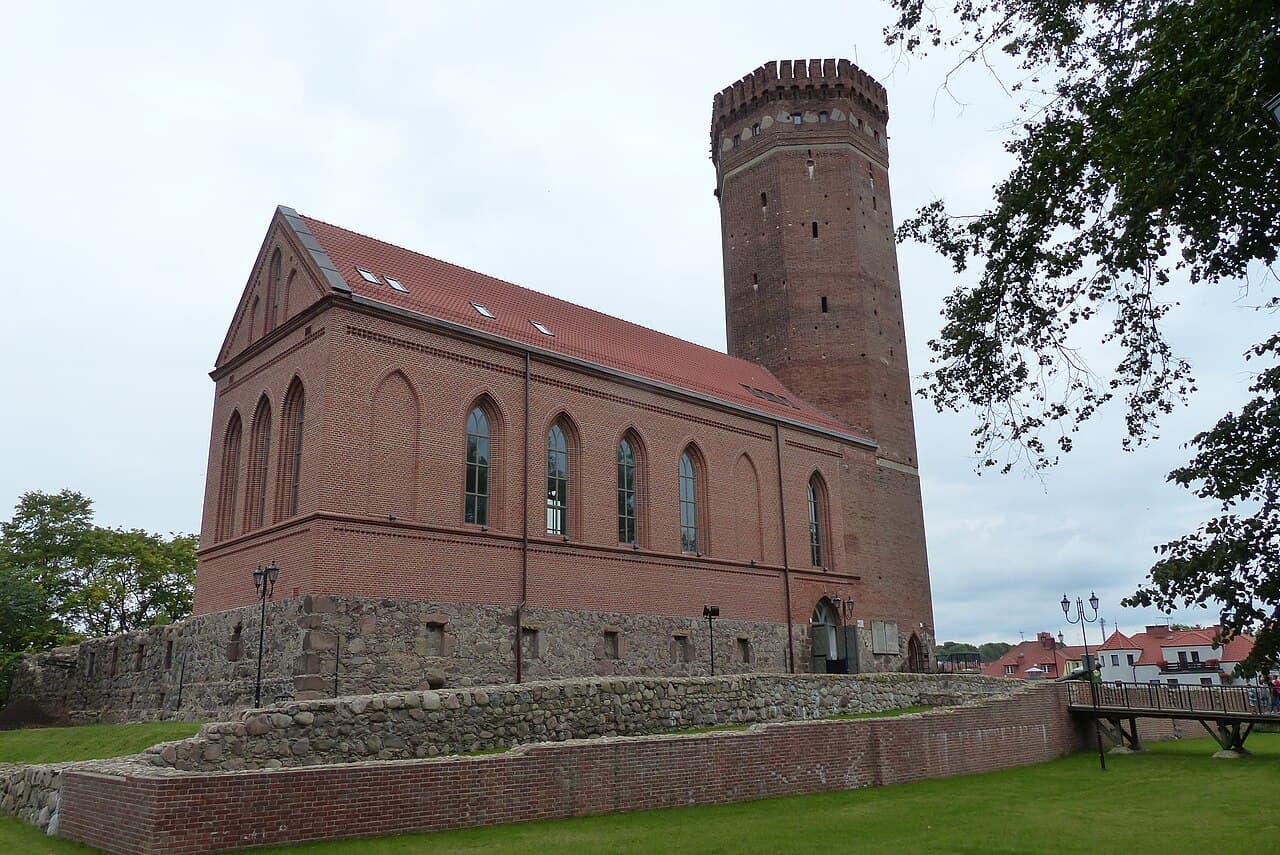
Demolition ceased in 1811 after new protection orders were issued. Between 1826 and 1828, a neo-Gothic Protestant church was constructed on the foundations of the former castle chapel, initially designed by Salzmann and later revised by the renowned architect Karl Friedrich Schinkel. The castle’s main tower was lowered and crowned with neo-Gothic battlements in 1844, integrating it into the church as a bell tower.
Archaeological discoveries and preservation efforts
Modern archaeological excavations beginning in 2008 have uncovered significant parts of the castle’s structure and artifacts, shedding light on its historical layout and usage. Discoveries include medieval cobblestone paving of the gate passage, remnants of three castle gates, ruins of a gatehouse, and a cache of 15th-century cannonballs and Gothic bricks.
Restoration efforts completed around 2015 stabilized the ruins and made the site accessible to visitors. The preserved main tower offers panoramic views of the surrounding landscape, while the exposed remains of the castle wings around the courtyard provide a tangible connection to its medieval past. Modern adaptations such as an elevator in the tower enhance accessibility for all visitors.
Cultural legacy and visitor experience
Człuchów Castle remains one of the largest and most historically significant Teutonic fortresses in Poland. Its ruins reflect the architectural grandeur and military strength of the medieval Order. The layered history—from its Teutonic origins through Polish administration, Swedish sieges, Prussian rule, and modern archaeological revival—illustrates the complex cultural heritage of the region.
Today, visitors can explore the castle grounds, climb the restored bergfried tower, and learn about the site’s role in regional history through museum exhibits and interpretive signage. The juxtaposition of medieval ruins with the 19th-century neo-Gothic church adds a unique architectural dimension. The castle’s scenic location between lakes and its well-preserved defensive structures make it a compelling destination for history enthusiasts and tourists alike.
Człuchów Castle stands as a significant monument to the enduring legacy of the Teutonic Order's architectural and military achievements, as well as the turbulent history of Central Europe’s borderlands.
Frequently asked questions (FAQ)
- When was Człuchów Castle built and by whom?
- Człuchów Castle was built by the Teutonic Order between 1308 and 1367 as a fortified hill castle in what is now Człuchów, Poland.
- What are the main architectural features of Człuchów Castle?
- The castle features a square plan with four four-story wings enclosing a courtyard, a massive bergfried tower, brick Gothic walls on a stone foundation, and multiple baileys with defensive walls and moats.
- Can visitors climb the main tower at Człuchów Castle?
- Yes, visitors can climb the restored bergfried tower, which offers panoramic views of the surrounding landscape and includes modern accessibility features like an elevator.
- What historical events involved Człuchów Castle?
- The castle was involved in the Hunger War of 1414, the Thirteen Years’ War, and Swedish-Polish wars, including sieges in 1627 and 1655 when it was captured by Swedish forces.
- Is Człuchów Castle accessible to the public?
- Yes, the castle ruins are open to visitors, featuring stabilized structures, museum exhibits, and interpretive signage to enhance the visitor experience.
Photo gallery

Information
Website
Visit websiteSources & official resources
Verify the information above using these authoritative references.
Loading map...
Visitor reviews
No reviews yet. Been here? Write the first review and help other travelers!
Write the first reviewVisited this castle? Share your experience
Your review helps other travelers and adds first-hand knowledge to our encyclopedia.