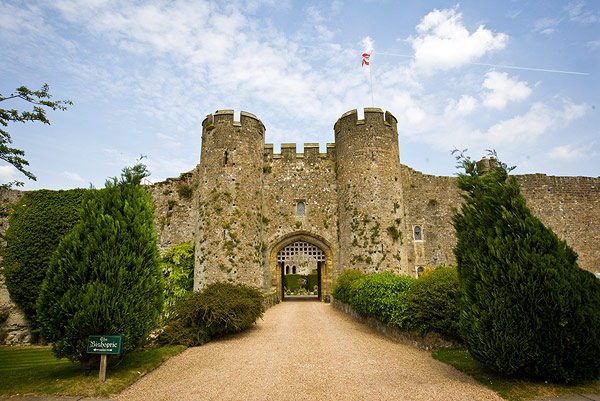
Cowdray House
Cowdray House, also known as Cowdray Castle or Midhurst Castle, is a significant Tudor-era fortified manor house ruin located near the town of Midhurst in West Sussex, England. It stands on the banks of the River Rother and represents a remarkable example of early 16th-century aristocratic architecture and history. The site has a layered past beginning with a fortified manor established in the late 13th century.
Early origins and medieval foundations
The initial building at Cowdray was constructed in the late 13th century by Sir John de Bohun. This early structure served as a fortified manor house, typical of the high medieval period, providing both residential comfort and defensive capabilities. Its strategic location by the river allowed control over the surrounding lands and access routes. While much of this early medieval construction has not survived, it laid the groundwork for the later grander developments.
Transformation into a Tudor mansion
In the early 16th century, the estate underwent a major transformation. Around the 1520s, Sir David Owen began construction of the present building, reflecting the evolving architectural tastes and social aspirations of the Tudor nobility. This phase marked a shift from purely defensive structures to a more palatial residence, blending fortification with comfort and style.
In 1529, the property was sold to William FitzWilliam, 1st Earl of Southampton, who in 1533 obtained a license to crenelate from King Henry VIII. This license allowed for the addition of battlements and other fortification features, reinforcing the castle's appearance and defensive potential while also symbolizing noble status.
Royal connections and historical significance
King Henry VIII visited Cowdray House on several occasions—in 1538, 1539, and 1545. The castle played a role in the turbulent religious and political climate of the time. In 1538, it was used to imprison Lady Margaret Pole, 8th Countess of Salisbury, a notable figure linked to the Plantagenet dynasty. The castle also hosted Mary of Guise in 1551, who was the queen consort of King James V of Scotland and mother of Mary, Queen of Scots.
The castle's royal visitors continued with King Edward VI in 1552 and Queen Elizabeth I in 1591, demonstrating its ongoing importance as a noble residence and political venue during the Tudor period.
Ownership and civil war impact
In 1548, Cowdray House was inherited by Sir Anthony Browne, who was later ennobled as the 1st Viscount Montague in 1554. The Browne family maintained the estate for generations, becoming influential figures in Sussex and English politics.
During the English Civil War in the mid-17th century, Cowdray was sequestered from Francis Browne, 3rd Viscount Montague due to his Royalist allegiance. The castle was garrisoned by Parliamentary troops, reflecting the widespread military and political upheaval that affected many noble estates.
Destruction and ruin
The castle's decline was dramatic and swift. In September 1793, while undergoing repair works, a devastating fire engulfed Cowdray House, leaving it almost completely destroyed. The only part of the structure to remain intact was the kitchen tower. This disaster marked the end of Cowdray as a habitable residence.
Tragically, less than two weeks after the fire, the then-owner, the 8th Viscount Montague, drowned in Switzerland. Local legend attributes this misfortune to a curse placed on the family in 1536 by an angry monk, linked to the family's acquisition of Battle Abbey following the Dissolution of the Monasteries.
Following the fire, Cowdray House was never rebuilt and was left to decay as a ruin, a poignant reminder of its former grandeur and the passage of time.
20th century preservation and public access
In the early 20th century, the estate including the ruins was purchased by Sir Weetman Dickinson Pearson, who was later titled the 1st Viscount Cowdray. He undertook efforts to consolidate and preserve the ruins, preventing further deterioration.
Today, Cowdray House remains a well-preserved ruin and a popular historic site open to the public. Restoration work completed in 2006 enhanced the site's safety and accessibility, leading to its reopening in 2007. Visitors can explore the extensive remains, including the impressive kitchen tower, curtain walls, and foundational structures that outline the castle's original footprint.
Architectural features and layout
Cowdray House is an example of a fortified Tudor manor house, combining defensive elements with the domestic comforts expected by the nobility of the period. The castle's layout includes a central courtyard surrounded by fortified walls, towers, and gatehouses.
The kitchen tower is one of the most notable surviving features, showcasing the scale and complexity of the service areas. The walls and battlements reflect the license to crenelate granted by Henry VIII, with defensive crenellations and arrow slits integrated into the design.
Although much of the residential quarters are now ruins, archaeological studies and surviving masonry reveal the castle's original grandeur, including large halls, private chambers, and service buildings arranged around the courtyard.
Cultural and historical legacy
Cowdray House holds a prominent place in English history due to its royal connections, architectural evolution, and dramatic narrative of destruction and survival. It illustrates the transition from medieval fortified manor houses to Tudor palatial residences with defensive features.
The castle's association with significant historical figures such as Henry VIII, Lady Margaret Pole, and Queen Elizabeth I enhances its cultural importance. Its story reflects broader themes in English history, including the Tudor monarchy's power, the religious upheavals of the Reformation, and the impact of the English Civil War.
Today, Cowdray House is valued both as a heritage site and as a subject of archaeological and architectural study. It attracts visitors interested in Tudor history, castle architecture, and English noble heritage.
Frequently asked questions (FAQ)
- How do I get to Cowdray House?
- Cowdray House is located in Midhurst, West Sussex. It is easily accessible by car, with parking available on-site. Public transport options include local bus services and nearby train stations, which are a short taxi ride away.
- What is the historical significance of Cowdray House?
- Cowdray House is a significant historical site, dating back to the 16th century. It was originally built as a grand residence for the Montague family and has witnessed many historical events, including the English Civil War.
- When was Cowdray House built?
- Cowdray House was constructed in the early 16th century, with its foundation laid around 1550. It has undergone various renovations and restorations throughout the centuries, reflecting different architectural styles.
- Can I take guided tours of Cowdray House?
- Yes, guided tours are available at Cowdray House, providing visitors with in-depth knowledge of its history and architecture. Tours are typically offered during the peak season, and it's advisable to book in advance to ensure availability.
- Why is Cowdray House famous for its architecture?
- Cowdray House is renowned for its impressive Tudor architecture, with intricate stonework and expansive grounds. Its ruins showcase a blend of Gothic and Renaissance styles, making it a captivating site for architecture enthusiasts.
- Is it possible to host events at Cowdray House?
- Yes, Cowdray House offers various spaces for hosting events, including weddings and corporate functions. The picturesque setting and historical backdrop make it a unique venue for memorable gatherings.
- What are the opening hours for Cowdray House?
- Cowdray House typically opens to visitors from 10 AM to 5 PM during the main season. However, it's advisable to check the official website for any seasonal changes or special events that may affect opening hours.
- What is the best time to visit Cowdray House?
- The best time to visit Cowdray House is during the spring and summer months when the gardens are in full bloom and the weather is pleasant. Additionally, various events and activities are often scheduled during this time, enhancing your experience.
- Are there any nearby attractions to Cowdray House?
- Yes, nearby attractions include the South Downs National Park, offering stunning landscapes for hiking and outdoor activities. Additionally, the charming town of Midhurst features quaint shops and restaurants, perfect for a day out.
- What are the ticket prices for Cowdray House?
- Ticket prices for Cowdray House vary, with discounts often available for children, students, and seniors. It's best to check the official website for current pricing and any special offers that may be available during your visit.
Information
Loading map...
Visitor reviews
No reviews yet. Been here? Write the first review and help other travelers!
Write the first reviewVisited this castle? Share your experience
Your review helps other travelers and adds first-hand knowledge to our encyclopedia.