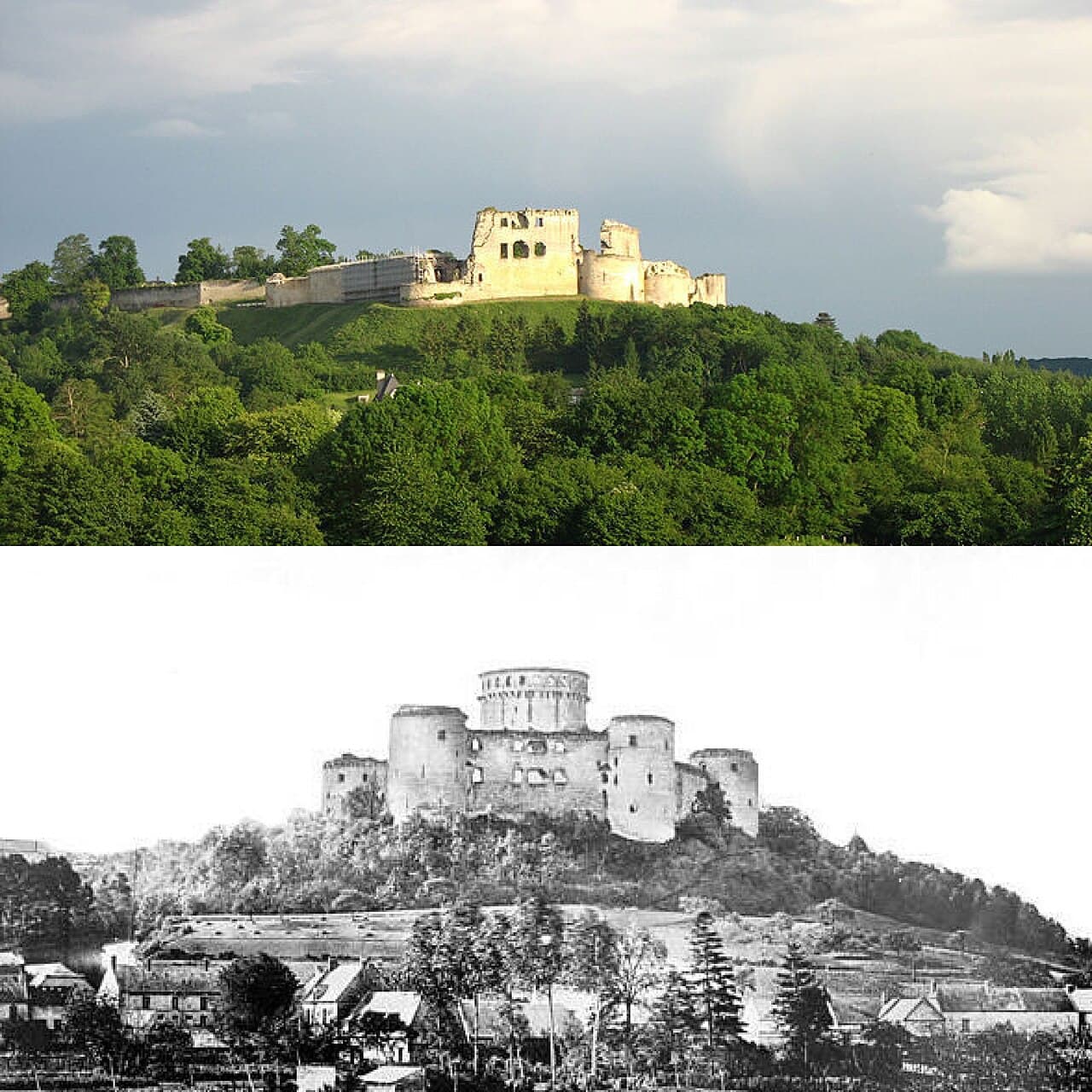
Coucy Castle
Coucy Castle, or Château de Coucy, stands as a monumental symbol of medieval military architecture and feudal power in the Hauts-de-France region. Situated in the village of Coucy-le-Château-Auffrique in the Aisne department, this hill castle was originally founded in the 10th century and evolved into one of the most formidable fortresses of medieval Europe. Its history reflects the ambitions of powerful lords, the turbulence of French medieval politics, and the ravages of war and time.
The site first hosted a simple fortification around 920 AD, established by Hervé, Archbishop of Reims, primarily as a defensive motte-and-bailey structure to protect ecclesiastical lands from Norman raids. This early fortification consisted likely of a wooden keep atop a stone base, marking the modest beginnings of what would become a grand castle complex.
The castle as it is renowned today was largely constructed between 1225 and 1245 under the direction of Enguerrand III de Coucy, a formidable nobleman who styled himself as "I am no King, nor Prince nor Duke nor Count; I am the Lord of Coucy!". His ambition and military prowess were reflected in the scale and strength of the castle he built. The fortress was strategically positioned on a bluff, separated from the town by a large moat, and featured multiple defensive layers including an outer ward and a main castle with massive fortifications.
Architectural grandeur and innovations
The mighty donjon: Europe's largest medieval keep
The centerpiece of Coucy Castle was its cylindrical donjon (keep), which at over 55 meters high and 35 meters in diameter was the largest of its kind in medieval Europe. Its walls were up to 7.5 meters thick, demonstrating advanced engineering designed to withstand prolonged sieges. This massive tower was surrounded by a deep moat and accessible only by a drawbridge, emphasizing its defensive isolation and symbolic dominance.
Corner towers and curtain walls
Four enormous circular corner towers, each approximately 40 meters high and 20 meters in diameter, guarded the main castle. These towers were comparable in size to royal keeps of the time, underscoring the lord's pride and status. The curtain walls connecting these towers were thick and high, reinforced internally by buttresses and pointed arches, a notable architectural innovation for strength and stability.
Inner and outer baileys
The castle complex included a large outer ward separated from the main castle by a moat, and a lower courtyard or basse-cour that housed ancillary buildings and served as a defensive buffer zone. The entire fortress occupied a trapezoidal limestone plateau, with dimensions roughly 92 by 35 by 50 by 80 meters, offering commanding views over the surrounding valleys of the Oise and Ailette rivers.
Historical significance and notable figures
Enguerrand III and the rise of Coucy
Enguerrand III de Coucy was a powerful noble and warrior who fought in significant military campaigns, including the invasion of England to depose King John and the Albigensian Crusade. His construction of the castle between 1225 and 1245 marked the height of Coucy's feudal power and influence.
Enguerrand VII and the castle's transformation
In the late 14th century, Enguerrand VII, the last male lord of the Coucy family, transformed the fortress into a more sumptuous palace, adding Gothic-style halls and residential buildings. His political connections were extensive: he was a grandson of the Archduke of Austria, son-in-law to King Edward III of England, and a loyal vassal to the King of France. His death in 1397 without a male heir led to the sale of Coucy to Louis I, Duke of Orléans in 1400, marking the castle's transition into royal hands.
Military conflicts and decline
The castle endured numerous sieges during the 15th century, including a notable three-month siege in 1411 during the Armagnac-Burgundian civil war, only surrendering when provisions were exhausted. The advent of artillery and changing military tactics diminished the castle's strategic importance. In 1652, during the Fronde civil wars, the fortress resisted royal forces but was eventually partially dismantled on orders from Cardinal Mazarin to prevent it from being a threat to royal authority.
Later history and preservation efforts
Natural disasters and revolutionary use
A strong earthquake in 1692 caused significant damage, including a large crack in the donjon. During the French Revolution, the castle was repurposed as a prison and later used as a quarry, leading to further degradation.
19th-century restoration
In 1829, King Louis-Philippe purchased the ruins, and by 1856 the castle became government property. The renowned architect Eugène Viollet-le-Duc undertook consolidation work, including reinforcing the donjon with metal braces to slow decay, preserving what remained of the castle's grandeur.
World War I destruction
During World War I, German forces occupied the castle, using it as a military outpost. In March 1917, on orders from General Erich Ludendorff, the retreating German army detonated over 25 tons of explosives, destroying the keep and the four corner towers. This act of destruction, possibly motivated by spite rather than military necessity, caused widespread outrage and led to the ruins being declared "a memorial to barbarity".
Architectural remains and archaeological discoveries
Surviving structures and layout
Today, Coucy Castle remains a dramatic ruin. Although the donjon collapsed, its rubble still shows traces of the 19th-century metal reinforcements. The foundations of the chapel, lord’s residence, and the great hall known as the Salle des Preux have been uncovered. The castle’s moat, curtain walls, and parts of the outer wards remain visible, illustrating the scale and complexity of the original fortress.
Recent archaeological findings
Excavations between 2018 and 2020 revealed 15th-century ducal kitchens commissioned by the Duke of Orléans, providing insight into the castle’s residential and administrative functions during its later medieval phase. Other discoveries include a deep well over 64 meters deep and remnants of defensive structures, enriching our understanding of medieval castle life.
Visitor experience and cultural significance
The castle is open to visitors for a modest fee, offering a compelling glimpse into medieval military architecture and feudal history. Stabilized pathways and safety measures allow exploration of the ruins, which host cultural events and educational programs. Coucy Castle remains a powerful testament to medieval ambition, architectural innovation, and the enduring legacy of France’s feudal past.
Its designation as a historic monument since 1862 underscores its cultural importance. Despite the destruction and decay, Coucy Castle continues to captivate historians, architects, and visitors alike with its monumental scale and storied past.
Frequently asked questions (FAQ)
- What is the historical significance of Coucy Castle?
- Coucy Castle, built in the 13th century, was one of the largest and most impressive castles in medieval France. It served as a symbol of power for the lords of Coucy and played a significant role in various historical conflicts, including the Hundred Years' War.
- When was Coucy Castle constructed?
- Construction of Coucy Castle began in the early 13th century, around 1225, and it was expanded throughout the following decades. The castle showcases remarkable medieval architecture and was designed to reflect the strength and prestige of its owners.
- What are the opening hours for visiting Coucy Castle?
- Coucy Castle is typically open to visitors from April to October, with varying hours depending on the season. It is advisable to check the official website for the most current opening hours and any seasonal changes to ensure a smooth visit.
- Can I purchase tickets in advance for Coucy Castle?
- Yes, it is possible to purchase tickets in advance through the castle's official website. This can help you avoid long lines and ensure your entry on busy days, especially during peak tourist season.
- Is Coucy Castle accessible for visitors with disabilities?
- Coucy Castle has taken steps to improve accessibility, but some areas may still present challenges due to the historical architecture. It is recommended to contact the castle administration in advance to inquire about specific accessibility options available for visitors with disabilities.
- What is the best time to visit Coucy Castle?
- The best time to visit Coucy Castle is during the spring and early autumn months, when the weather is generally mild and pleasant. These seasons also tend to have fewer crowds compared to the peak summer months, allowing for a more enjoyable experience.
- What nearby attractions can I visit while in Coucy-le-Château-Auffrique?
- While visiting Coucy Castle, you can also explore the charming village of Coucy-le-Château-Auffrique, which offers picturesque streets and local shops. Additionally, nearby attractions include the historic city of Laon and the beautiful Parc Naturel Régional de l'Aisne, perfect for a day of exploration.
- How much does it cost to enter Coucy Castle?
- The ticket prices for Coucy Castle are generally affordable, with discounts available for students and children. It is recommended to check the official website for the most up-to-date pricing and any special offers that may be available during your visit.
Photo gallery

Information
Sources & official resources
Verify the information above using these authoritative references.
Loading map...
Visitor reviews
No reviews yet. Been here? Write the first review and help other travelers!
Write the first reviewVisited this castle? Share your experience
Your review helps other travelers and adds first-hand knowledge to our encyclopedia.



