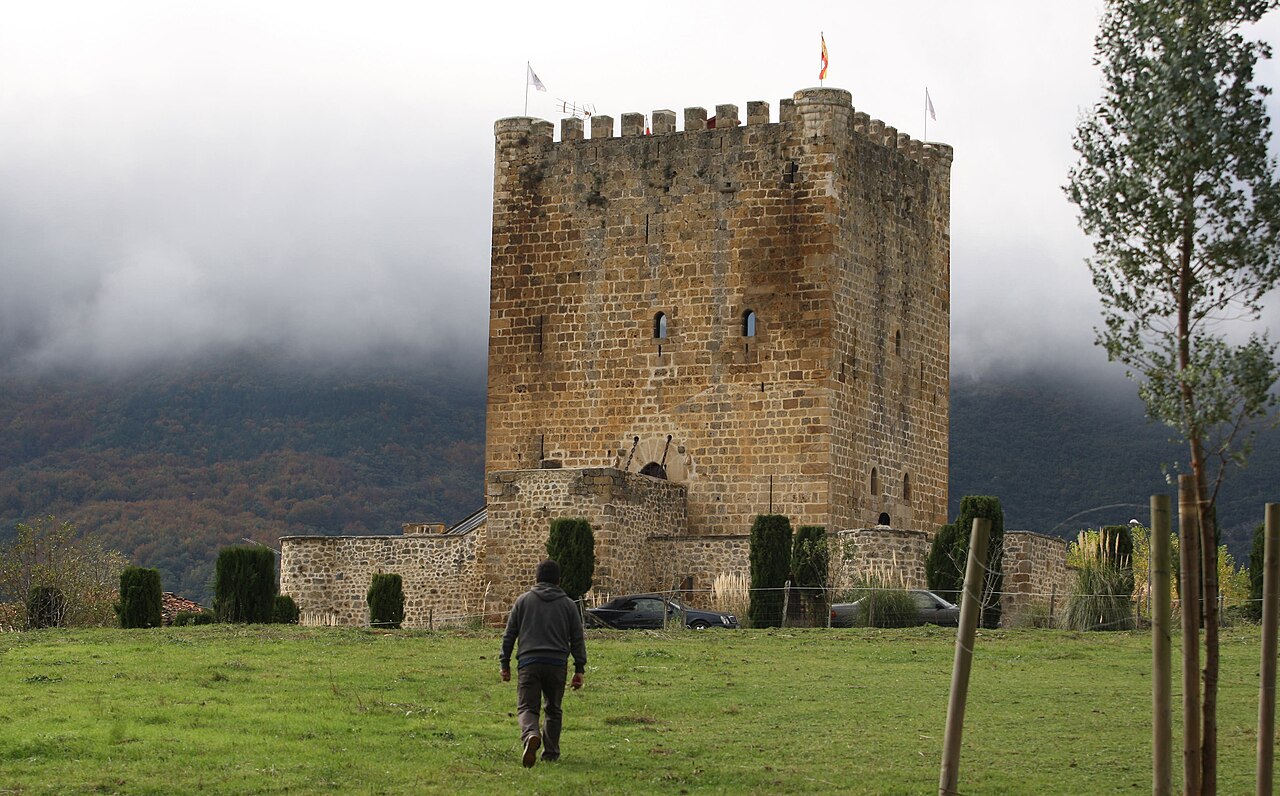
Convent and Palace of Quejana
The Convent and Palace of Quejana stands as a remarkable medieval complex in the Ayala Valley, within the municipality of Quejana, Spain. Established during the 14th century by the Kingdom of Castile, this site served as the residence and religious center of the influential Ayala noble family. The ensemble reflects the intertwined nature of feudal power and ecclesiastical patronage, combining fortified architecture with monastic functions.
The Ayala family rose to prominence in the early 1300s, notably through the military achievements of Fernán Pérez de Ayala, who secured the hereditary title of Señor de Ayala. To consolidate his lordship, Fernán Pérez commissioned a fortified palace as the family seat. In 1378, he founded the convent of San Juan Bautista, entrusting it to the Dominican nuns and ensuring its endowment for religious and social influence. This foundation was further supported by his descendant, Pedro López de Ayala, Chancellor of Castile from 1398, a statesman, poet, and historian who elevated the convent’s status through royal patronage and cultural investment.
Architectural features of the palace and convent
The fortified palace
The palace is a square-plan structure built primarily from limestone, featuring two stories that enclose a spacious inner courtyard. Its eastern façade is distinguished by a pointed arch entrance with minimal decorative elements, emphasizing its defensive purpose. The palace’s fortification is enhanced by two substantial corner towers, designed to oversee and protect the estate. The northern façade retains original Gothic architectural elements, including paired lancet windows with finely carved stone arches. Some windows were altered during an 18th-century restoration, but several remain intact, offering insight into the medieval Gothic style favored by the Ayala family.
The convent complex
Adjacent to the palace lies the convent complex, centered around a two-story cloister arranged in a quadrangular layout. The ground floor cloister features ribbed vaults intersected by semicircular transverse arches, characteristic of Gothic construction methods. The upper floor was remodeled in the 18th century to include a Baroque assembly hall with a flat ceiling decorated with geometric moldings and crescent shapes, exemplifying the evolving architectural tastes over centuries.
Torre-capilla de la virgen del cabello
A prominent feature of the site is the Torre-Capilla de la Virgen del Cabello, constructed in 1399 as a funerary chapel and pantheon for the Ayala family. This robust square tower is built from limestone blocks with reinforced ashlar-stone corners. The battlemented top is supported by three curved modillions, adding to its fortified appearance. The tower’s openings are minimal, with narrow slit windows and a pointed arch doorway adorned with sculpted archivolts and column capitals carved with human heads. Inside, the chapel’s pointed barrel vault is divided into two bays by a transverse arch resting on attached columns. The chapel houses four high-artistic-value tombs of the Ayala lineage, underscoring its role as a dynastic mausoleum.
Notably, the chapel originally contained a 1396 altarpiece now preserved at the Art Institute of Chicago. This Gothic linear-style artwork depicted scenes from the lives of Christ and the Virgin Mary, framed by gilded columns and arches featuring heraldic emblems of the Ayala and Guzmán families. The altarpiece reflects artistic influences from French and Italian Gothic painting traditions.
Church of san juan bautista and other religious structures
Church architecture and decoration
The church of San Juan Bautista exhibits a rectangular plan with a single nave divided into five segments or bays, terminating in an octagonal apse. The apse is externally buttressed by four large supports and pierced by a circular oculus that illuminates the interior. The vaulting, added in 1739, consists of ribbed ceilings with curved ribs forming circular patterns around the nave. The vault surfaces are decorated with grisaille grotesques, adding a rich decorative element to the sacred space.
Baroque altarpieces and funerary monuments
The church houses several Baroque altarpieces and funerary sculptures commemorating key members of the Ayala family, including Fernán Pérez de Ayala and María Sarmiento. These artworks and monuments highlight the continuing religious and cultural significance of the site beyond its medieval origins.
Additional historic features and site layout
Abbot's residence and residential buildings
Within the complex is an 18th-century abbot’s residence characterized by a façade with rows of regular windows and ground-floor semicircular arches. Nearby residential buildings constructed from stone feature Gothic windows and porticos lining the access road and bridge, contributing to the historic atmosphere of the site.
Stone bridge and bell gable
A stone bridge with a pointed arch and stone balustrades from the 17th century crosses a small plaza near the convent’s entrance, suggesting a defensive function. Adjacent to the bridge stands an independent bell gable (espadaña) with masonry construction and ashlar corners. Its northern face is decorated with Mudéjar-style ceramic tiles, reflecting the artistic blending of Christian and Islamic traditions typical of Spanish architecture. This bell gable marks the periphery of the complex and completes the architectural ensemble of Quejana’s historic site.
Historical significance and preservation
The Convent and Palace of Quejana is a testament to the power and cultural influence of the Ayala family in medieval Castile. The site’s combination of fortified noble residence, religious convent, and funerary chapel illustrates the multifaceted role of aristocratic estates in medieval Spain. Its architectural elements span from Gothic to Baroque styles, reflecting centuries of continuous use and adaptation.
Recognized for its cultural and historical value, the site was declared a National Monument in 1984 and later designated a Bien de Interés Cultural in 2002. Since 2023, the Diputación Foral de Álava has taken custodianship, underscoring ongoing efforts to preserve this emblematic medieval estate for future generations. The site remains a significant destination for those interested in medieval architecture, noble lineage, and Spanish heritage.
Frequently asked questions (FAQ)
- What is the historical significance of the Convent and Palace of Quejana?
- The Convent and Palace of Quejana is a significant example of medieval architecture in Spain, originally established in the 14th century. It served as a monastery for the Order of San Agustín and reflects the region's rich cultural and religious history.
- When was the Convent and Palace of Quejana built?
- Construction of the Convent and Palace of Quejana began in the late 14th century and continued into the 15th century. Over the years, various renovations and restorations have preserved its historical integrity and architectural beauty.
- Can I visit the Convent and Palace of Quejana?
- Yes, the Convent and Palace of Quejana is open to visitors. Guided tours are available, allowing guests to explore its stunning architecture and learn about its history.
- What are the opening hours for the Convent and Palace of Quejana?
- The Convent and Palace of Quejana is typically open to the public from 10 AM to 6 PM, Tuesday to Sunday. It is advisable to check the official website for any changes in hours or special holiday closures.
- Are there ticket prices for visiting the Convent and Palace of Quejana?
- Yes, there is an admission fee to visit the Convent and Palace of Quejana. Ticket prices are generally affordable, with discounts available for students and seniors, and children often enter for free.
- Is it possible to access the Convent and Palace of Quejana for visitors with disabilities?
- Yes, the Convent and Palace of Quejana is committed to accessibility. There are facilities in place to assist visitors with mobility challenges, making it easier for everyone to enjoy the site.
- What is the best time to visit the Convent and Palace of Quejana?
- The best time to visit the Convent and Palace of Quejana is during the spring and fall when the weather is mild and pleasant. Additionally, these seasons tend to attract fewer crowds, allowing for a more enjoyable experience.
- What nearby attractions can I visit while in Quejana?
- While in Quejana, visitors can explore the beautiful surrounding countryside, as well as nearby historical sites like the town of Amurrio and the scenic natural areas of the Aizkorri-Aratz Natural Park. These attractions offer a great complement to your visit to the Convent and Palace of Quejana.
Information
Website
Visit websiteSources & official resources
Verify the information above using these authoritative references.
Loading map...
Visitor reviews
No reviews yet. Been here? Write the first review and help other travelers!
Write the first reviewVisited this castle? Share your experience
Your review helps other travelers and adds first-hand knowledge to our encyclopedia.