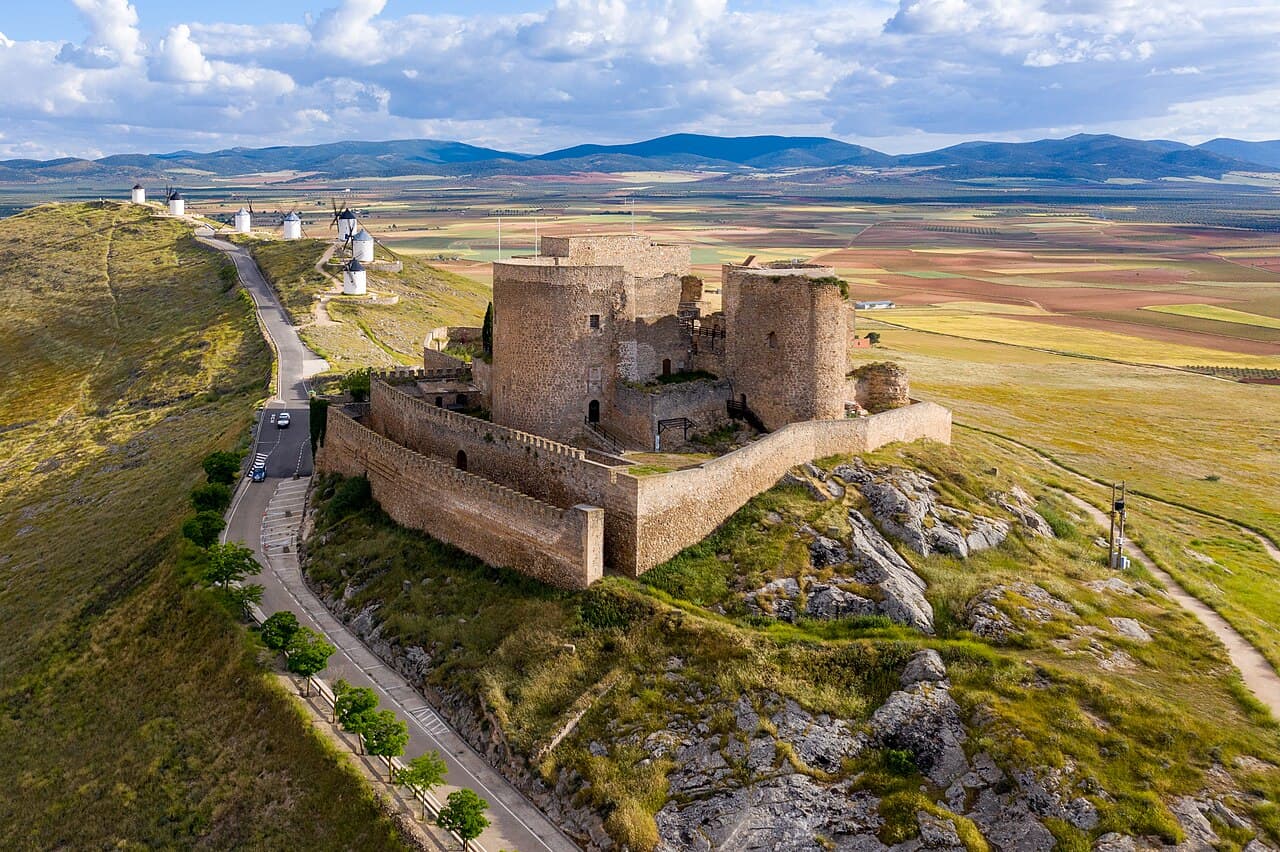
Consuegra Castle
Consuegra Castle, also known as Castillo de Consuegra, is a prominent hill castle located on Cerro el Calderico in the province of Toledo, Spain. This fortress dominates the surrounding landscape, offering spectacular views of the countryside and serving as an iconic backdrop to the famous white windmills of Consuegra. Its strategic position atop a ridge has made it a significant military stronghold throughout history.
Early origins and moorish period
The site of Consuegra Castle has a long history of human occupation, with evidence dating back to the 5th century BCE. Originally, the area was home to the ancient Roman town of Consabura in the 2nd century BCE, which featured typical Roman infrastructure such as baths, defensive walls, an aqueduct, and a circus. The castle itself likely began as a modest fortification during the 10th century under the Caliphate of Córdoba, possibly constructed or enhanced by the military leader Almanzor.
During the period of Moorish rule, the castle played a crucial role in the regional power struggles, especially in the civil wars between the caliphates of Toledo and Córdoba. The fortress was a key military asset due to its commanding position and defensive capabilities.
Transition to christian control and knights hospitaller influence
Between 1085 and 1090, the castle came under the control of the Christian king Alfonso VI. The exact circumstances of this transfer remain unclear, with some sources suggesting it was gained through siege, while others propose it was part of a dowry arrangement. The castle briefly returned to Moorish control before being permanently captured by Alfonso VII in 1147.
In 1183, King Alfonso VIII granted the castle to the Knights Hospitaller, a military order formally known as the Order of Saint John of Jerusalem. Recognizing the fortress's strategic importance, Alfonso VIII endowed the castle with the revenue from a tax on the nearby city of Toledo for ten years to fund its maintenance and fortification. Under the Hospitallers, the castle was extensively rebuilt, transforming it from its Moorish origins into a robust medieval fortress with enhanced military and residential features. This reconstruction gave the castle a unique architectural character distinct from other fortifications in the region.
Architectural features and layout
The castle's design is notable for its three large, irregularly shaped enclosures, each protected by strong defensive walls and multiple (semi-)circular towers. The interior is a complex labyrinth of gates, walkways, stairs, and chambers, all engineered to complicate entry for attackers. Some towers have specific names, such as the Shield Tower and the Bell Tower, reflecting their historical roles or distinctive features.
Within the castle grounds, several cisterns were constructed to collect and store water, vital for withstanding sieges. Some of these cisterns were later repurposed as prisons during the 16th and 17th centuries. The castle also included a chapel, which served as a religious center for the knights and residents.
A distinctive architectural element is the albarrana tower on the southern side, a circular watchtower separated from the main walls but connected by a raised walkway called an adarve or chemin de ronde. This tower, standing four stories tall, was designed during the Arab period as a forward defense post to launch counterattacks or isolate itself if captured by enemies.
Historical significance and later periods
Throughout the 14th century, the castle served as the regional headquarters of the Knights Hospitaller, with notable figures such as Fernando Rodríguez de Valbuena acting as prior. The fortress was referenced in contemporary romances, emphasizing its strength and importance in medieval Spain.
After the completion of the Reconquista, the castle's military importance declined, leading to periods of neglect. However, in the 17th century, it regained political prominence when Juan José de Austria, Grand Prior of the Order in Castile and prime minister under King Carlos II, used the castle as a leadership base.
During the Napoleonic Wars, French forces occupied the castle from 1809 to 1813, causing severe damage during their retreat. The subsequent Mendizábal confiscations in 1836 led to the castle's abandonment and further deterioration due to neglect and fires.
Restoration and current status
In 1962, the municipality of Consuegra purchased the castle and initiated restoration efforts to preserve this historic monument. Today, the castle is partially restored and open to visitors for a small entrance fee. Restoration has revealed many architectural features, including the vaulted cistern from the Arab period, the barbican, battlements, chapter house, and the restored chapel, which was once the site of the knights' investiture ceremonies.
The castle's unusual layout, combining a square core with large cylindrical towers at each side, and its robust defensive walls built from roughly hewn local stone using early concrete techniques, make it an exceptional example of medieval military architecture in Spain.
Visitors can explore the castle's three floors, including rooms that once served as kitchens, prisons, and administrative chambers. The castle's elevated position provides panoramic views of the La Mancha plains and the iconic windmills, making it a popular destination for history enthusiasts and tourists alike.
Cultural significance and tourism
Consuegra Castle is not only a monument of military and architectural importance but also a cultural symbol of the region's rich history. Its image frequently appears in travel literature and promotional materials for Castilla-La Mancha, highlighting its role as a landmark of Spanish heritage.
The castle's combination of Moorish origins, Christian reconquest, and the influence of the Knights Hospitaller offers visitors a comprehensive narrative of Spain's complex medieval past. The site is accessible via a dead-end road leading up the hill, ensuring a peaceful visit complemented by the spectacular natural surroundings.
Frequently asked questions (FAQ)
- How do I get to Consuegra Castle?
- Consuegra Castle is located on Cerro el Calderico hill in the town of Consuegra, accessible by a dead-end road leading up the ridge. Visitors can reach it by car or local transport from Toledo.
- What is the historical significance of Consuegra Castle?
- Consuegra Castle played a vital role during the Moorish period, the Christian Reconquista, and as the headquarters of the Knights Hospitaller, reflecting its strategic military and political importance.
- Can I visit the interior of Consuegra Castle?
- Yes, the castle is partially restored and open to visitors. You can explore its towers, cisterns, chapel, and defensive walls for a small entrance fee.
- When was Consuegra Castle built?
- The current castle structure mainly dates from the Renaissance period in the 17th century, although its origins trace back to earlier Moorish fortifications from the 10th century.
- Why is Consuegra Castle famous?
- Consuegra Castle is famous for its unique architectural layout, historical association with the Knights Hospitaller, and its scenic location alongside the iconic white windmills of La Mancha.
Photo gallery

Information
Sources & official resources
Verify the information above using these authoritative references.
Loading map...
Visitor reviews
No reviews yet. Been here? Write the first review and help other travelers!
Write the first reviewVisited this castle? Share your experience
Your review helps other travelers and adds first-hand knowledge to our encyclopedia.


