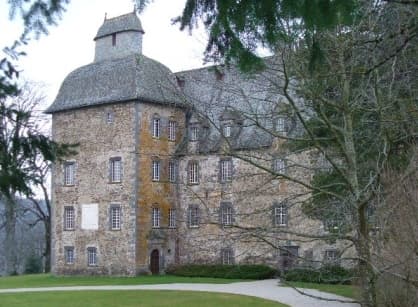
Conros Castle
Conros Castle, also known as Château de Conros, is a notable high medieval hill castle located east of the village of Crespiat in the Cantal department of France. Perched strategically on a height overlooking a medieval bridge spanning the Cère river, the castle's origins trace back to the early 12th century when an earlier fortress, known as Montal Castle, occupied the site.
The origins and medieval construction of Conros Castle
The original castle mentioned in early records was referred to as Montal Castle. During the 12th century, ownership passed to Astorg I d'Orlhac, a noble whose family name later evolved to d'Aurillac. It was under his descendant, Astorg II d'Aurillac, that the present castle was constructed shortly before the year 1230. This construction marked the establishment of the castle under the name Conros that it retains to this day.
The castle's location provided a commanding view over the surrounding landscape, especially the vital river crossing, serving both defensive and administrative purposes. The architecture from this period reflects typical high medieval fortification features, including robust stone walls, defensive towers, and a strategic placement on elevated terrain to maximize visibility and defense.
Ownership transitions and architectural evolution
Conros Castle remained in the hands of the d'Aurillac family until 1443, when it passed to the Courcelle family through marriage. Over the following centuries, the castle changed ownership multiple times, often through marital alliances or sales, reflecting the common practice among noble families to consolidate power and property.
In 1570, during the turbulent period of the French Wars of Religion, the castle was unexpectedly seized by Protestant troops while its owner, Rigaud de Saint-Martial, was absent. The castle suffered significant damage during this assault, indicative of the widespread destruction many such fortresses endured during the religious conflicts of 16th-century France.
Following this event, Conros Castle underwent various modifications throughout the 17th century. These alterations likely included updates to its defensive structures and residential quarters, adapting the medieval fortress to changing military technologies and domestic needs of the period.
Later history and restoration efforts
In 1777, the castle entered the possession of the Humières family by marriage. The late 19th century saw the castle become the home of Robert d'Humières, a distinguished writer and translator known for his French translations of Rudyard Kipling's works. His residence at Conros Castle adds a layer of cultural significance to the site beyond its military and architectural heritage.
After Robert d'Humières' death in 1914 during World War I, the castle was left abandoned for several decades. This period of neglect led to vandalism and deterioration, threatening the castle's survival. The castle was at risk of falling into complete ruin until it was purchased in 1971 by Robert's granddaughter, Maud, and her husband, Alain Mongon. Their dedicated restoration efforts revived Conros Castle, preserving its historical fabric and architectural character.
Architectural features and current condition
Conros Castle is classified as a hill castle, taking advantage of elevated terrain for defense. Its construction in the 12th century places it firmly within the high medieval period. The castle's architecture exhibits typical medieval defensive elements such as stone curtain walls, towers, and a strategic position overseeing the river crossing.
Throughout its history, the castle has been heavily modified, especially in the 17th century, reflecting shifts in architectural styles and military technology. Despite periods of damage and neglect, the castle today is restored and maintained, allowing visitors to experience its historical ambiance and architectural complexity.
Visiting Conros Castle today
Currently, Conros Castle is open to the public for visits, typically for a fee. It offers visitors a chance to explore a medieval fortress with a layered history, from its early 12th-century origins through its Renaissance modifications and 20th-century restoration. The castle's connection to Robert d'Humières adds a unique cultural dimension, attracting those interested in literary history as well as medieval architecture.
Visitors should check opening times in advance, as the castle has experienced temporary closures, such as during health-related restrictions. The site provides an engaging experience with its scenic location, historical significance, and well-preserved structures.
Frequently asked questions (FAQ)
- How do I visit Conros Castle?
- Conros Castle is open to visitors for a fee, but it is advisable to check current opening hours in advance as they can vary due to special circumstances. The castle offers guided tours that showcase its medieval architecture and history.
- What is the historical significance of Conros Castle?
- Conros Castle dates back to the 12th century and played an important role in regional defense and administration. It also has cultural significance as the home of writer Robert d'Humières, known for translating Rudyard Kipling's works into French.
- When was Conros Castle built?
- The present Conros Castle was constructed shortly before 1230 by Astorg II d'Aurillac, although an earlier castle existed on the site in the early 12th century.
- Can I learn about the architectural styles of Conros Castle during my visit?
- Yes, visitors can observe the castle's high medieval defensive features, including stone walls and towers, as well as later modifications from the 17th century that reflect evolving architectural styles.
- Is Conros Castle accessible to people with mobility issues?
- Due to its medieval hilltop location and historic construction, accessibility may be limited for visitors with mobility challenges. It is recommended to contact the castle management for specific accessibility information before planning your visit.

Information
Address
Allée de Château, Arpajon-sur-Cère, France
Loading map...
Visitor reviews
No reviews yet. Been here? Write the first review and help other travelers!
Write the first reviewVisited this castle? Share your experience
Your review helps other travelers and adds first-hand knowledge to our encyclopedia.



