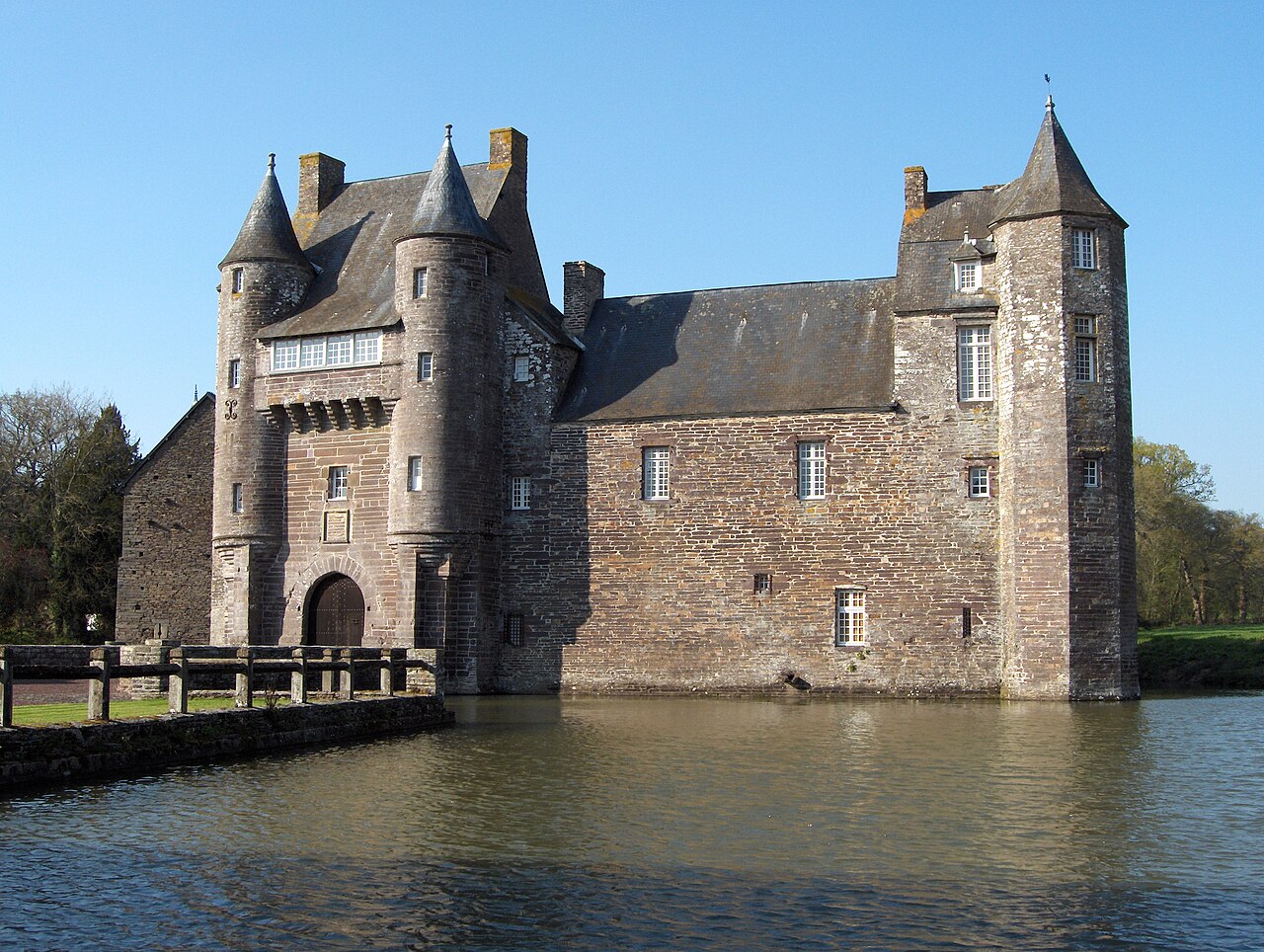
Comper Castle

Comper Castle: medieval fortress and Arthurian legend site in Brittany
Concoret, France
High Medieval (11th–13th c.)

Comper Castle, or Château de Comper, is a historic medieval fortress located near the village of Concoret in the Morbihan department of Brittany, France. Nestled at the western edge of the legendary Paimpont forest, traditionally identified with the mythical Brocéliande forest of Arthurian legend, the castle occupies a strategic position overlooking a large pond that once fed its defensive moats. This pond is famously associated with the mythic Lady of the Lake, adding a layer of cultural and legendary significance to the site.

The earliest recorded mention of Comper Castle dates back to 868 AD, when it was reportedly the residence of Salomon, King of Brittany. The castle's documented history begins in earnest in the High Medieval period, particularly in the 13th century, when it was recognized as one of the most formidable fortresses in Upper Brittany. Its robust fortifications and natural defenses made it a coveted stronghold, leading to numerous battles and sieges over the centuries.

Medieval origins and strategic importance

Comper Castle was originally constructed atop a natural foundation of red schist rock, which enhanced its defensive capabilities. The castle's layout was a classic example of medieval military architecture, featuring a roughly square plan with four corner towers connected by thick curtain walls. These walls were punctuated by narrow arrow slits (meurtrières) that allowed defenders to repel attackers while remaining protected. The main entrance was fortified with a drawbridge over a moat, a portcullis, and a pointed arch doorway, all designed to withstand prolonged sieges.

Water defenses played a critical role in the castle's security. It was surrounded on three sides by a large pond, known locally as the lake of Diane, and two deep moats carved into the living rock, approximately ten meters wide. These natural and man-made features effectively isolated the castle, making it accessible only by a single road and giving it an almost island-like character.

Historical conflicts and ownership changes

Throughout its history, Comper Castle changed hands among several noble families, including the Barons of Gaël-Montfort, the Counts of Laval, the Rieux family, the Coligny family, and the La Trémoille family. Its strategic importance made it a focal point during key regional conflicts.

In 1370, the castle was severely damaged by the forces of Bertrand du Guesclin, a celebrated Breton knight and later Constable of France. Despite this devastation, the fortress was quickly rebuilt, underscoring its military value. By the late 15th century, under the rule of Duke Guy XIV de Laval, Comper was the site of the charte des usements et coutumes de Brécilien (charter of uses and customs of Brécilien), an important document regulating the division and management of the surrounding forest, further linking the castle to the legendary Brocéliande.

The castle's most dramatic episode occurred during the French Wars of Religion in the late 16th century. In 1595, Comper was held by the forces of the Duke of Mercœur, leader of the Catholic League. The castle withstood a month-long siege by troops loyal to King Henry IV, but was eventually captured through a ruse by royalist soldiers. In retaliation, Henry IV ordered the castle's fortifications dismantled in 1598, effectively ending its role as a military stronghold and transforming it into a manor house.

Decline, restoration, and modern use

During the French Revolution in 1790, part of the Renaissance manor house on the site was burned down by revolutionaries, leaving the castle in ruins. The 19th century saw a revival when Armand de Charette rebuilt the manor house within the medieval enclosure, incorporating numerous chimneys and timber roofing characteristic of the period. His initials remain visible on several mantelpieces, marking his contribution to the site's restoration.

Today, Comper Castle is classified as a monument historique by the French Ministry of Culture, recognizing its architectural and historical significance. While the medieval remains are not open to the public, the restored château houses the Centre de l’Imaginaire Arthurien, a cultural center dedicated to exhibitions on Arthurian legends and local folklore. Visitors can explore the grounds, including the dry moat and the surrounding forest, immersing themselves in the rich tapestry of history and myth that defines Comper.

Architectural features and archaeological context

The castle's original medieval structure featured large interior rooms with wide fireplaces and square stone mullioned windows set deep within thick walls that included built-in seating, reflecting a balance between defense and domestic comfort. The surviving curtain walls and towers, including the prominent tour Gaillarde, provide a tangible sense of the castle's former strength.

Archaeological investigations in the vicinity have uncovered alignments of prehistoric menhirs, indicating that the site has been of human significance long before the castle's construction. This adds a layer of prehistoric cultural heritage to the already rich medieval and Renaissance history of Comper.

The castle's dry moat and remnants of water defenses remain visible today, although the moat no longer holds water. The surrounding forest and pond continue to evoke the legendary atmosphere that has inspired countless stories and myths, particularly those related to the Arthurian cycle.

Frequently asked questions (FAQ)

What are the opening hours of Comper Castle?
Comper Castle is open to visitors from April to October, typically from 10 AM to 6 PM. During the off-season, it may have reduced hours, so it's advisable to check the official website or contact them for the most accurate information.
How do I get to Comper Castle?
Comper Castle is located in Concoret, France, and can be accessed by car or public transport. The nearest major city is Rennes, from which you can take a regional train or bus to reach Concoret.
Is it possible to take guided tours of Comper Castle?
Yes, guided tours are available at Comper Castle, providing visitors with insights into its rich history and architectural features. These tours usually run at scheduled times throughout the day, so it's best to check in advance for availability.
When was Comper Castle built?
Comper Castle dates back to the 12th century and has been a significant historical site ever since. Its architecture reflects the medieval style, with various renovations over the centuries that showcase its evolution.
Can I bring my children to Comper Castle?
Absolutely! Comper Castle is family-friendly, and children will enjoy exploring the grounds and learning about its history. There are often activities and educational programs designed for younger visitors.
What is the historical significance of Comper Castle?
Comper Castle played an essential role in the defense and governance of the region during the medieval period. It is closely associated with local legends, particularly those involving the Arthurian tales, making it a culturally significant landmark.
Are there any nearby attractions to visit when at Comper Castle?
Yes, there are several attractions in the vicinity, including the beautiful Brocéliande Forest and the charming village of Paimpont. These sites complement your visit to the castle and offer opportunities for hiking, picnicking, and exploring nature.
What are the ticket prices for Comper Castle?
Ticket prices for Comper Castle vary, with discounts available for children, students, and seniors. It's recommended to check the official website for the most current pricing and any special offers that may be available.
Is Comper Castle accessible for visitors with disabilities?
Comper Castle strives to be accessible for all visitors, including those with disabilities. There are facilities and accommodations in place to assist with mobility, but it's advisable to contact the castle in advance to ensure a comfortable visit.

Information

Hill Castle

Sources & official resources

Verify the information above using these authoritative references.

Loading map...

Visitor reviews

No reviews yet. Been here? Write the first review and help other travelers!

Write the first review

Visited this castle? Share your experience

Your review helps other travelers and adds first-hand knowledge to our encyclopedia.

Write a review

(5/5)

0/2000 characters

Your review will be visible after admin approval

Nearby castles

9 km

Château de Boutavent Ruins

Iffendic, France

Château de Boutavent is a historic medieval fortress located in Iffendic, France, perched on a rocky outcrop surrounded by dense forest and near a pond. While the castle is believed to have been constructed in the 11th century, no direct written records confirm its exact founding date. The site is enveloped in local legend linking it to the 7th century, when it is said to have been the residence of Judicaël, King of Domnonée, an early Breton ruler. According to tradition, this castle was the meeting place of Judicaël and Saint Éloi, who was sent as a mediator to resolve border conflicts between the Bretons and the French. Although this legend adds cultural depth, archaeological evidence firmly dates the castle’s occupation to the High medieval period, particularly from the late 12th century onward. The castle is historically significant as a feudal stronghold within the Duchy of Brittany. During the 13th and 14th centuries, it was owned by the powerful Lords of Montfort, who controlled a network of fortifications in the region, including nearby castles such as Comper, Montfort, Montauban, and Gaël. These castles collectively served to maintain territorial control and defense during a period marked by frequent conflicts and shifting alliances. Historical context and ownership The Lords of Montfort were among the most influential noble families in Brittany during the medieval era. Their possession of Château de Boutavent underscores its strategic importance in regional defense and governance. The castle’s location atop a natural rocky spur provided a commanding view of the surrounding landscape, enabling early warning of approaching enemies and control over nearby routes. Despite its prominence, detailed historical records about Château de Boutavent are sparse. The castle’s decline began by the 16th century, when it was already noted as a ruin. The exact circumstances of its destruction remain uncertain. Historians hypothesize that its dismantling may have occurred during the War of Succession of Brittany in the late 14th century or during the military campaigns of Bertrand du Guesclin in 1373, who led French forces in Brittany. However, there is no definitive proof that the castle was completely abandoned immediately following these events, leaving room for speculation about intermittent habitation or use. Architectural layout and fortifications The castle’s remains cover an area exceeding two hectares and are divided into two primary sections: the haute-cour (upper courtyard) and the basse-cour (lower courtyard or barnyard), separated by a deep defensive ditch or moat. This separation was a common medieval defensive feature, complicating direct assaults and providing layered protection. Significant portions of the curtain walls around the lower courtyard remain intact, showcasing the castle’s robust defensive design. These stone walls once enclosed the main living and working areas, reinforced to withstand sieges. Alongside these walls are the ruins of several buildings, which are believed to have served as guesthouses or auxiliary quarters. Archaeological evidence reveals internal partition walls, indicating subdivided rooms likely used for accommodation or storage. Defensive structures and archaeological discoveries Excavations conducted since 2006 have uncovered key defensive elements, including a gate tower at the main entrance, which controlled access and served as a strongpoint against attackers. Adjacent to this was a flanking tower, designed to provide lateral defense and surveillance over the approaches to the castle. Additional findings include three splayed openings in the northeast curtain wall. These openings, wider on the inside than outside, allowed archers to cover a broad firing angle while remaining protected. A possible postern gate, a small secondary door, was also identified, providing a discreet exit or entry route for defenders or messengers. Material remains recovered during restoration and excavation include fragments of ceramic, glazed tiles, slate roofing materials, and floor pavements. These artifacts reflect the castle’s domestic life and its architectural sophistication. Subtle reliefs and foundation traces have enabled archaeologists to reconstruct the layout of additional buildings and defensive features such as arrow slits, narrow vertical openings used by archers. Cultural significance and preservation efforts Interest in Château de Boutavent was revived in the 19th century by local writers such as Poignand, Vigoland, and Oresve, who documented the ruins and preserved oral histories. Their writings provide valuable insights into the castle’s past and regional folklore, despite the limited archival records. Since 2006, systematic campaigns to consolidate and stabilize the ruins have been undertaken. These efforts aim to prevent further deterioration and to facilitate archaeological research. The castle has not yet undergone extensive archaeological excavation, leaving much of its history and structure to be uncovered in the future. Today, Château de Boutavent stands as an evocative ruined hill castle, offering visitors a glimpse into medieval fortification design and Breton feudal history. Its remains provide a tangible connection to the region’s turbulent past and the noble families who shaped it. Visiting château de boutavent The castle’s location in the Hauts-de-France region, near the town of Iffendic, makes it accessible for visitors interested in medieval architecture and history. While the site is primarily ruins, the visible defensive walls and archaeological features offer an engaging experience for history enthusiasts and hikers exploring the surrounding natural landscape. Visitors should prepare for uneven terrain and limited facilities, as the site remains largely undeveloped for tourism. The castle’s evocative setting amid forest and rocky outcrops enhances its atmosphere and provides opportunities for photography and exploration.

High Medieval (11th–13th c.)
Details
12.9 km
Trécesson Castle — France castle

Trécesson Castle

Campénéac, France

Trécesson Castle, known in French as Château de Trécesson, is a remarkable example of a medieval water castle located near the village of Campénéac in the Morbihan department of Brittany, France. Nestled on a man-made island and surrounded by a moat, the castle's imposing reddish schist walls reflect beautifully in the waters encircling it, creating a striking visual impression that complements its defensive design. This castle's history spans several centuries, intertwining with noble families and regional power struggles, making it a significant cultural and architectural landmark in Brittany. The earliest mention of the site dates back to the 8th century, when it served as the seat of the Lords of Ploërmel and Campénéac. Although the original fortifications from this early period have not survived, the documented lineage of the Trécesson family begins in the 13th century, with Jean de Trécesson as a notable early figure. His grandson rose to prominence as the Constable of Brittany in the 14th century, reflecting the family's growing influence in the region. The current castle structure is believed to have been constructed around the late 14th or early 15th century, likely commissioned by Jean de Trécesson, who was chamberlain to John IV, Duke of Brittany. Historical lineage and ownership Around 1440, the castle's ownership transitioned through marriage when the last heiress of the Trécesson family, Jeanne de Trécesson, married Éon de Carné. The Carné family adopted the Trécesson name and undertook significant rebuilding and expansion of the castle, enhancing its defensive and residential features. The Carné-Trécesson family maintained possession of the estate until 1773, when it passed by marriage to the Le Preste de Châteaugiron family through Agathe de Trécesson and René-Joseph Le Preste. During the turbulent years of the French Revolution, specifically in 1793, the castle served as a refuge for Jacques Defermon, a Girondist deputy who hid there for over a year during the Reign of Terror. Following the revolution, the castle was repurposed as an agricultural school between 1814 and 1830, reflecting the changing social and political landscape of France. Subsequent ownership passed through several families, including the Perrien de Crenan, Montesquieu, and Prunelé families. The Prunelé family retained ownership into the 21st century until the château was sold in April 2022. Recognizing its cultural and historical importance, French authorities designated Trécesson Castle as a historic monument in 1922, with protections later extended to its surrounding grounds and estate. Architectural features and layout Trécesson Castle is a prime example of a water castle—a fortified residence surrounded by water for defensive purposes. The castle is situated on a man-made island and is encircled by a moat, originally accessed by a drawbridge now replaced by a fixed bridge. The main entrance is guarded by a fortified gatehouse flanked by two narrow towers on corbelling, connected by a gallery equipped with machicolations—openings that allowed defenders to drop projectiles or boiling substances on attackers below. The castle's exterior features a long, almost windowless wall with a steep slate roof that terminates in a distinctive hexagonal corner tower. This tower houses a vaulted chamber richly decorated with a mural depicting the medieval tale "The Loves of Renaud and Armide". This chamber is believed to have been a former bathhouse or étuve, indicating the castle's provision for comfort alongside defense. Within the trapezoidal inner courtyard, the corps de logis (main residential building) dates in part from the 18th century, reflecting later modifications. Opposite the corps de logis are domestic buildings, including a 15th-century seigneurial chapel and a watchtower on the exterior facade. Historically, a stone wall enclosed the northern edge of the courtyard, later removed to provide direct access to the water via a second bridge. Additional estate structures include an annex with a pointed (ogival) arch door and window, adorned with carved motifs such as animals and the fleur-de-lys, connected to a rectangular agricultural building. One of the castle's unique features is the presence of approximately 1,800 boulins—specialized nesting holes built into the walls to house pigeons. These were managed with a large pivoting ladder to collect eggs and maintain the nests, illustrating the castle's self-sufficiency and economic activities. Cultural significance and preservation Trécesson Castle stands as a testament to the evolution of medieval fortifications in Brittany, blending military architecture with residential comfort. Its water defenses, robust gatehouse, and towers exemplify the strategic design principles of the late medieval period. The castle's continuous occupation and adaptation through centuries highlight its importance as a noble residence and local power center. Today, the castle remains a private residence and is not open to the public, but it can be admired from nearby public roads. The preservation of its original defensive features alongside later additions offers valuable insights into the architectural and social history of the region. The castle's designation as a historic monument ensures its protection and underscores its significance within the cultural heritage of Brittany and France. Visitors and scholars alike are drawn to the castle's picturesque setting, architectural integrity, and rich history. Its moat, towers, chapel, and murals contribute to a comprehensive understanding of medieval noble life and defensive strategies. Trécesson Castle remains an iconic symbol of Brittany's feudal past and architectural legacy.

Late Medieval (14th–15th c.)
Details
15.3 km

Castle of Trecesson

Campeneac, France

The Castle of Trecesson stands as a remarkable example of high medieval military architecture in the heart of Brittany, France. Constructed in the 13th century, this castle is renowned for its distinctive reddish schist walls that majestically reflect in the waters of the surrounding moat, creating a striking visual impression that has captivated visitors and historians alike. Architectural features and defensive structures The castle is strategically designed with an imposing gatehouse that serves as the main entrance, approached via a sturdy bridge spanning the moat. This entrance is fortified by two narrow towers on corbelling, which are linked by an ancient gallery equipped with machicolations. These machicolations, characteristic of medieval fortifications, allowed defenders to drop projectiles or boiling substances on attackers below, emphasizing the castle's defensive purpose. The reddish schist stone used in the construction not only provides a unique aesthetic but also reflects the local geology and building traditions of Brittany. The walls are thick and robust, designed to withstand sieges and assaults common during the turbulent medieval period. Historical context and significance Built during the high medieval period, the Castle of Trecesson played a significant role in the regional power dynamics of Brittany. Its construction coincided with a time of frequent conflicts, including feudal disputes and external threats, necessitating strong defensive structures. The castle's location in Campeneac allowed it to control important routes and assert the authority of its owners. Throughout its history, the castle has witnessed various phases of occupation and alterations, reflecting the evolving military and residential needs of its inhabitants. Despite these changes, the core medieval features have been preserved, offering valuable insights into the architectural and social history of the region. Preservation and cultural heritage The Castle of Trecesson has been officially recognized for its historical and architectural importance, having been listed as a monument historique by the French Ministry of Culture since 1922. This designation helps ensure the protection and conservation of the castle's unique features for future generations. Visitors to the site can appreciate the castle's well-preserved defensive elements and its picturesque setting, which together convey the atmosphere of medieval Brittany. The castle remains a significant cultural landmark, attracting historians, architects, and tourists interested in medieval fortifications and Breton heritage. Surroundings and visitor experience Surrounded by a tranquil lake, the castle's reflection in the water enhances its romantic and mysterious aura. The moat not only served defensive purposes but also contributes to the scenic beauty of the site today. The approach via the bridge and gatehouse offers an immersive experience into medieval fortification design. The castle's location in the rural landscape of Campeneac provides visitors with opportunities to explore the natural environment alongside the historical monument. The site is accessible to the public, allowing for educational visits and cultural appreciation. Architectural details of the gatehouse and towers The gatehouse is particularly notable for its narrow towers, which are raised on corbels, a medieval architectural technique that projects the upper parts of the towers beyond the lower walls. This design improved defensive capabilities by allowing defenders to observe and attack enemies at the base of the walls more effectively. The connecting gallery above the gatehouse, equipped with machicolations, is a rare surviving feature that exemplifies the castle's military architecture. These openings in the floor of the gallery were used to defend the entrance without exposing the defenders to direct attack. Materials and construction techniques The use of reddish schist stone is significant both aesthetically and structurally. Schist is a metamorphic rock that splits into thin layers, which was skillfully employed in the castle's walls to create durable and weather-resistant fortifications. The masonry work reflects the craftsmanship of medieval builders in Brittany. Legacy and influence The Castle of Trecesson remains an important example of medieval fortification in Brittany, illustrating the region's historical conflicts and architectural responses. Its preservation allows scholars to study medieval defensive strategies and building methods. The castle also contributes to the cultural identity of Campeneac and serves as a symbol of Breton heritage. Today, the castle continues to inspire interest in medieval history and architecture, drawing visitors who seek to experience the ambiance of a fortified stronghold from the high medieval era.

High Medieval (11th–13th c.)
Details