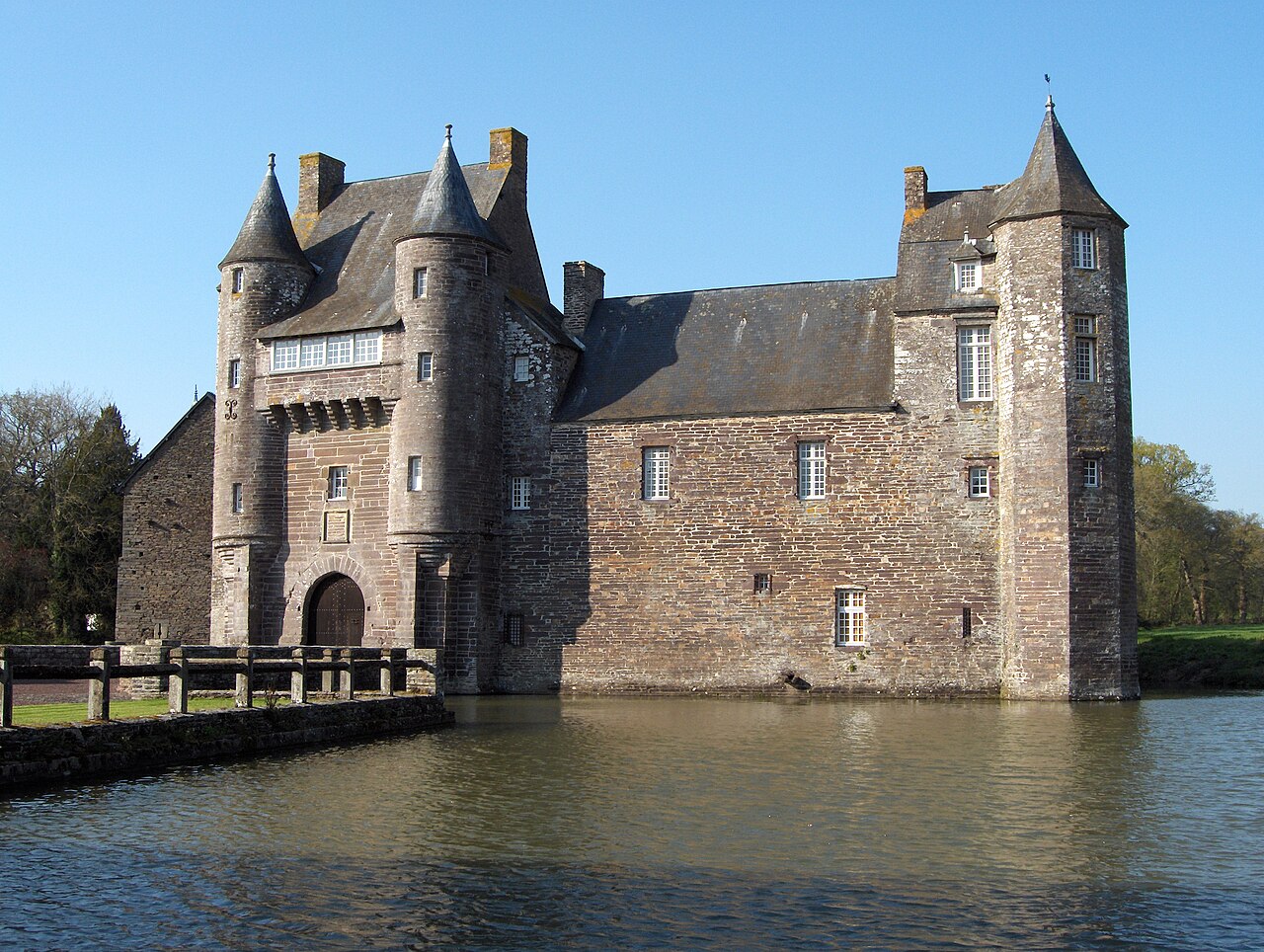
Castle of Trecesson
The Castle of Trecesson stands as a remarkable example of high medieval military architecture in the heart of Brittany, France. Constructed in the 13th century, this castle is renowned for its distinctive reddish schist walls that majestically reflect in the waters of the surrounding moat, creating a striking visual impression that has captivated visitors and historians alike.
Architectural features and defensive structures
The castle is strategically designed with an imposing gatehouse that serves as the main entrance, approached via a sturdy bridge spanning the moat. This entrance is fortified by two narrow towers on corbelling, which are linked by an ancient gallery equipped with machicolations. These machicolations, characteristic of medieval fortifications, allowed defenders to drop projectiles or boiling substances on attackers below, emphasizing the castle's defensive purpose.
The reddish schist stone used in the construction not only provides a unique aesthetic but also reflects the local geology and building traditions of Brittany. The walls are thick and robust, designed to withstand sieges and assaults common during the turbulent medieval period.
Historical context and significance
Built during the high medieval period, the Castle of Trecesson played a significant role in the regional power dynamics of Brittany. Its construction coincided with a time of frequent conflicts, including feudal disputes and external threats, necessitating strong defensive structures. The castle's location in Campeneac allowed it to control important routes and assert the authority of its owners.
Throughout its history, the castle has witnessed various phases of occupation and alterations, reflecting the evolving military and residential needs of its inhabitants. Despite these changes, the core medieval features have been preserved, offering valuable insights into the architectural and social history of the region.
Preservation and cultural heritage
The Castle of Trecesson has been officially recognized for its historical and architectural importance, having been listed as a monument historique by the French Ministry of Culture since 1922. This designation helps ensure the protection and conservation of the castle's unique features for future generations.
Visitors to the site can appreciate the castle's well-preserved defensive elements and its picturesque setting, which together convey the atmosphere of medieval Brittany. The castle remains a significant cultural landmark, attracting historians, architects, and tourists interested in medieval fortifications and Breton heritage.
Surroundings and visitor experience
Surrounded by a tranquil lake, the castle's reflection in the water enhances its romantic and mysterious aura. The moat not only served defensive purposes but also contributes to the scenic beauty of the site today. The approach via the bridge and gatehouse offers an immersive experience into medieval fortification design.
The castle's location in the rural landscape of Campeneac provides visitors with opportunities to explore the natural environment alongside the historical monument. The site is accessible to the public, allowing for educational visits and cultural appreciation.
Architectural details of the gatehouse and towers
The gatehouse is particularly notable for its narrow towers, which are raised on corbels, a medieval architectural technique that projects the upper parts of the towers beyond the lower walls. This design improved defensive capabilities by allowing defenders to observe and attack enemies at the base of the walls more effectively.
The connecting gallery above the gatehouse, equipped with machicolations, is a rare surviving feature that exemplifies the castle's military architecture. These openings in the floor of the gallery were used to defend the entrance without exposing the defenders to direct attack.
Materials and construction techniques
The use of reddish schist stone is significant both aesthetically and structurally. Schist is a metamorphic rock that splits into thin layers, which was skillfully employed in the castle's walls to create durable and weather-resistant fortifications. The masonry work reflects the craftsmanship of medieval builders in Brittany.
Legacy and influence
The Castle of Trecesson remains an important example of medieval fortification in Brittany, illustrating the region's historical conflicts and architectural responses. Its preservation allows scholars to study medieval defensive strategies and building methods. The castle also contributes to the cultural identity of Campeneac and serves as a symbol of Breton heritage.
Today, the castle continues to inspire interest in medieval history and architecture, drawing visitors who seek to experience the ambiance of a fortified stronghold from the high medieval era.
Frequently asked questions (FAQ)
- What is the best way to reach the Castle of Trecesson?
- The Castle of Trecesson is located in Campeneac, Brittany, and can be reached by car via local roads. Public transportation options are limited, so driving is recommended for visitors.
- When was the Castle of Trecesson built?
- The Castle of Trecesson was constructed in the 13th century during the high medieval period, reflecting the architectural styles and defensive needs of that era.
- Is the Castle of Trecesson open to the public for visits?
- While the castle is a protected historic monument, public access may be limited or subject to specific visiting hours. It is advisable to check local tourism resources for current visitor information.
- What are the notable architectural features of the Castle of Trecesson?
- Notable features include the reddish schist walls, the gatehouse with two narrow towers on corbelling, the bridge over the moat, and the gallery with machicolations above the entrance.
- Why is the Castle of Trecesson significant in Brittany's history?
- The castle is significant as a well-preserved example of high medieval military architecture in Brittany, illustrating the region's feudal conflicts and defensive strategies.
Information
Website
Visit websiteSources & official resources
Verify the information above using these authoritative references.
Loading map...
Visitor reviews
No reviews yet. Been here? Write the first review and help other travelers!
Write the first reviewVisited this castle? Share your experience
Your review helps other travelers and adds first-hand knowledge to our encyclopedia.