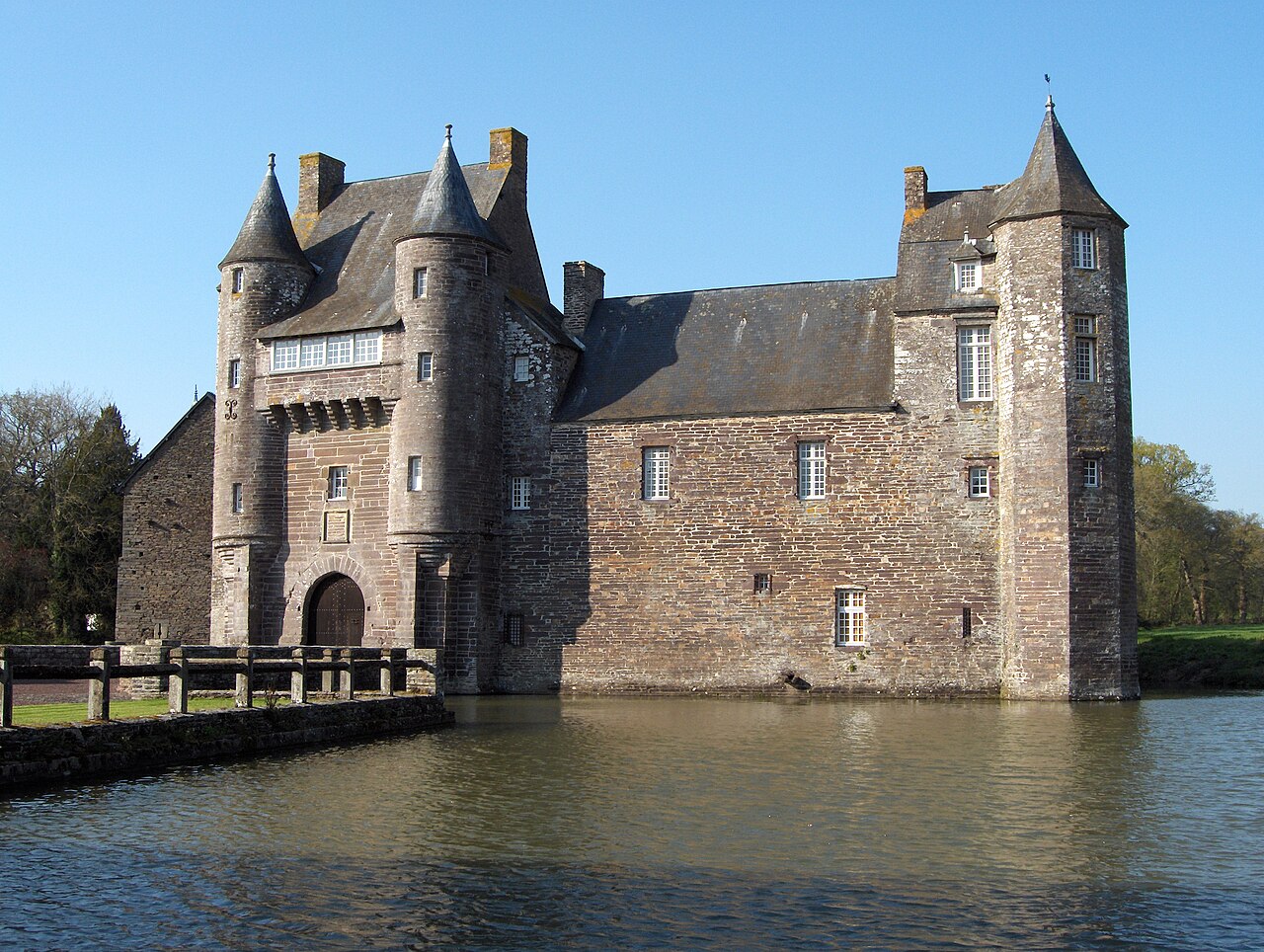
Château de Boutavent Ruins
Château de Boutavent is a historic medieval fortress located in Iffendic, France, perched on a rocky outcrop surrounded by dense forest and near a pond. While the castle is believed to have been constructed in the 11th century, no direct written records confirm its exact founding date. The site is enveloped in local legend linking it to the 7th century, when it is said to have been the residence of Judicaël, King of Domnonée, an early Breton ruler. According to tradition, this castle was the meeting place of Judicaël and Saint Éloi, who was sent as a mediator to resolve border conflicts between the Bretons and the French. Although this legend adds cultural depth, archaeological evidence firmly dates the castle’s occupation to the High medieval period, particularly from the late 12th century onward.
The castle is historically significant as a feudal stronghold within the Duchy of Brittany. During the 13th and 14th centuries, it was owned by the powerful Lords of Montfort, who controlled a network of fortifications in the region, including nearby castles such as Comper, Montfort, Montauban, and Gaël. These castles collectively served to maintain territorial control and defense during a period marked by frequent conflicts and shifting alliances.
Historical context and ownership
The Lords of Montfort were among the most influential noble families in Brittany during the medieval era. Their possession of Château de Boutavent underscores its strategic importance in regional defense and governance. The castle’s location atop a natural rocky spur provided a commanding view of the surrounding landscape, enabling early warning of approaching enemies and control over nearby routes.
Despite its prominence, detailed historical records about Château de Boutavent are sparse. The castle’s decline began by the 16th century, when it was already noted as a ruin. The exact circumstances of its destruction remain uncertain. Historians hypothesize that its dismantling may have occurred during the War of Succession of Brittany in the late 14th century or during the military campaigns of Bertrand du Guesclin in 1373, who led French forces in Brittany. However, there is no definitive proof that the castle was completely abandoned immediately following these events, leaving room for speculation about intermittent habitation or use.
Architectural layout and fortifications
The castle’s remains cover an area exceeding two hectares and are divided into two primary sections: the haute-cour (upper courtyard) and the basse-cour (lower courtyard or barnyard), separated by a deep defensive ditch or moat. This separation was a common medieval defensive feature, complicating direct assaults and providing layered protection.
Significant portions of the curtain walls around the lower courtyard remain intact, showcasing the castle’s robust defensive design. These stone walls once enclosed the main living and working areas, reinforced to withstand sieges. Alongside these walls are the ruins of several buildings, which are believed to have served as guesthouses or auxiliary quarters. Archaeological evidence reveals internal partition walls, indicating subdivided rooms likely used for accommodation or storage.
Defensive structures and archaeological discoveries
Excavations conducted since 2006 have uncovered key defensive elements, including a gate tower at the main entrance, which controlled access and served as a strongpoint against attackers. Adjacent to this was a flanking tower, designed to provide lateral defense and surveillance over the approaches to the castle.
Additional findings include three splayed openings in the northeast curtain wall. These openings, wider on the inside than outside, allowed archers to cover a broad firing angle while remaining protected. A possible postern gate, a small secondary door, was also identified, providing a discreet exit or entry route for defenders or messengers.
Material remains recovered during restoration and excavation include fragments of ceramic, glazed tiles, slate roofing materials, and floor pavements. These artifacts reflect the castle’s domestic life and its architectural sophistication. Subtle reliefs and foundation traces have enabled archaeologists to reconstruct the layout of additional buildings and defensive features such as arrow slits, narrow vertical openings used by archers.
Cultural significance and preservation efforts
Interest in Château de Boutavent was revived in the 19th century by local writers such as Poignand, Vigoland, and Oresve, who documented the ruins and preserved oral histories. Their writings provide valuable insights into the castle’s past and regional folklore, despite the limited archival records.
Since 2006, systematic campaigns to consolidate and stabilize the ruins have been undertaken. These efforts aim to prevent further deterioration and to facilitate archaeological research. The castle has not yet undergone extensive archaeological excavation, leaving much of its history and structure to be uncovered in the future.
Today, Château de Boutavent stands as an evocative ruined hill castle, offering visitors a glimpse into medieval fortification design and Breton feudal history. Its remains provide a tangible connection to the region’s turbulent past and the noble families who shaped it.
Visiting château de boutavent
The castle’s location in the Hauts-de-France region, near the town of Iffendic, makes it accessible for visitors interested in medieval architecture and history. While the site is primarily ruins, the visible defensive walls and archaeological features offer an engaging experience for history enthusiasts and hikers exploring the surrounding natural landscape.
Visitors should prepare for uneven terrain and limited facilities, as the site remains largely undeveloped for tourism. The castle’s evocative setting amid forest and rocky outcrops enhances its atmosphere and provides opportunities for photography and exploration.
Frequently asked questions (FAQ)
- What is the historical significance of Château de Boutavent Ruins?
- Château de Boutavent Ruins, located in Iffendic, France, dates back to the 14th century and is a remarkable example of medieval architecture. It played a crucial role in the region's history, serving as a defensive stronghold and residence for the nobility during the feudal period.
- When was Château de Boutavent built?
- Construction of Château de Boutavent began in the late 14th century, with significant modifications and expansions occurring in the following centuries. The castle's strategic location allowed it to serve as a key military and administrative site throughout its history.
- Is it possible to visit Château de Boutavent Ruins?
- Yes, visitors can explore the ruins of Château de Boutavent. The site is open to the public, allowing guests to wander through the remains and appreciate the historical significance and scenic views of the surrounding countryside.
- What are the opening hours for Château de Boutavent Ruins?
- Château de Boutavent Ruins is typically open to visitors from dawn until dusk. However, it is advisable to check for specific seasonal hours or any closures due to maintenance or special events before planning your visit.
- Can I take guided tours of Château de Boutavent?
- While there are no formal guided tours available, informative signage throughout the ruins provides valuable insights into the castle's history and architecture. Additionally, local tourist information centers may offer brochures and resources to enhance your visit.
- What is the best time to visit Château de Boutavent Ruins?
- The best time to visit Château de Boutavent is during the spring and early fall when the weather is mild and the surrounding landscape is vibrant. These seasons also tend to attract fewer crowds, allowing for a more peaceful exploration of the ruins.
- Are there any nearby attractions to visit?
- Yes, there are several nearby attractions, including the beautiful Forest of Brocéliande, known for its enchanting legends and hiking trails. The town of Iffendic also offers charming local shops and cafes to enjoy after visiting the ruins.
- What are the ticket prices for visiting Château de Boutavent?
- Visiting Château de Boutavent Ruins is free of charge, making it an accessible option for history enthusiasts and casual visitors alike. However, donations to help maintain the site are appreciated and can enhance the preservation of this historical landmark.
- How do I get to Château de Boutavent Ruins?
- Château de Boutavent Ruins is accessible by car, with parking available nearby. Public transportation options may be limited, so it is recommended to check local bus schedules or consider a taxi service if you are traveling from nearby towns or cities.
Information
Website
Visit websiteSources & official resources
Verify the information above using these authoritative references.
Loading map...
Visitor reviews
No reviews yet. Been here? Write the first review and help other travelers!
Write the first reviewVisited this castle? Share your experience
Your review helps other travelers and adds first-hand knowledge to our encyclopedia.