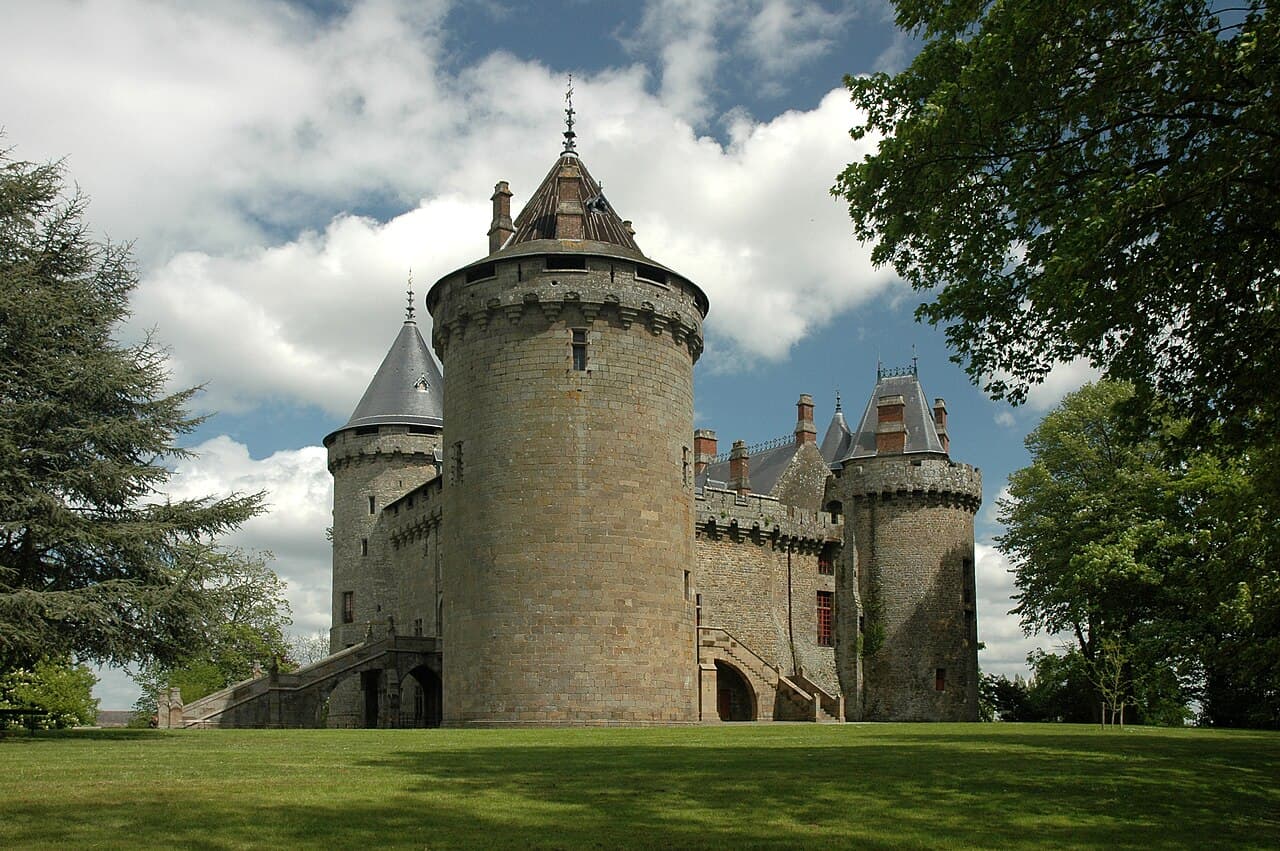
Combourg Castle
Combourg Castle stands as a formidable example of medieval fortress architecture in the heart of Brittany, France. Its origins trace back to the early 11th century, with construction beginning around 1025 under the auspices of Archbishop Guinguené. The castle was initially built to assert control and defend the region, particularly the important religious site of Dol Cathedral, and to uphold the independence of Brittany during a period marked by territorial disputes and feudal conflicts.
The castle's strategic location and robust design reflect its primary function as a military stronghold. It features four large granite buildings arranged around a rectangular courtyard, each corner fortified by a round tower with conical roofs, crenellations, and machicolations. These defensive elements are characteristic of High Medieval military architecture, designed to repel invaders and provide vantage points for archers and lookouts. The use of dressed granite not only enhanced the castle's durability but also gave it an imposing aesthetic presence in the landscape.
The architectural evolution of Combourg Castle
Significant modifications and expansions occurred between the 15th and 19th centuries, reflecting changing architectural styles and the castle's transition from purely military use to a noble residence. The castle's enduring structure includes elements from the High Medieval period while also showcasing later adaptations that accommodated residential comfort and aesthetic considerations. The restoration completed in 1876 was particularly important in preserving the castle's historical integrity and enhancing its romantic appeal.
Defensive features and layout
The castle's design incorporates traditional medieval defensive features such as crenellated battlements for protection during sieges and machicolations that allowed defenders to drop projectiles on attackers below. The round towers at each corner improved the field of vision and eliminated blind spots, a strategic advantage in medieval fortification design. The rectangular courtyard served as a central gathering space and facilitated internal communication between the different parts of the fortress.
Residential transformation and restoration
By the time the Chateaubriand family acquired the castle in 1761, it had begun to shift from a military fortress to a noble residence. The castle became the childhood home of the renowned writer and politician François-René de Chateaubriand (1768–1848), whose literary works later immortalized the castle as the "cradle of romanticism" in French literature. The 19th-century restoration led by the family sought to preserve the castle's medieval character while adapting it for modern habitation and aesthetic appreciation.
Combourg's cultural and literary significance
François-René de Chateaubriand is one of France's most celebrated literary figures, and his association with Combourg Castle greatly enhances its cultural importance. His autobiographical work, Mémoires d'Outre-Tombe, vividly describes the castle and its surroundings, contributing to the castle's reputation as a symbol of French romanticism. The castle's evocative atmosphere and historic grandeur inspired not only Chateaubriand but also subsequent generations of writers and artists who sought to capture the spirit of the romantic era.
The castle's park and gardens, designed in 1876 by the landscape architect Denis Buhler, are inspired by Chateaubriand's literary descriptions. Covering approximately 25 hectares, the park features centuries-old trees and a tranquil lake known as Lake Tranquille. This landscape design enhances the castle's romantic ambiance and offers visitors a serene environment that complements the historic architecture.
Visiting Combourg Castle today
Today, Combourg Castle remains a well-preserved monument open to the public through guided tours. Visitors can explore seven interior rooms as well as the tower walls during a typical 45-minute visit. These tours provide insight into the castle's architectural features, historical context, and its significance in French literature.
The park surrounding the castle is accessible for free tours, including walks around Lake Tranquille. Visitors are welcome to bring leashed pets, making it a family-friendly destination. The castle continues to be privately owned by descendants of the Chateaubriand family, maintaining a direct link to its storied past.
Architectural highlights and historical context
The castle's granite construction is notable for its durability and the skillful masonry work evident in the dressed stone blocks. The crenellations and machicolations are classic defensive features that highlight the castle's martial origins. The round towers with their distinctive conical roofs are typical of Breton fortifications and contribute to the castle's iconic silhouette.
Historically, the castle played a role in the defense of Brittany during the High Medieval period, a time of frequent conflicts between local lords and external forces. Its position near Dol Cathedral underscores its strategic importance in protecting ecclesiastical interests and regional autonomy.
Legacy and preservation
Combourg Castle's preservation as a well-maintained medieval fortress and its association with a major literary figure make it a unique cultural landmark. The careful restoration efforts in the 19th century and ongoing maintenance have ensured that the castle remains an enduring symbol of Brittany's history and France's literary heritage.
Frequently asked questions (FAQ)
- How do I get to Combourg Castle?
- Combourg Castle is located in the charming town of Combourg, France, easily accessible by car or public transport. If you're traveling by train, the nearest station is Combourg, which is just a short walk from the castle.
- What is the historical significance of Combourg Castle?
- Combourg Castle dates back to the 11th century and is known for its role in the history of Brittany. It was the residence of the famous writer François-René de Chateaubriand, who drew inspiration from its surroundings for his literary works.
- When was Combourg Castle built?
- Construction of Combourg Castle began in the 11th century, with significant renovations occurring in the 15th and 17th centuries. Its architecture reflects various styles that evolved over the centuries, showcasing the castle's rich history.
- Can I visit Combourg Castle year-round?
- Yes, Combourg Castle is open to visitors throughout the year, although opening hours may vary by season. It’s recommended to check the official website for the latest information on hours and any seasonal events.
- Why is the architecture of Combourg Castle unique?
- The architecture of Combourg Castle is a blend of medieval and Renaissance styles, characterized by its imposing towers and well-preserved ramparts. The castle's design offers a glimpse into the feudal past of Brittany and showcases its historical importance.
- Is it possible to take guided tours of Combourg Castle?
- Yes, guided tours are available and provide an enriching experience as you explore the castle's history and architecture. Tours are often conducted in multiple languages, making it accessible for international visitors.
- What are the ticket prices for visiting Combourg Castle?
- Ticket prices for Combourg Castle are quite reasonable, with discounts available for students and seniors. Children under a certain age may enter for free, so it's best to check the official site for detailed pricing information.
- What is the best time to visit Combourg Castle?
- The best time to visit Combourg Castle is during spring and early fall when the weather is pleasant, and the gardens are in full bloom. Additionally, visiting during weekdays may help you avoid the crowds.
- Are there any nearby attractions to Combourg Castle?
- Yes, Combourg is surrounded by beautiful landscapes and charming villages. Nearby attractions include the picturesque Lake Monténeuf and the historic town of Dinan, which is just a short drive away.
Photo gallery

Information
Website
Visit websiteSources & official resources
Verify the information above using these authoritative references.
Loading map...
Visitor reviews
No reviews yet. Been here? Write the first review and help other travelers!
Write the first reviewVisited this castle? Share your experience
Your review helps other travelers and adds first-hand knowledge to our encyclopedia.



