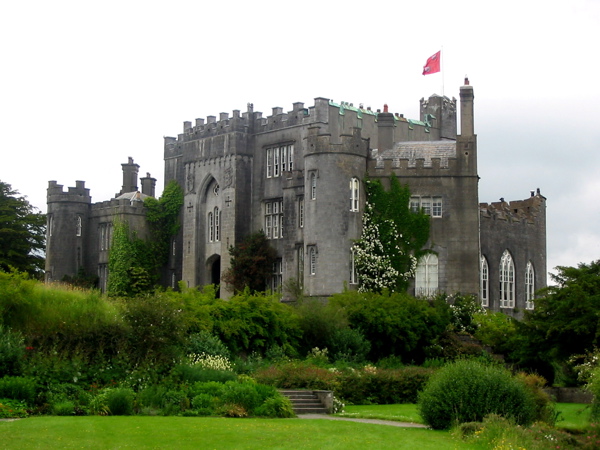
Clonony Castle
Clonony Castle stands as a remarkable example of a Tudor-period tower house in County Offaly, Ireland, embodying the architectural and historical heritage of the late medieval era. Constructed around 1500 by the Irish McCoughlan (MacCochlan) clan, the castle reflects the Gaelic lordship's authority and presence in the region during a period of significant political and social change. Its strategic location near the famous monastic site of Clonmacnoise situates it within a landscape rich in Irish cultural and historical significance.
Historical significance and ownership transitions
The castle's early history is deeply intertwined with the Gaelic Irish clans, particularly the McCoughlan family, who established it as a fortified residence to assert control over their lands. In the mid-16th century, Clonony Castle became a focal point in the broader context of English expansion and Tudor consolidation in Ireland. John Óg McCoughlan surrendered the castle and its lands to King Henry VIII, marking a pivotal shift from Gaelic to English control. Subsequently, the property was granted to Thomas Boleyn, father of Anne Boleyn, linking Clonony Castle to the English aristocracy and the Tudor court. This connection was further cemented by the residence of Mary and Elizabeth Boleyn, relatives of Queen Elizabeth I, whose graves were discovered near the castle in 1803, marked by a limestone slab inscribed with their family lineage.
The early 17th century saw another significant change in ownership following the Nine Years’ War (1594–1603), during which the McCoughlan family supported the Irish forces. Their forfeiture of the castle led to its acquisition by Matthew de Renzi, a cloth merchant from London originally from Cologne, who held the property from 1612 to around 1620. This transition illustrates the castle's role in the shifting political and economic landscape of Ireland during the early modern period.
Clonony Castle also features in the martial history recorded in the Annals of the Four Masters, which recount a battle on the lands of the Delbna involving descendants of Farrell Mac Coghlan and the Donnells. The death of James Mac Coghlan, prior of Gailinne, by a shot from Cluain Damhna (the Gaelic name for Clonony) underscores the castle's strategic military importance in local clan conflicts.
Architectural features and defensive design
Clonony Castle is a three-storey tower house approximately 15 meters tall, set within formal gardens and surrounded by a moat. Its design exemplifies key defensive features characteristic of Tudor-era fortifications in Ireland. The castle's west entrance is protected by machicolations, openings through which defenders could drop stones or boiling substances on attackers. Additional defensive elements include murder holes positioned above the doorway to repel invaders and gun loops integrated into the walls, reflecting the period's adaptation to firearms and evolving military technology.
The base of the tower is sloped, a feature intended to deflect projectiles and hinder climbing assailants. Internally, a spiral staircase connects the vaulted, fire-resistant ground-floor casemate to the upper levels. The first floor, once collapsed, has been carefully reconstructed, while the second floor retains its original barrel-vaulted ceilings, which provide both structural strength and aesthetic character.
The castle also includes a garderobe turret, a projecting chamber that served as a medieval latrine, designed to dispose of waste away from the main structure. Windows of various types—round-arched, pointed (kielbogen), and flat-lintel—are strategically placed to balance light admission with defensive needs.
Surrounding the tower is a curtain wall featuring two square corner towers. This wall, reconstructed in the 19th century, includes an entrance adorned with a coat of arms, preserving elements of the castle's original defensive complex. An additional internal building dating from the same century was likely added during restoration efforts, reflecting renewed interest in the castle's preservation and historical importance.
Clonony castle in the context of irish heritage
Today, Clonony Castle is recognized as a National Monument of Ireland, highlighting its cultural and historical significance. Its proximity to Clonmacnoise, one of Ireland's most important medieval monastic sites, enhances its appeal as a destination for visitors interested in Ireland's rich medieval past. The castle's preservation allows for an intimate exploration of Gaelic lordship, Tudor architectural innovation, and the complex interplay between Irish and English forces during a transformative period in Irish history.
Clonony Castle's layered history, from its Gaelic origins through Tudor conquest and early modern ownership changes, offers valuable insights into the social, political, and military developments that shaped Ireland. Its architectural features provide a tangible connection to the defensive strategies and domestic arrangements of tower houses, a distinctive castle type prevalent in Ireland during the late medieval and Tudor periods.
Visitor experience and accessibility
Visitors to Clonony Castle can explore the well-preserved tower house and its surrounding moat and gardens, gaining a vivid sense of the castle's defensive capabilities and residential functions. The reconstructed first floor and restored barrel vaults offer a glimpse into the castle's original interior spaces. Interpretive signage and the castle's setting near Clonmacnoise enrich the visitor experience, connecting the site to broader narratives of Irish history.
While the castle is partially restored and in good condition, visitors should be prepared for uneven surfaces and limited accessibility in some areas due to the historic nature of the structure. The site is ideal for those interested in medieval architecture, Irish history, and the Tudor period's impact on Ireland.
Frequently asked questions (FAQ)
- What is the historical significance of Clonony Castle?
- Clonony Castle is historically significant as a Tudor-era tower house built by the McCoughlan clan around 1500, reflecting Gaelic lordship and later English royal connections through the Boleyn family.
- Can I visit Clonony Castle year-round?
- Visiting hours may vary; it is best to check with local heritage authorities or the managing entity for current opening times before planning your visit.
- What defensive features does Clonony Castle have?
- The castle includes machicolations, murder holes, gun loops, a sloped base, and a moat, all designed to protect against attackers and reflect evolving military technology of the Tudor period.
- Is Clonony Castle accessible for visitors with limited mobility?
- Due to its historic structure and partial restoration, some areas may have uneven surfaces and limited accessibility; visitors with mobility concerns should plan accordingly.
- Where is Clonony Castle located in relation to other historical sites?
- Clonony Castle is near Clonmacnoise, a renowned medieval monastic site, making it part of a rich historical landscape in County Offaly.
Information
Current owner
State museum
Loading map...
Visitor reviews
No reviews yet. Been here? Write the first review and help other travelers!
Write the first reviewVisited this castle? Share your experience
Your review helps other travelers and adds first-hand knowledge to our encyclopedia.