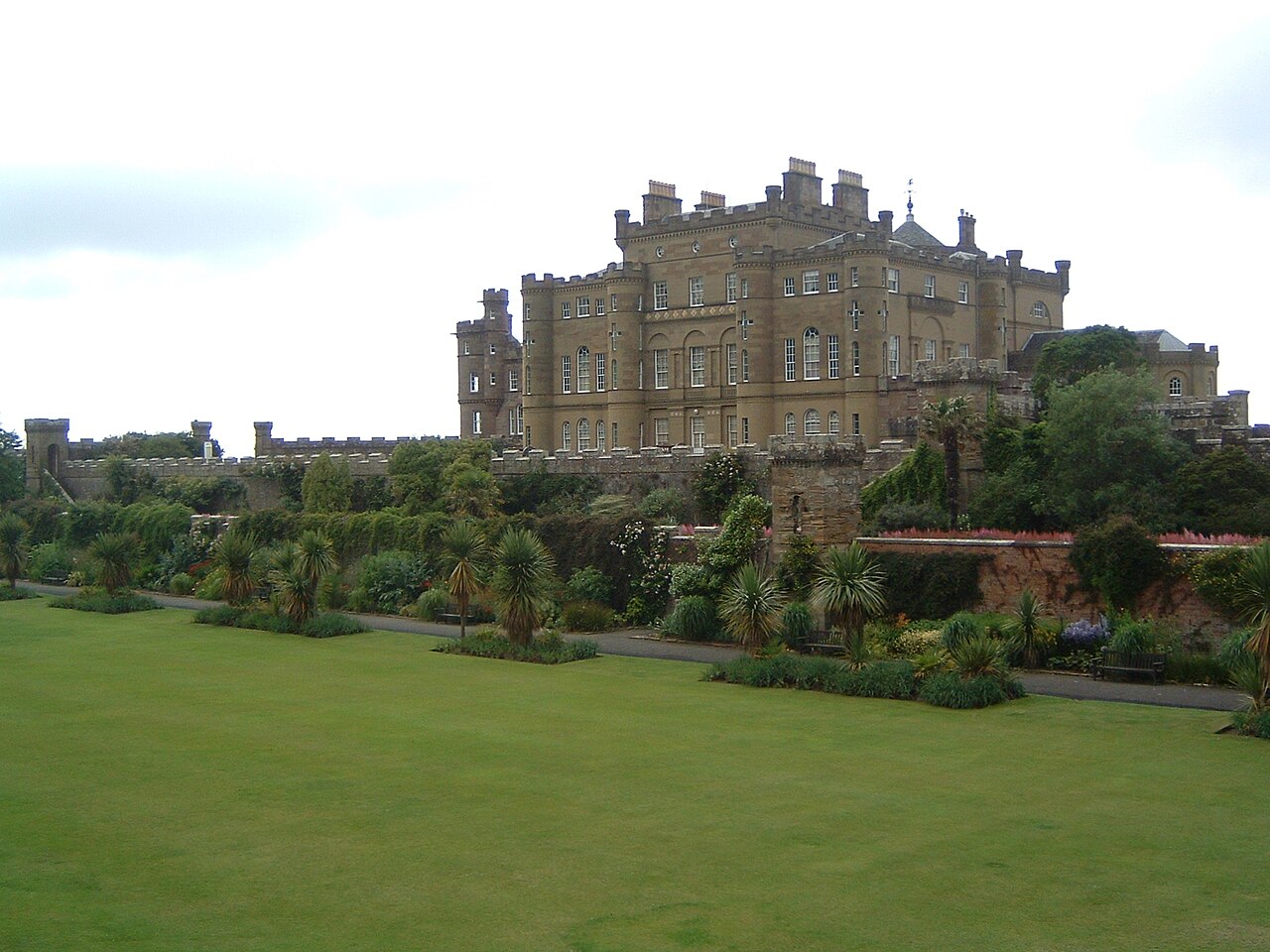
Cloncaird Castle
Cloncaird Castle stands as a remarkable example of a 16th-century fortified mansion nestled in the scenic countryside of Kirkmichael, Scotland. This historic estate embodies the architectural evolution from a feudal stronghold to a refined country house, reflecting centuries of social change and adaptation. The castle’s enduring presence beside the Kelsie Burn and within a sprawling 140-acre estate highlights its significance as both a defensive residence and a symbol of landed power.
Early history and feudal origins
The origins of Cloncaird Castle trace back to the late 1500s, firmly anchored by an armorial panel dated 1585 that remains embedded in the castle’s wall. This panel not only marks the construction period but also serves as a heraldic testament to its early owners. The castle was initially built by Scottish feudal lords, specifically the Auchendrane family, with Walter Mure as a notable figure in its early history. Mure’s involvement in the infamous murder of Sir Thomas Kennedy of Culzean underscores the turbulent political and familial rivalries characteristic of the era.
As a fortified mansion, the castle combined residential comfort with defensive features typical of the late medieval Scottish nobility. Its large square tower, accessible via a narrow spiral staircase, was designed for both defense and habitation, embodying the dual purpose of security and status. The strategic location beside a watercourse further enhanced its defensibility and provided practical resources.
Architectural evolution and 19th-century renovations
In the early 19th century, Cloncaird Castle underwent significant transformation under the ownership of Henry Ritchie of Craigton and Busbie, a prosperous Glasgow merchant. In 1814, Ritchie modernized the castle’s front façade, adapting it to contemporary tastes while preserving key historic elements such as the armorial panel. This renovation reflected the broader 19th-century Scottish architectural trends that favored refinement and aesthetic appeal over purely defensive considerations.
The estate’s ancillary structures also reveal layers of architectural history. A garage built in the Arts and Crafts style showcases early 20th-century craftsmanship ideals, emphasizing natural materials and artisanal quality. Meanwhile, a U-shaped stable block designed in a neogothic style illustrates Victorian and Edwardian enthusiasm for medieval revivalism. Together, these buildings enrich the estate’s architectural tapestry.
20th-century uses and preservation
The 20th century brought further changes to Cloncaird Castle, reflecting shifting social needs and ownership. In 1905, the castle was sold to Mrs. Dubs, who initiated extensive renovations that continued the process of adaptation and preservation. Later, from 1949, the property served as the Dubs Memorial Convalescent Home, managed by local government authorities until its closure later in the century.
Following its institutional use, the castle returned to private ownership, with Ephraim Belcher acquiring it before 2003. Throughout these transitions, the castle’s historic fabric has been carefully maintained, balancing modern functionality with heritage conservation.
Estate layout and landscape features
Cloncaird Castle is set within a carefully curated landscape that complements its architectural heritage. The estate’s proximity to the Kelsie Burn provides natural water features including a pond and a weir adorned with a fountain, enhancing both the aesthetic and practical aspects of the grounds. The presence of a walled garden reflects traditional approaches to horticulture, offering privacy and protection for cultivated plants.
The castle’s layout retains elements typical of a fortified mansion, with the large square tower as a dominant feature. The narrow spiral staircase within the tower exemplifies medieval defensive design, facilitating controlled access between floors. The estate also includes a bridge crossing the Kelsie Burn, which adds to the picturesque qualities and functional infrastructure of the property.
Architectural significance and heritage status
The layered architectural history of Cloncaird Castle illustrates the evolution of Scottish country houses from fortified medieval residences to refined estates incorporating revivalist styles. The preservation of the 1585 armorial panel alongside 19th and 20th-century additions demonstrates a continuous narrative of adaptation and respect for heritage.
Ancillary buildings such as the Arts and Crafts style garage and the neogothic stable block are recognized for their architectural and historic interest, holding separate listed status. These structures contribute to the estate’s overall significance as a repository of Scottish architectural trends spanning several centuries.
Visiting cloncaird castle and its surroundings
While Cloncaird Castle is primarily a private residence today, its historic and architectural importance makes it a noteworthy landmark within the region of Dumfries and Galloway. The castle’s setting in Kirkmichael offers visitors a glimpse into Scotland’s feudal past and the evolution of country estates. The surrounding landscape, with its water features and gardens, provides a tranquil environment reflective of traditional Scottish estate design.
Frequently asked questions (FAQ)
- How do I visit Cloncaird Castle?
- Cloncaird Castle is a private residence and is not generally open to the public. Visitors can enjoy views of the castle and its estate from nearby public roads and paths in Kirkmichael.
- What is the historical significance of Cloncaird Castle?
- Cloncaird Castle is significant for its origins as a 16th-century fortified mansion and its association with notable Scottish feudal families, reflecting the turbulent history of the region.
- When was Cloncaird Castle originally built?
- The castle was originally constructed in the late 16th century, with an armorial panel dated 1585 marking its early phase.
- Can I explore the gardens and water features at Cloncaird Castle?
- The estate includes a walled garden and water features like a pond and a fountain-adorned weir. However, access is restricted as the property is privately owned.
- What architectural styles are represented at Cloncaird Castle?
- Cloncaird Castle showcases a mixture of architectural styles including late medieval fortified mansion elements, 19th-century renovations, Arts and Crafts, and neogothic influences in ancillary buildings.
Information
Sources & official resources
Verify the information above using these authoritative references.
Loading map...
Visitor reviews
No reviews yet. Been here? Write the first review and help other travelers!
Write the first reviewVisited this castle? Share your experience
Your review helps other travelers and adds first-hand knowledge to our encyclopedia.