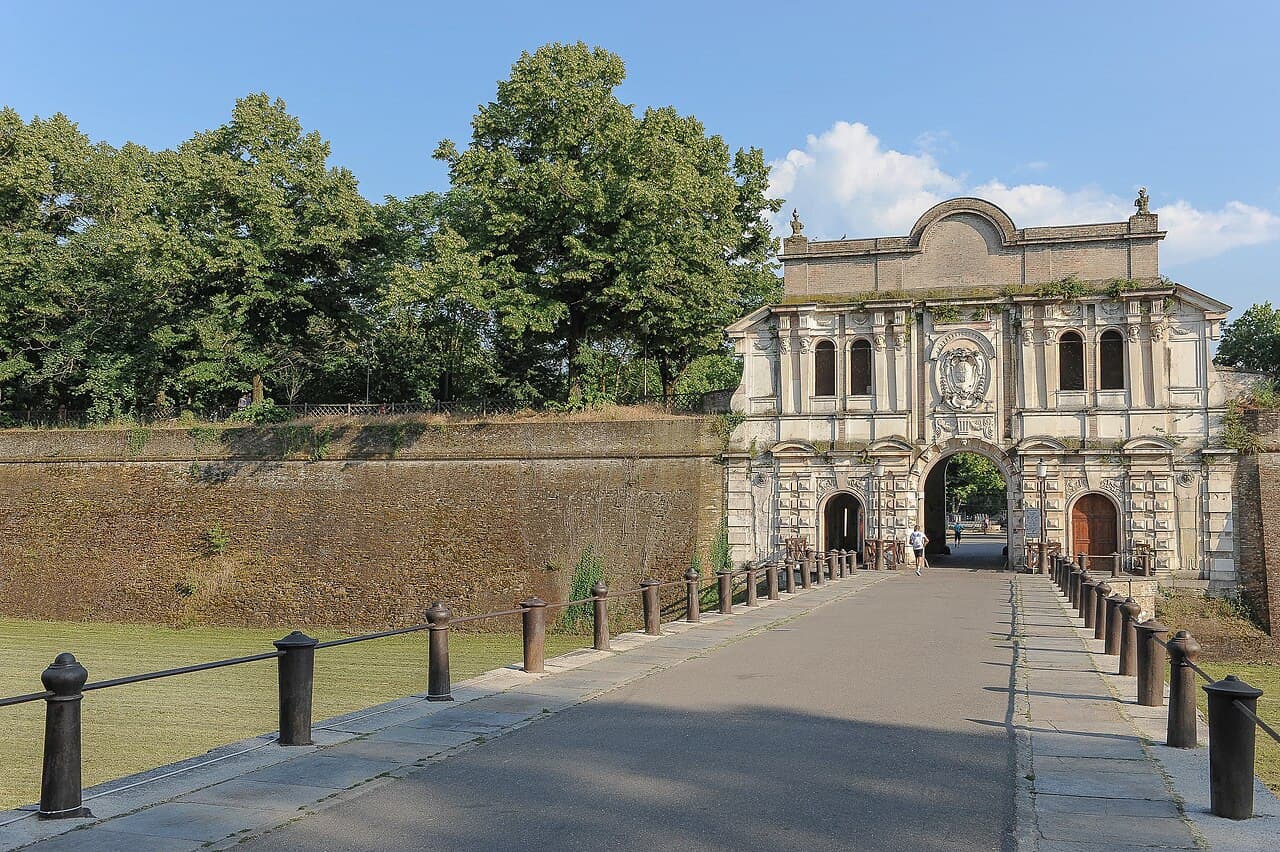
Cittadella di Parma
The Cittadella di Parma, also known as the Citadel of Parma, is a distinctive example of a Renaissance bastioned fortress located in the Emilia region of northern Italy. Built in the late 16th century, this fortress exhibits the characteristic pentagonal layout that was typical of military architecture during the period, designed to optimize defense against artillery and siege warfare.
Historical context and construction
The fortress was commissioned by Alessandro Farnese, the Duke of Parma and Piacenza, a prominent figure in Italian Renaissance politics and military affairs. The construction began in the final decades of the 1500s, a time when the art of fortification was evolving rapidly due to the introduction of gunpowder and cannon. The design was entrusted to the engineers Giovanni Antonio Stirpio de' Brunelli and Genesio Bresciani, with collaboration from Smeraldo Smeraldi, reflecting the expertise required to create such a complex defensive structure.
A significant engineering feat during the construction was the diversion of the Maggiore canal, whose waters were rerouted to join the Comune canal up to the Porta Nuova (now known as Barriera Farini). This water management was essential for the fortress's moat system, enhancing its defensive capabilities by surrounding the walls with water obstacles.
Architectural features and design
The pentagonal layout of the fortress is defined by its five bastions, which allowed defenders to cover all approaches with overlapping fields of fire. This design was a hallmark of Renaissance military architecture, responding to the challenges posed by cannon artillery. The bastions are connected by thick curtain walls that were built to withstand bombardment.
The fortress is surrounded by a moat, which was fed by the diverted canals, creating a formidable barrier to attackers. The ramparts atop the walls provided platforms for artillery and infantry defense. These features combined to make the Cittadella a stronghold capable of withstanding prolonged sieges.
The main entrance to the fortress, located on the northern side, is notable for its monumental facade crafted from Angera stone. This gate was designed by the architect Simone Moschino and constructed by Giambattista Carra in 1596. Remarkably, the gate has been preserved in its original form without significant modifications, offering a direct link to the fortress's Renaissance origins.
On the southern side, the fortress features a secondary gate known as the Porta del Soccorso, which served as an auxiliary entrance and exit point.
Uses and transformations over time
Originally built for defensive military purposes, the Cittadella di Parma was equipped with the necessary fortifications to protect the city and its strategic interests. Over the centuries, its role evolved in response to changing political and social circumstances.
During later periods, the fortress was repurposed as barracks for troops, reflecting its continued military utility. It also served as a prison for political detainees and a site for executions, marking a darker chapter in its history.
In the late 20th and early 21st centuries, the fortress underwent significant renovation. The restoration focused on preserving the original pentagonal shape and structural integrity while adapting the space for public use. Today, the Cittadella functions as a public park featuring areas dedicated to sports and children's activities, integrating cultural heritage with community life.
Significance and heritage
The Cittadella di Parma stands as an important example of Renaissance military architecture in Italy. Its well-preserved bastions and original gates provide valuable insight into the defensive strategies and construction techniques of the period.
The fortress's transformation into a public space demonstrates a successful adaptive reuse of historical military architecture, allowing visitors to engage with Parma's past in a contemporary setting. Its location in the Emilia region adds to the rich tapestry of Italian Renaissance heritage sites.
Frequently asked questions (FAQ)
- What is the historical significance of Cittadella di Parma?
- Cittadella di Parma is a 16th-century fortress built to protect the city of Parma and its inhabitants. It played a crucial role in the military history of Italy, showcasing the architectural advancements of the Renaissance period. Today, it stands as a symbol of Parma's rich history and cultural heritage.
- When was Cittadella di Parma built?
- Construction of Cittadella di Parma began in 1590 and was completed in 1610. Designed by architect Giovanni Battista Aleotti, the fortress was part of a larger defensive system to safeguard the region. Its strategic layout reflects the military architecture of the time.
- What are the opening hours for Cittadella di Parma?
- Cittadella di Parma is open to visitors from Tuesday to Sunday, with varying hours depending on the season. Typically, the fortress opens at 9 AM and closes at 7 PM during the summer months. It is advisable to check the official website for any changes or special events.
- Can I visit Cittadella di Parma with children?
- Yes, Cittadella di Parma is family-friendly and welcomes visitors of all ages. The spacious grounds and engaging historical exhibits make it an enjoyable experience for children. However, parental supervision is recommended, especially in areas with steep steps or uneven terrain.
- Is it possible to buy tickets online for Cittadella di Parma?
- Yes, tickets for Cittadella di Parma can be purchased online through the official website. Buying tickets in advance is recommended to avoid long queues, especially during peak tourist seasons. Online purchase also allows you to select specific time slots for your visit.
- What is the best time to visit Cittadella di Parma?
- The best time to visit Cittadella di Parma is during the spring and fall months, when the weather is mild and comfortable for exploring. Additionally, these seasons typically see fewer crowds, allowing for a more enjoyable experience. Summer can be hot, while winter may bring limited accessibility.
- How do I get to Cittadella di Parma using public transport?
- Cittadella di Parma is easily accessible by public transport, with several bus lines connecting the fortress to the city center. The nearest train station is Parma, from where you can take a short bus ride or a leisurely walk to the castle. Be sure to check local schedules for the most convenient routes.
- Are there any nearby attractions to visit while at Cittadella di Parma?
- Yes, the area around Cittadella di Parma boasts several attractions, including the stunning Parma Cathedral and the Baptistery. Additionally, the Palazzo della Pilotta and the National Gallery are within walking distance, offering a rich cultural experience. Visitors can easily spend a whole day exploring these historical sites.
- What are the ticket prices for Cittadella di Parma?
- Ticket prices for Cittadella di Parma vary based on age and special discounts. Generally, adult tickets are around €5, while reduced rates are available for students and seniors. Children under a certain age may enter for free, but it's best to check the official site for the most current pricing information.
Photo gallery

Photo by Pjt56 --- If you use the picture outside Wikipedia I would appreciate a short e-mail to [email protected] or a message on my discussion page•CC BY-SA 4.0
Information
Loading map...
Visitor reviews
No reviews yet. Been here? Write the first review and help other travelers!
Write the first reviewVisited this castle? Share your experience
Your review helps other travelers and adds first-hand knowledge to our encyclopedia.


