Citadel of Besancon
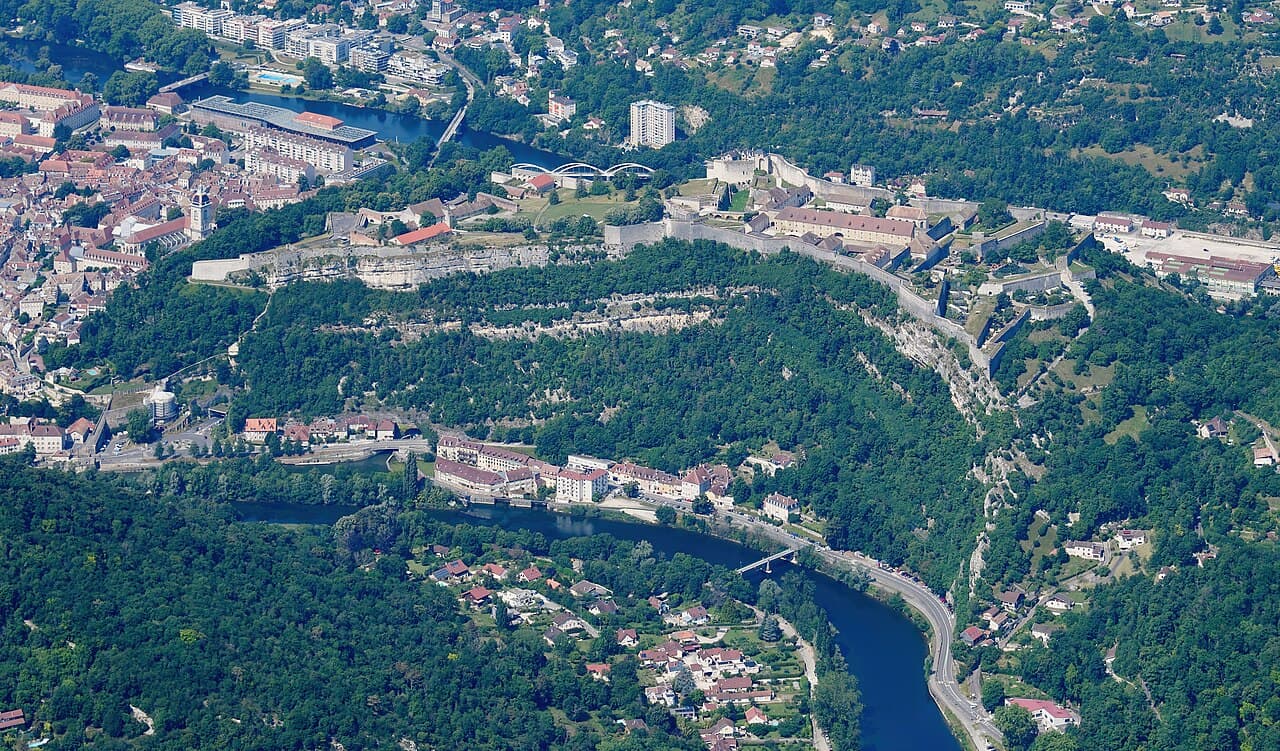
The Citadel of Besancon stands as one of the most exemplary fortresses of 17th-century military architecture in France, designed by the legendary engineer Sébastien Le Prestre de Vauban. Situated on Mount Saint-Étienne, one of the seven hills overlooking the city of Besancon, this imposing fortress covers approximately eleven hectares and dominates the natural oxbow bend of the Doubs River. Its strategic location atop a steep limestone promontory rising about 130 meters above the river and the old town has made it a key defensive site since ancient times, recognized by Julius Caesar as early as 58 BC.
The citadel not only offers commanding views of the historic city center but also represents a pinnacle of bastioned fortification design that reflects the evolution of military engineering during the Renaissance and early modern periods. Its extensive defensive works, including multiple bastions, curtain walls, ditches, and outworks, illustrate Vauban's innovative approach to fortification, emphasizing overlapping fields of fire and robust protection against artillery assaults.
Historical significance and construction timeline
The site of the Citadel of Besancon has been valued for its military importance since antiquity. The natural defensive advantages of Mount Saint-Étienne were utilized by the Romans, with evidence of an enclosed wall noted by Julius Caesar. Over the centuries, the location saw various fortifications, but the present citadel's origins date to the late 17th century when Besancon was under the control of the Spanish Habsburgs.
Construction of the initial fortress began on September 29, 1668, under the supervision of Prosper-Ambroise de Precipiano and the Dutch military engineer Cornelius Verboom. Their work laid the foundations for a strong defensive position controlling the river and surrounding region. Following the Treaty of Nijmegen in 1678, control of Besancon shifted to France, and King Louis XIV entrusted Vauban with the task of enhancing and completing the fortress.
Between 1678 and 1683, Vauban implemented extensive improvements, transforming the citadel into a formidable bastioned fortress with three successive defensive fronts conforming to the natural contours of the hill. The final phases of construction and city defenses were completed by 1695, establishing the citadel as a key stronghold in France’s eastern frontier.
Architectural design and defensive features
Layout and fortifications
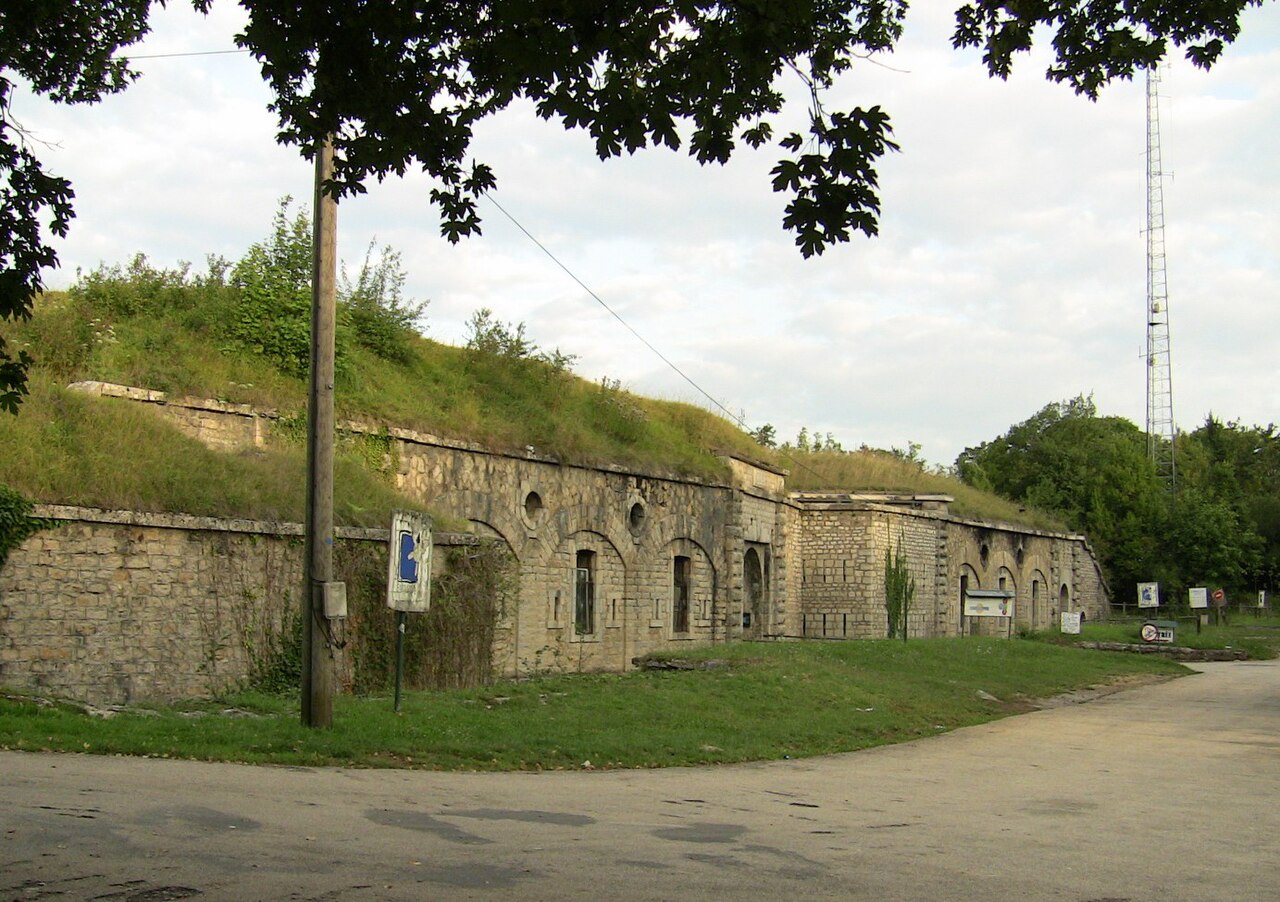
The citadel’s design exemplifies Vauban’s principles of fortification, emphasizing geometric bastions, angled walls to deflect cannon fire, and layered defenses. The fortress comprises three main bastioned fronts: Front Saint-Étienne, Front Royal, and Front de Secours. These are arranged in succession along the steep limestone ridge, creating overlapping fields of fire and maximizing defensive coverage.
Front Saint-Étienne is the outermost line of defense, built on the site of a former church. It features a distinctive half-moon-shaped outwork flanked by demi-bastions equipped with orillons, rounded projections that protect artillery from flanking fire. Defensive ditches and steep escarpments surround the walls, with drawbridges controlling access points. Specialized traverses protect defenders from enfilading fire from nearby high ground.
The inner fronts, Front Royal and Front de Secours, incorporate elements from the original Spanish fortifications, enhanced by Vauban’s modifications. These fronts tightly follow the natural rock formations and feature massive limestone curtain walls with a chemin de ronde (patrol walkway) atop. Originally lined with ten guérites (sentry posts), only two remain today, offering insight into the fortress’s surveillance capabilities.
Military buildings and infrastructure
Within the citadel are several well-preserved military buildings that supported the garrison’s daily functions. The Cadets’ barracks and school, constructed in 1682, could accommodate up to 600 trainees and featured a dividing wall for protection against lateral attacks. The Major’s building housed essential services including a bakery, kitchen, storage, and officer quarters, while the Officers’ building contained multiple chambers over two floors for accommodation.
The powder magazine is a notable structure designed to minimize explosion risks. Built beneath a vaulted arch, it utilized bronze nails and hinges to prevent sparks, and strict protocols required visitors to wear wooden clogs. Nearby, the arsenal stored artillery and small arms, with separate floors dedicated to different types of weaponry and ammunition.
Water supply and chapel
Ensuring a reliable water supply was critical for the citadel’s resilience during sieges. A deep well, approximately 117 meters deep, was excavated and equipped with a large wheel powered by human effort to raise water. Due to the brackish nature of the well water, additional rainwater cisterns were installed at each defensive front and near the well to collect fresh water.
A small chapel dedicated to Saint-Étienne was consecrated in 1683 within the fortress. This modest religious building, featuring Doric columns, served the spiritual needs of the garrison and commemorated the church demolished to build the outer defenses.
Historical role and military engagements
Throughout the 18th century, the Citadel of Besancon served primarily as a military garrison and an arms storage facility. Its strategic importance continued into the 19th century, when it was repurposed as a prison for various detainees, including royalists during the French Revolution, deserters, and prisoners of the Napoleonic Wars.
The fortress endured sieges with minimal damage during the 1814 Austrian campaign and the Franco-Prussian War of 1871. During World War II, German forces occupied the citadel without resistance in June 1940. Between 1941 and 1944, it was used as an execution site for approximately 100 resistance fighters from various nationalities. A memorial now commemorates these victims.
The citadel was liberated by American troops on September 7, 1944 and subsequently served as a prisoner of war camp until 1948. Its military functions ceased thereafter, transitioning to preservation and cultural uses.
Modern preservation and cultural significance
The Citadel of Besancon is remarkably well preserved, retaining much of its original 17th-century fortifications and internal buildings. Recognized for its architectural and historical value, it was designated a Monument historique by the French Ministry of Culture in the 1940s. In 1960, management of the site was transferred to the city of Besancon, which has since developed it as a major tourist destination.
In 2008, the citadel, along with the nearby Fort Griffon, was inscribed on the UNESCO World Heritage List as part of the network of fortifications designed by Vauban across France. Today, it attracts over a quarter of a million visitors annually, drawn by its imposing structure, panoramic views, and the several museums housed within its walls.
The fortress’s extensive glacis and subterranean passages, such as the "communication 110", demonstrate the advanced defensive strategies employed. Its comprehensive design, combining natural topography with expertly engineered bastions, makes the Citadel of Besancon a quintessential example of Vauban’s military genius and a vital cultural heritage site.
Frequently asked questions (FAQ)
- What is the historical significance of the Citadel of Besancon?
- The Citadel of Besancon, built in the 17th century by Vauban, is a UNESCO World Heritage site that showcases the military architecture of the time. It played a crucial role in defending the city against various invasions and is a symbol of the historical power of the region.
- When was the Citadel of Besancon constructed?
- Construction of the Citadel began in 1668 and was completed in 1711. It was designed to enhance the defenses of Besancon and to reflect the military engineering prowess of the era.
- Can I visit the Citadel of Besancon year-round?
- Yes, the Citadel of Besancon is open for visitors throughout the year, though hours may vary by season. It's advisable to check the official website for specific opening times before planning your visit.
- What are the ticket prices for the Citadel of Besancon?
- Ticket prices for the Citadel of Besancon vary based on age and group status, with discounts available for students and seniors. As of 2023, general admission is approximately €8, while reduced rates can be found for children and families.
- Is it possible to access the Citadel of Besancon with mobility challenges?
- The Citadel offers accessible pathways and facilities for visitors with mobility challenges; however, some areas might be difficult to navigate due to the historic nature of the site. It is recommended to contact the visitor services in advance for specific accessibility options.
- When is the best time to visit the Citadel of Besancon?
- The best time to visit the Citadel is during the spring and early fall when the weather is mild, and the gardens are in full bloom. Visiting during these seasons allows for a more pleasant experience while exploring the expansive grounds and views of the city.
- Are there nearby attractions to visit after the Citadel of Besancon?
- Yes, visitors can explore other nearby attractions such as the Museum of Time, which delves into the history of horology, and the beautiful Saint-Jean Cathedral. The city of Besancon itself offers charming streets and cafes to enjoy after touring the Citadel.
- What architectural features are notable at the Citadel of Besancon?
- The Citadel features impressive stone walls, bastions, and a unique layout designed for defense. Its architecture includes both military and residential buildings, showcasing the creativity of Vauban and the strategic importance of the site.
Photo gallery

Information
Website
Visit websiteSources & official resources
Verify the information above using these authoritative references.
Loading map...
Visitor reviews
No reviews yet. Been here? Write the first review and help other travelers!
Write the first reviewVisited this castle? Share your experience
Your review helps other travelers and adds first-hand knowledge to our encyclopedia.