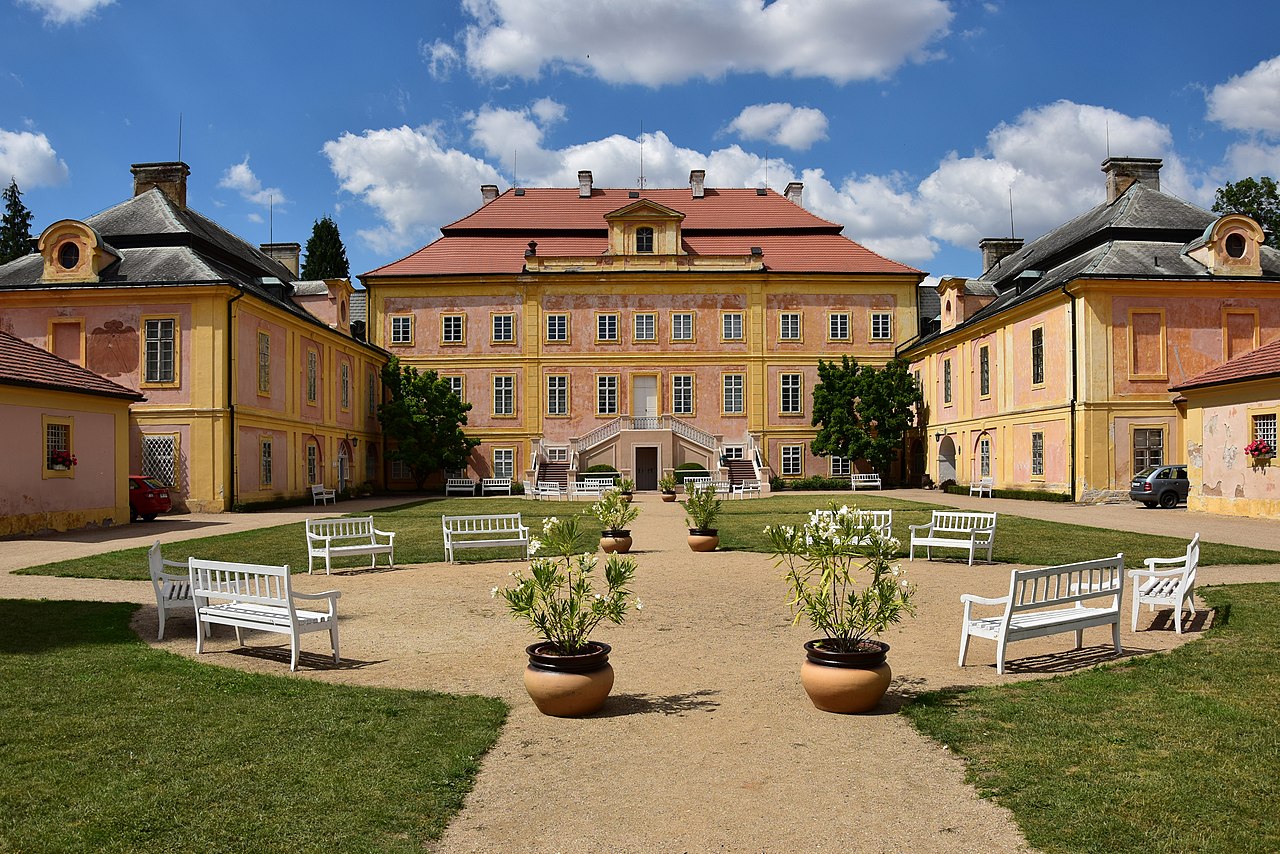
Chyse Castle
Chyse Castle stands as a remarkable example of layered architectural evolution in the Czech Republic, located in the municipality of Chyše, approximately 35 km east of the renowned spa town of Karlovy Vary. Its origins date back to 1169, making it a site of significant historical and cultural importance. Over the centuries, the castle has undergone multiple transformations, reflecting the changing architectural styles and the shifting needs of its noble owners.
Medieval origins and gothic reconstruction
The castle began as a fortified settlement in the late 12th century, initially serving as a noble residence and a defensive stronghold. By 1254, it was the seat of the Odolenovic family, marking its early prominence in the region. The original medieval fortress featured a trapezoidal layout with two palaces, a main gate tower, and a smaller tower, designed for defense and residence.
In the mid-15th century, the castle suffered destruction during military campaigns led by King George of Bohemia’s forces in 1467. Following this devastation, it was rebuilt in the late Gothic style, a phase that introduced characteristic defensive elements such as arrow slits with wooden closing mechanisms, particularly preserved in the eastern tower. This reconstruction emphasized both fortification and the Gothic architectural aesthetic prevalent at the time.
Renaissance and baroque transformations
By the 16th century, the fortress transitioned from a primarily defensive structure to a more comfortable and elegant residence. In 1578, it was transformed into a Renaissance chateau, reflecting the era's emphasis on symmetry, proportion, and decorative elements that enhanced residential comfort.
The castle underwent further stylistic changes in the late 17th and early 18th centuries, with a significant Baroque reconstruction completed in 1708. This phase introduced dynamic forms, ornate decorations, and grand spatial arrangements typical of the Baroque movement, aligning the castle with contemporary aristocratic tastes and cultural trends.
19th-century neo-gothic redesign
Between 1856 and 1858, the castle experienced its most visually striking transformation under the guidance of architect Ignác Ullmann. He redesigned the complex in the Tudor Gothic style, a romantic historicist interpretation of medieval English architecture. This redesign incorporated elements such as triangular gables, corner turrets, battlemented galleries, and a large entrance tower, giving the castle its distinctive neo-Gothic character that dominates its current appearance.
The southern façade is notable for its large entrance tower with two open battlemented galleries, while the northeast corner features a smaller hexagonal tower. The northwest wing is lower, rising only two stories, and is adorned with refined neo-Gothic decorations, enhancing the castle's romantic medieval ambiance.
Interior features and artistic treasures
The castle's interiors, while furnished mainly with period pieces not originally from the site, include significant artworks and family portraits. Among these are six portraits of the Lažanský family members, spanning the 17th to 19th centuries, highlighting the lineage's long association with the castle. Two landscape paintings and a detailed veduta depicting the castle after its neo-Gothic renovation add to the historical narrative presented within the rooms.
A particularly unique artistic treasure is the Baroque oil painting from 1699 by Petr Brandl, portraying the biblical scene of King David receiving the severed head of his son Ammon. This ceiling artwork exemplifies the rich cultural heritage preserved within the castle's walls.
Castle grounds and brewery heritage
The castle is surrounded by an English-style landscaped park dating from the 17th century, featuring a pond and naturalistic garden design that reflects the period's aesthetic preferences. The entrance is marked by a wrought-iron gate flanked by two stone lions bearing the Lažanský family coat of arms, symbolizing the family's historical presence and influence.
Adjacent to the castle stands a historic brewery built between 1839 and 1841, notable for its vaulted cellars, a restaurant, pub, and guest rooms. The brewery maintains its traditional interiors and resumed brewing in 2006 after a 74-year hiatus, continuing a brewing tradition that dates back to 1580. This blend of cultural and industrial heritage adds depth to the castle's significance in the region.
Historical significance and modern restoration
Throughout its history, Chyse Castle has been owned by numerous noble families, including the Gutštejn, Lobkovic, Švamberk, Michnov of Vacínov, Kolovrat-Krakovský, Putz of Breidenbach, and finally the Lažanský family from 1766. Each ownership period contributed to the castle's architectural and cultural development.
In the early 20th century, the castle gained literary significance when the renowned Czech writer Karel Čapek worked there as a home tutor in 1917, an experience that influenced his later works.
Following World War II, the castle was nationalized and used for various institutional purposes, leading to gradual neglect and closure in 1976. It was returned to private ownership in 1996 by Vladimír Lažanský and his wife, who initiated extensive restoration efforts supported by cultural heritage programs. These efforts have preserved the castle's historic fabric and revitalized its status as a cultural monument protected under heritage catalog number 1000144076.
Architectural layout and defensive features
The castle's layout is characterized by a three-story building arranged in four wings around a roughly square courtyard. The medieval trapezoidal core remains evident in parts of the structure, especially in the eastern tower with its defensive arrow slits and wooden closing mechanisms, underscoring the castle's original military function.
The combination of medieval defensive elements with Renaissance elegance, Baroque grandeur, and neo-Gothic romanticism makes Chyse Castle a unique architectural palimpsest. It offers valuable insights into the evolution of castle architecture in Central Europe from the high medieval period through the 19th century.
Frequently asked questions (FAQ)
- What are the opening hours of Chyse Castle?
- Chyse Castle is typically open to visitors from April to October, with hours varying by day. It is advisable to check the official website for the most current hours and any special holiday schedules.
- Can I take guided tours of Chyse Castle?
- Yes, guided tours are available at Chyse Castle, providing an in-depth look at its rich history and architecture. These tours are often conducted in multiple languages to accommodate international visitors.
- When was Chyse Castle built?
- Chyse Castle was originally constructed in the 13th century and has undergone several renovations throughout its history. Its architecture reflects various historical styles that have evolved over the centuries.
- Is it possible to access Chyse Castle with a wheelchair?
- Chyse Castle strives to be accessible to all visitors; however, some areas may present challenges due to the historical nature of the site. It is recommended to contact the castle administration for specific accessibility information before your visit.
- What is the historical significance of Chyse Castle?
- Chyse Castle holds great historical significance as a former noble residence that has witnessed various historical events in Czechia. Its architecture and preserved interiors offer valuable insights into the region's past.
- What are the ticket prices for visiting Chyse Castle?
- Ticket prices for Chyse Castle vary depending on the type of tour and the age of the visitor. Discounts may be available for students, seniors, and groups, so it's best to check the official website for detailed pricing information.
- When is the best time to visit Chyse Castle?
- The best time to visit Chyse Castle is during the spring and early autumn months when the weather is mild and the gardens are in bloom. Additionally, visiting during weekdays can help avoid larger crowds.
- Are there any nearby attractions to Chyse Castle?
- Yes, there are several nearby attractions including beautiful parks, historical churches, and local museums that can enhance your visit to Chyse Castle. Exploring the charming town of Chyše itself is also highly recommended.
Information
Website
Visit websiteSources & official resources
Verify the information above using these authoritative references.
Loading map...
Visitor reviews
No reviews yet. Been here? Write the first review and help other travelers!
Write the first reviewVisited this castle? Share your experience
Your review helps other travelers and adds first-hand knowledge to our encyclopedia.