Chotyn Castle
Chotyn Castle, located on a commanding rocky hill overlooking the right bank of the Dniester River in Ukraine's Chernivetska oblast, stands as one of the most impressive and well-preserved medieval fortresses in Eastern Europe. Its strategic location made it a vital defensive and economic stronghold for centuries, witnessing numerous historic battles and political shifts. Today, it attracts thousands of visitors annually, drawn by its formidable architecture, rich history, and cinematic fame.
The fortress’s origins trace back to the early medieval period, with archaeological evidence indicating initial wooden fortifications built by East Slavic tribes in the 8th or 9th century. These early defenses evolved into stone walls by the late 12th or early 13th century, marking the transition from a simple settlement to a significant military and administrative center. The fortress’s medieval core, covering approximately 2 hectares, was expanded over time to more than 16 hectares, reflecting its growing importance.
During the 14th century, when Khotyn was part of the Moldavian Principality, the stone fortress seen today began to take shape. Under the reign of Alexander the Good (1400–1432), the fortress underwent significant expansion. His successor, Stephen the Great, further reinforced the defenses in the 15th century, constructing thick walls up to 40 meters high and five meters thick, multiple towers, and dividing the interior into distinct military and ruling areas. Stephen personally oversaw these enhancements, which solidified the fortress’s reputation for impregnability.
Architectural features and defensive structures
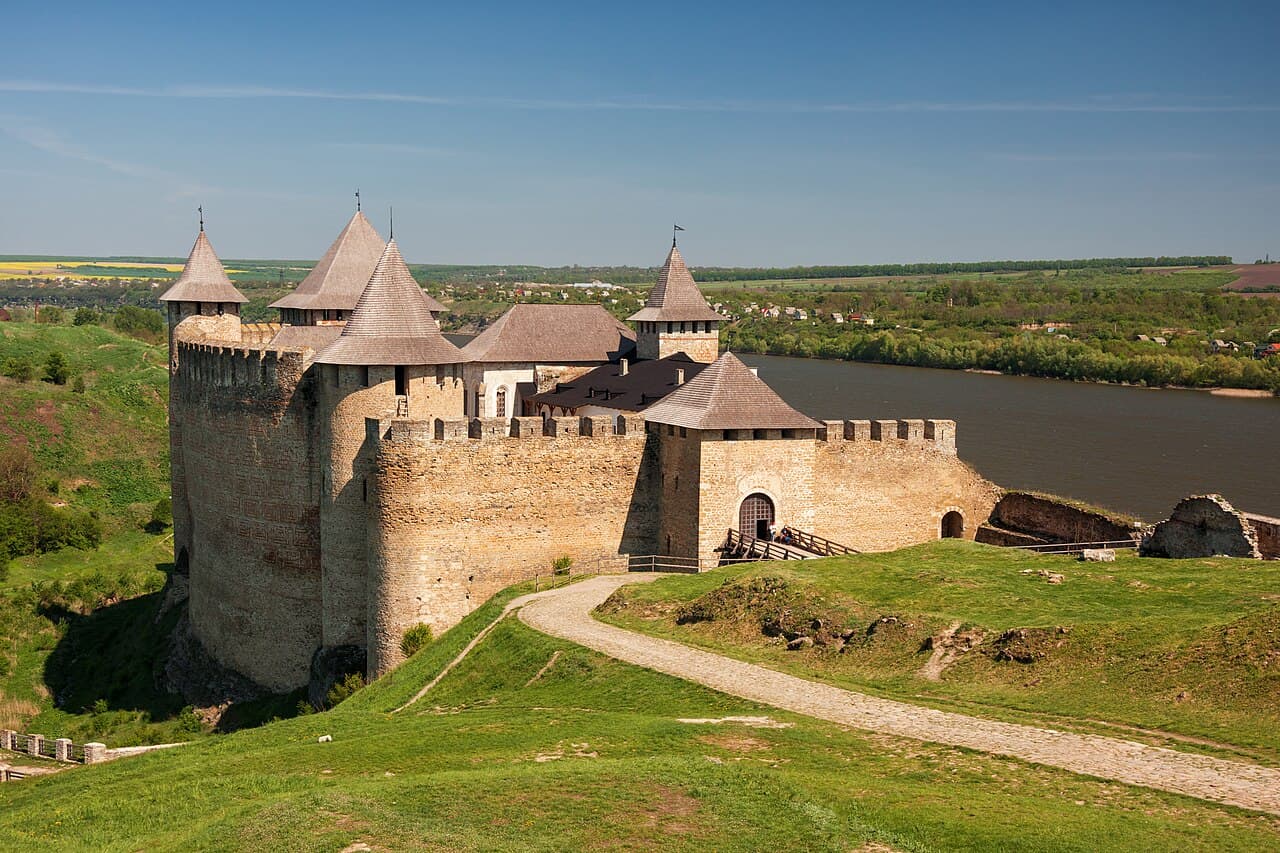
The fortress’s walls are built from roughly cut quarry stones arranged in even layers, accented by distinctive bands of red bricks forming geometric patterns. The oldest surviving stone fortifications date from the 13th century and include walls approximately six meters thick, surrounded by a triangular moat. These early walls were incorporated into later constructions, preserving a tangible link to the fortress’s medieval origins.
The interior is divided into two main sections: the princely court and the military courtyard. The princely court housed the ruler’s palace and administrative buildings, while the military courtyard contained barracks and storage facilities. Deep cellars beneath these courtyards were used for storing provisions during sieges. The fortress features five main towers with shingled roofs, including two round towers and a rectangular gate tower on the south side, built under Stephen the Great’s direction. The gate tower is accessible via a wooden bridge resting on pilings. Two additional rectangular towers are older, with the northernmost likely serving as the original donjon or main keep. The tallest towers reach about 25 meters in height, and the walls vary in thickness, with the western walls being the thickest and the river-facing walls designed with fewer openings but equipped with arrow slits.
The new fortress and ottoman modifications
In the early 18th century, under Ottoman control, the fortress was extensively modernized with the addition of a "New Fortress" bastion system. This outer ring of fortifications included earthen ramparts, artillery bastions shaped to withstand cannon fire, and broad moats reinforced with finely dressed stone. The new defenses comprised three gate towers and six artillery bastions, transforming the fortress into a bastioned fortress capable of supporting a large garrison. Within this enclosure are the ruins of a Turkish mosque, identifiable by the foundations of its minaret, as well as remnants of a Turkish bath introduced by the Ottoman borsholder who resided there with his harem.
Historical significance and key events
Khotyn Fortress has been a focal point of regional power struggles for centuries. Its strategic position on the border of the Moldavian Principality made it a coveted prize for various empires, including the Kingdom of Poland, the Ottoman Empire, and the Russian Empire. The fortress famously resisted multiple Ottoman sieges, including the notable 1476 attack by Sultan Mehmed II.
One of the most dramatic events in the fortress’s history was the 1621 Battle of Khotyn, where the combined forces of the Polish-Lithuanian Commonwealth and the Zaporozhian Cossacks under Hetman Petro Sagaydachny successfully repelled the Ottoman army. This victory prevented further Ottoman expansion into Eastern Europe and led to a peace treaty that stabilized the region for several decades.
Throughout the 18th century, the fortress changed hands multiple times, with the Ottomans recapturing and strengthening it before it was eventually incorporated into the Russian Empire following the Russo-Turkish War of 1806-1812. The Russians established a garrison and constructed the Church of Alexander Nevsky within the fortress, which remains in good condition and is still active today.
Cultural heritage and preservation
Since 1963, Khotyn Fortress has been protected as an architectural monument, and in 2000 it was designated a state historical-architectural reserve. This status ensures the preservation of its extensive fortifications, towers, palaces, and other structures, allowing visitors to explore a site rich in history and architectural innovation.
Archaeological excavations have revealed layers of history beneath the fortress, including remnants of earlier wooden fortifications and a wealth of artifacts such as coins and building materials. These findings provide valuable insights into the fortress’s development from a Slavic settlement to a medieval stronghold and beyond.
Today, the fortress is a popular tourist destination, known not only for its historical and architectural significance but also for its appearances in numerous films. Its imposing walls, towers, and scenic location on the Dniester River make it a compelling site for both history enthusiasts and casual visitors alike.
Notable architectural elements
- The two-story princely palace with decorative brickwork and extensive cellars
- The chapel dedicated to the Dormition of the Mother of God, featuring Gothic design and 16th-century frescoes
- The well in the military courtyard that historically supplied water during sieges
- Five main towers, including the original donjon and gate towers with defensive wooden bridges
- Remnants of the Ottoman-era Turkish mosque and bathhouse
Visitor experience and significance
Visitors to Chotyn Castle can explore a vast complex that vividly illustrates the evolution of military architecture from the early medieval period through the Ottoman era. The fortress’s well-preserved walls and towers offer panoramic views of the Dniester River valley, enhancing its appeal as a cultural landmark. Guided tours often highlight the castle’s role in key historical events, including the 1621 battle and its strategic importance in Eastern European history.
Overall, Chotyn Castle remains a testament to the region’s turbulent history and architectural ingenuity, embodying centuries of cultural exchange, military innovation, and political power struggles.
Frequently asked questions (FAQ)
- What is the historical significance of Chotyn Castle?
- Chotyn Castle, located in Khotyn, Ukraine, is a remarkable example of medieval military architecture. It has played a crucial role in various historical conflicts, serving as a fortress against invasions and a seat of power for regional leaders throughout its history.
- When was Chotyn Castle built?
- Chotyn Castle was originally constructed in the late 10th century, with significant expansions and renovations occurring over the centuries. The castle's current form reflects various architectural styles, primarily from the 14th to 17th centuries.
- Can I visit Chotyn Castle year-round?
- Yes, Chotyn Castle is open to visitors year-round, although the best time to visit is during the warmer months from late spring to early autumn. This is when the weather is pleasant, and you can fully enjoy the outdoor surroundings and scenic views.
- What are the opening hours for Chotyn Castle?
- Chotyn Castle typically opens at 10 AM and closes at 6 PM from April to October. During the winter months, the hours may vary, so it's best to check the official website or contact local tourism for the most accurate information.
- Is it possible to take guided tours of Chotyn Castle?
- Yes, guided tours are available at Chotyn Castle, offering visitors an in-depth look at its history and architecture. These tours are led by knowledgeable guides who provide fascinating insights into the castle's past and its significance in Ukrainian history.
- What are the ticket prices for visiting Chotyn Castle?
- Ticket prices for Chotyn Castle are quite affordable, typically ranging from 50 to 100 UAH for adults, while discounts are often available for students and children. Prices may vary during special events or exhibitions, so it's advisable to check in advance.
- Are there any nearby attractions to visit while at Chotyn Castle?
- Yes, the area surrounding Chotyn Castle is rich in history and culture. Nearby attractions include the Khotyn Fortress and the scenic Dniester River, making it an excellent destination for a full day of exploration.
- How do I get to Chotyn Castle?
- Chotyn Castle is easily accessible by car or public transportation from major cities in Ukraine. There are local buses that connect Khotyn with larger cities, and once in Khotyn, the castle is within walking distance from the town center.
- Is Chotyn Castle accessible for individuals with disabilities?
- Chotyn Castle has made efforts to improve accessibility for all visitors, including those with disabilities. However, due to the historic nature of the site, some areas may still present challenges, so it's advisable to contact the castle administration for specific accessibility information before your visit.
Photo gallery

Information
Website
Visit websiteSources & official resources
Verify the information above using these authoritative references.
Loading map...
Visitor reviews
No reviews yet. Been here? Write the first review and help other travelers!
Write the first reviewVisited this castle? Share your experience
Your review helps other travelers and adds first-hand knowledge to our encyclopedia.