Chobienia Castle
Chobienia Castle is a historic hill castle located in Chobienia, Poland, with origins tracing back to an early Slavic fortified settlement known as a gród. This site, originally called Cobena, was inhabited by the Dziadoszan tribe and first documented in 845 by the Bavarian Geographer, who listed it among the key fortified locations along the left bank of the Oder River. The castle's history spans over a millennium, reflecting the region's complex political and architectural evolution.
The earliest phase of the site featured wooden fortifications typical of Slavic settlements, which were gradually replaced by stone structures in the 14th century. This transition marked the construction of a late Gothic stone defensive building, representing a significant architectural upgrade from the original wooden gród. The Gothic castle stood for several centuries, embodying medieval military architecture, before falling into disrepair or being dismantled during the 16th century.
Renaissance transformation and noble ownership
In 1583, the property was acquired by Georg von Kottwitz, who initiated a major reconstruction, replacing the medieval fortress with a Renaissance castle. This renovation reflected the changing defensive needs and the increasing emphasis on residential comfort and status display during the Renaissance period. The castle's layout was adapted to Renaissance architectural principles, integrating both fortification and elegant living spaces.
Georg's successor, Leonhard von Kottwitz, expanded the castle in the early 17th century, further enhancing its residential and defensive features. A notable historical event from this period is the 1611 wedding of Johann Heermann, a prominent German poet and theologian, held at the castle under Leonhard's patronage, highlighting the castle's role as a cultural and social hub.
18th-century modernization and prussian royal visit
During the 18th century, the castle underwent modernization under the ownership of Carl Sigismund von Gellhorn. These updates aligned with contemporary architectural tastes and functional requirements, blending Renaissance foundations with Baroque influences. A significant historical moment occurred in 1759 when King Frederick II of Prussia visited the castle to see soldiers wounded in the Battle of Kunowice. The king's speech during this visit was commemorated in a painting now housed at the Museum of Art in Düsseldorf, underlining the castle's importance in regional military history.
20th-century decline and preservation efforts
Ownership passed through several hands, with Wolfgang von Saurma being the last private owner before the castle was nationalized between the World Wars. The castle suffered damage during World War II in 1945 and remained largely unrestored for decades. Since 2009, a dedicated foundation has been working on the castle's maintenance and renovation, aiming to preserve its historical and architectural legacy.
Architectural features and surviving elements
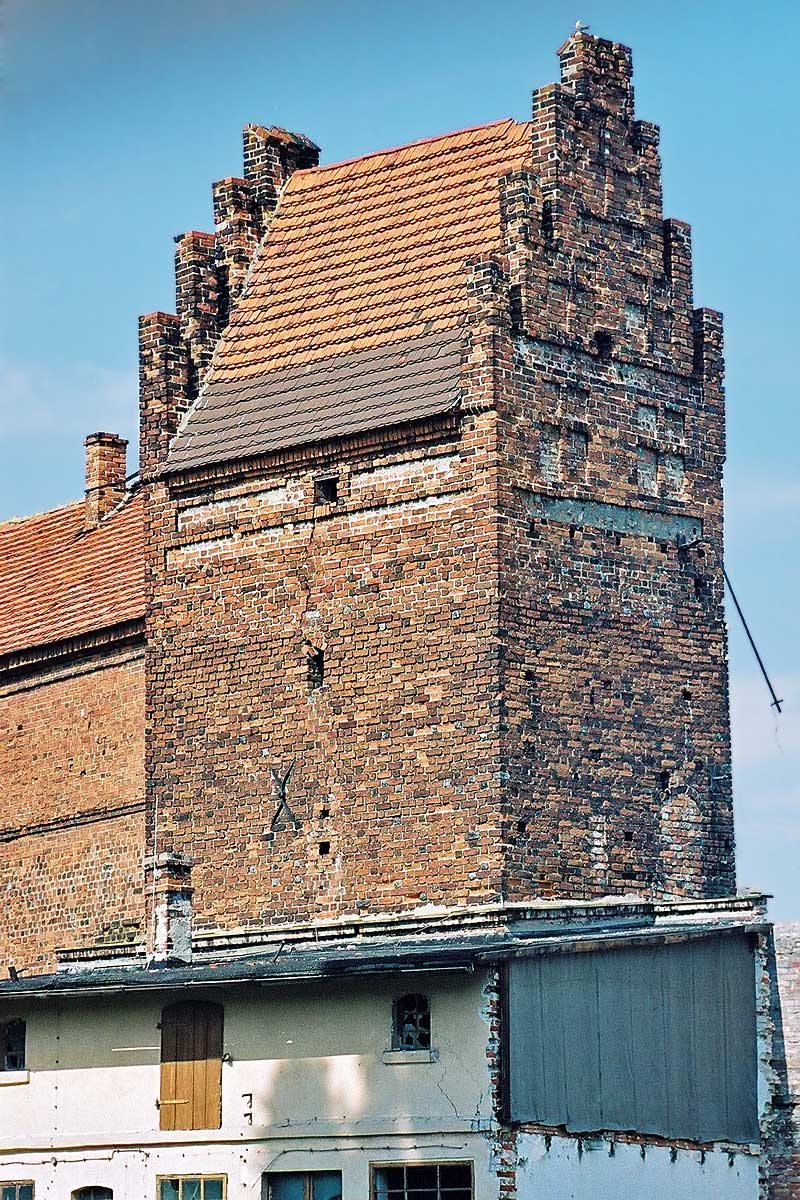
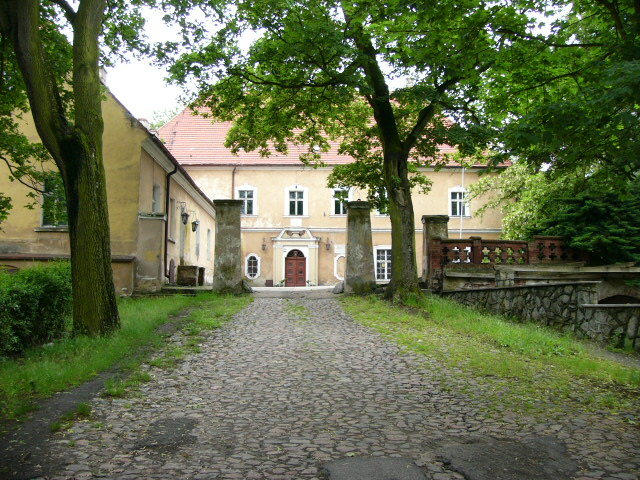
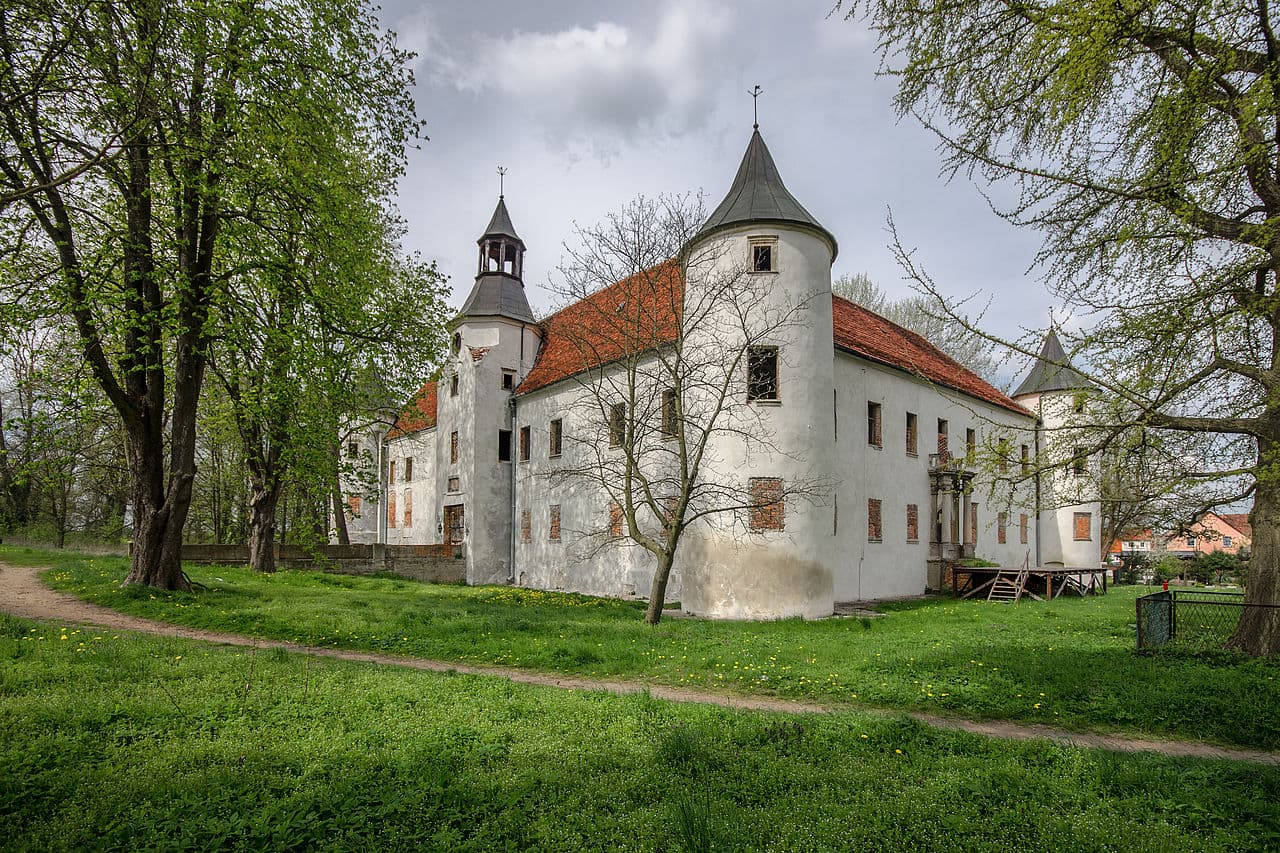
Chobienia Castle is built on a rectangular plan with two levels of wings enclosing a central courtyard. The main entrance is through a passage beneath a rectangular tower in the western wing, serving as a gatehouse controlling access. Three round towers occupy the castle's corners, enhancing its defensive silhouette and architectural complexity.
The oldest surviving part is the basement of the northwest wing, a remnant of the earliest stone construction phase. Originally, the castle was surrounded by a water-filled moat, serving both defensive and symbolic purposes.
Interior layout and decoration
The ground floor features rooms arranged in both one- and two-tract plans, with interiors characterized by barrel vaulting enhanced by lunettes. These architectural elements provide structural support and aesthetic appeal, typical of Renaissance design.
Renovations uncovered a painted ceiling dated to 1583, adorned with family coats of arms that link the castle's interior decoration to its noble occupants. Other surviving artistic features include Renaissance and Baroque portals, such as one on the southern façade bearing the von Saurma family coat of arms. Stone window frames and fragments of stucco decorations further illustrate the castle's stylistic evolution over centuries.
Defensive and residential evolution
The castle's transformation from a medieval stronghold to a Renaissance noble residence reflects broader changes in military architecture and aristocratic lifestyle. The combination of defensive towers, fortified walls, and elegant residential quarters demonstrates the dual function of castles in this period as both fortresses and symbols of noble power.
Today, Chobienia Castle stands as a testament to Poland's rich medieval and Renaissance heritage, offering insights into architectural trends, historical events, and noble life from the early Middle Ages through the 18th century and beyond.
Frequently asked questions (FAQ)
- When was Chobienia Castle originally established?
- Chobienia Castle originated as a Slavic fortified settlement called Cobena, first documented in 845 by the Bavarian Geographer.
- What architectural styles are present in Chobienia Castle?
- The castle features a mix of late Gothic, Renaissance, and Baroque architectural styles reflecting its development over several centuries.
- Can visitors see the original defensive features of the castle?
- Yes, visitors can observe the rectangular tower gatehouse, three round corner towers, and remnants of the original water-filled moat.
- What significant historical events took place at Chobienia Castle?
- Notable events include the 1611 wedding of poet Johann Heermann and King Frederick II of Prussia's visit in 1759 after the Battle of Kunowice.
- Is Chobienia Castle open to the public?
- The castle is managed by a private foundation and may have limited public access; it is advisable to check current visiting hours before planning a visit.
Photo gallery

Information
Sources & official resources
Verify the information above using these authoritative references.
Loading map...
Visitor reviews
No reviews yet. Been here? Write the first review and help other travelers!
Write the first reviewVisited this castle? Share your experience
Your review helps other travelers and adds first-hand knowledge to our encyclopedia.