Chillon Castle
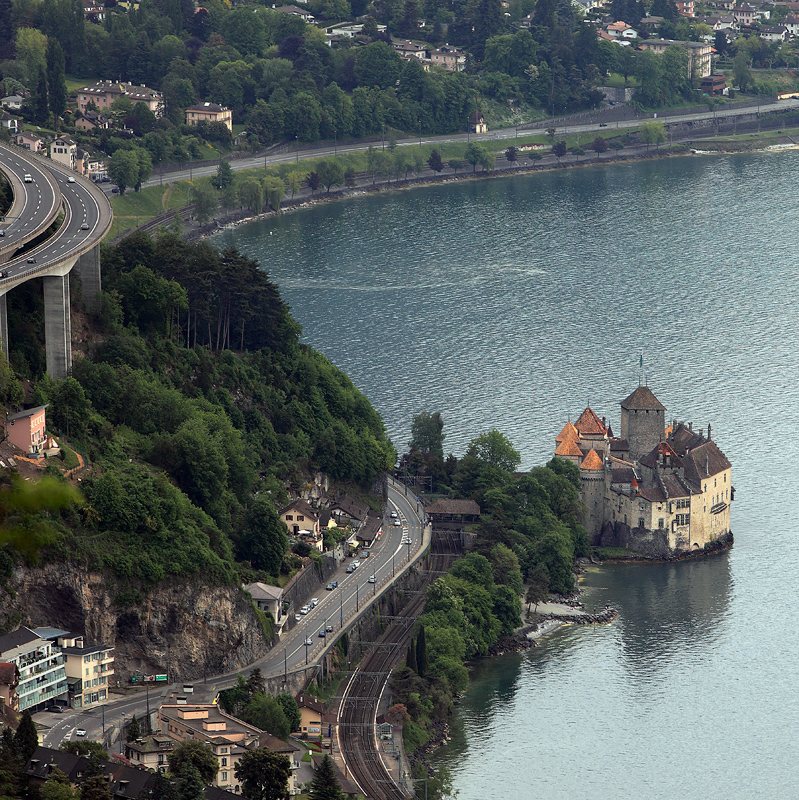
Chillon Castle stands as one of the most iconic and best-preserved medieval castles in Europe, attracting thousands of visitors annually as Switzerland's most visited historic monument. Nestled on a small limestone island in Lake Geneva, the castle's strategic location between Montreux and Villeneuve in the Swiss Alps allowed it to control vital trade and military routes from northern to southern Europe for centuries. Unlike many European castles, Chillon has never been destroyed, maintaining its structural integrity and historical authenticity through careful preservation and restoration efforts.
The origins of the site date back to the Bronze Age and Roman times, when it served as a Roman outpost guarding the critical Alpine passes. The earliest fortifications visible today were constructed in the 10th and 11th centuries, marking the beginning of its transformation into a formidable medieval fortress. The castle first appears in written records in 1150, when Count Humbert III of Savoy asserted control, establishing Chillon as the oldest Savoyard stronghold north of Lake Geneva.
Architectural evolution and layout
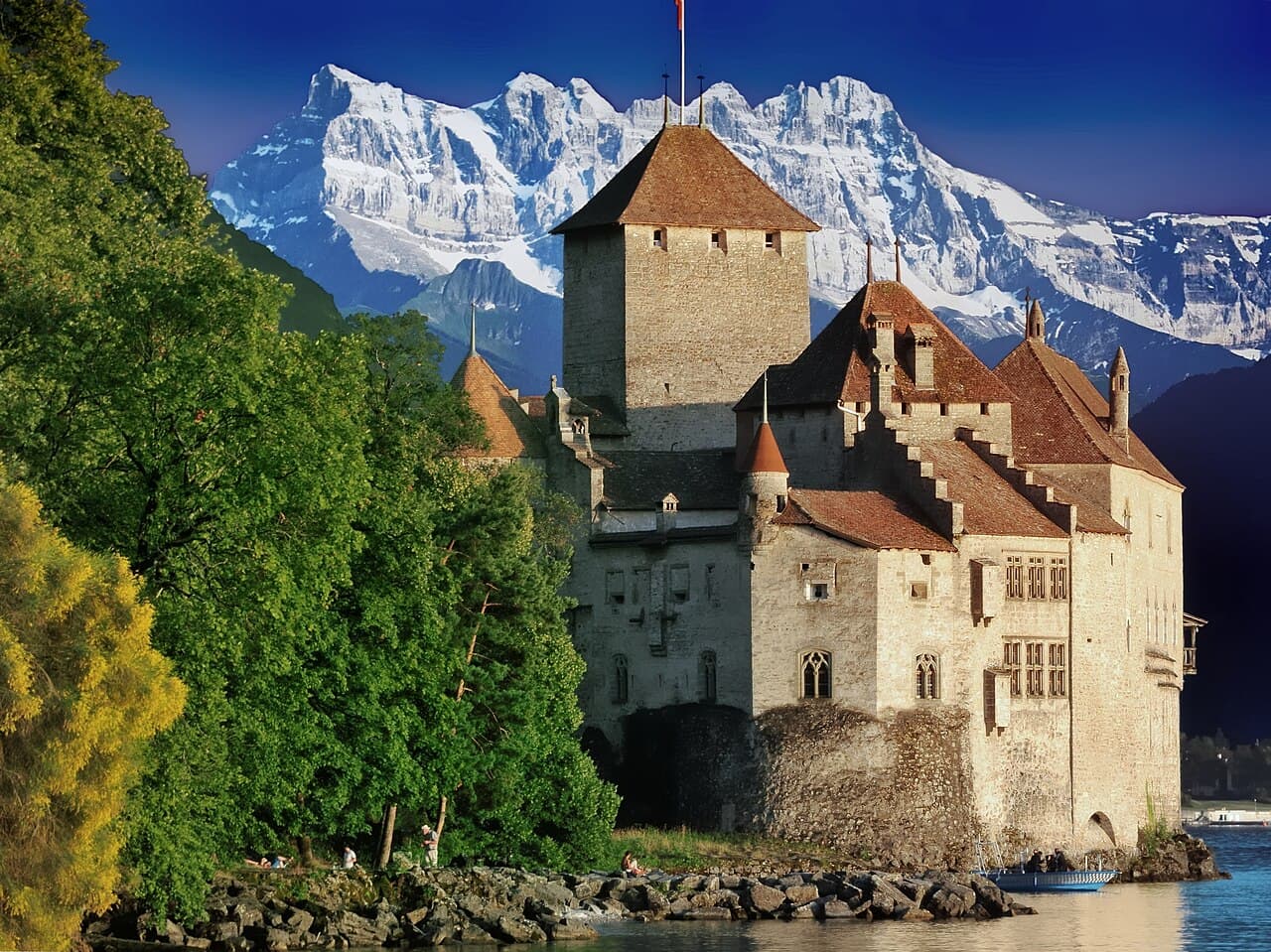
Chillon Castle occupies an oblong island approximately 110 meters long and 50 meters wide, rising about eight meters above the lake surface. The castle complex comprises around 25 buildings and 40 interior rooms arranged over several levels, enclosed by two concentric defensive walls. Its architectural design is uniquely adapted to the oval shape of the rocky island, blending harmoniously with the natural landscape.
Defensive structures
The castle's defenses include a large rectangular donjon (main tower) rising about 25 meters high, several semi-circular towers, and thick curtain walls featuring machicolations—openings for dropping projectiles on attackers—and narrow arrow slits. The 13th century saw the addition of a second defensive wall with three half-round towers on the landward side, enhancing protection against siege warfare. The moat surrounding the island was originally water-filled, serving as a natural barrier, and was restored to this state in the early 20th century after being filled in during the 18th century.
Residential and ceremonial spaces
The castle's interior includes a series of significant rooms such as the great hall (aula nova), the Camera domini or ducal chamber, and a chapel adorned with 14th-century frescoes by Jean de Grandson depicting religious and heraldic themes. The residential quarters were expanded under the rule of Counts Thomas I, Peter II, and Amadeus VI of Savoy during the 12th to 14th centuries, reflecting the castle's dual role as both a military fortress and a noble residence.
Historical significance and ownership
For nearly four centuries, from the 12th to the early 16th century, Chillon Castle was the domain of the powerful House of Savoy. The castle functioned as a residence, administrative center, and toll station, controlling passage through the Alpine valleys and the lake. The Counts of Savoy invested in fortifying and embellishing the castle, making it a symbol of their regional power.
In 1536, the castle was seized by Bernese forces from the House of Savoy during their expansion into the Pays de Vaud region. Under Bernese rule, Chillon became the seat of the bailiff of Vevey and underwent modifications to accommodate firearms, including the addition of gunports and defensive adaptations. The Bernese also added stables, an external clock tower with a 16th-century mechanism, and renovated the residential areas. By 1733, the bailiff relocated to Vevey, and the castle's military importance declined, transitioning into a prison and military depot.
The castle was nationalized during the Vaudois Revolution in 1798 and has belonged to the Canton of Vaud since its foundation in 1803. Throughout the 19th century, it served variously as a military arsenal, prison, and storage facility.
Cultural impact and literary inspiration
Chillon Castle has inspired numerous writers, poets, and artists over the centuries. The British poet Lord Byron immortalized the castle in his poem The Prisoner of Chillon, recounting the imprisonment of the Catholic monk François Bonivard in the castle's dungeon during the early 16th century. This evocative underground prison, with its vaulted chambers and mysterious atmosphere, remains one of the castle's most captivating features, drawing visitors fascinated by its legends and history.
Other notable figures inspired by Chillon include Jean-Jacques Rousseau, Henry James, and painters such as William Turner, Eugène Delacroix, and Gustave Courbet. The castle's picturesque setting on Lake Geneva and its well-preserved medieval architecture have made it a muse for Romantic and modern artists alike.
Restoration and modern preservation
Restoration efforts began earnestly in the late 19th century with the founding of the Association for the Restoration of Chillon. Between 1896 and 1898, architect and archaeologist Albert Naef led extensive excavations and scientific restorations, aiming to preserve the castle's medieval fabric while distinguishing new additions. These efforts have ensured that Chillon Castle remains a well-preserved monument and a testament to medieval architecture.
Access to the castle is provided by a historic iron bridge built in 1861 over the railway line, one of Switzerland's oldest of its kind, with a roof added in 1937. The surrounding area includes a Savoyard park listed among Switzerland's historic gardens and a lakeside promenade connecting Montreux and Villeneuve. Modern visitor facilities, added in 2020, support the castle's preservation and enhance the visitor experience.
Today, visitors to Chillon Castle can explore four great halls, three courtyards, numerous bedrooms, and the evocative underground dungeon. The castle's blend of military architecture, noble residences, and artistic heritage make it a unique cultural landmark and a vivid window into medieval European history.
Frequently asked questions (FAQ)
- What is the historical significance of Chillon Castle?
- Chillon Castle is one of Switzerland's most important historical sites, dating back to the 12th century. It served as a strategic stronghold for various rulers and has seen countless historical events, making it a vital part of Swiss heritage.
- When was Chillon Castle built?
- Construction of Chillon Castle began in the 12th century, with significant expansions and renovations occurring over the centuries. The castle showcases a blend of architectural styles that reflect its long history and evolution.
- What are the opening hours for Chillon Castle?
- Chillon Castle is typically open to visitors daily, with hours varying by season. Generally, it opens at 9 AM and closes between 5 PM and 7 PM, so it's advisable to check the official website for the most current opening times.
- Can I visit Chillon Castle with children?
- Yes, Chillon Castle is a family-friendly destination with activities and exhibits suitable for children. The castle's guided tours and interactive displays make it an engaging experience for visitors of all ages.
- Is it possible to access Chillon Castle by public transport?
- Absolutely! Chillon Castle is easily accessible by train and bus, with regular services connecting it to nearby cities like Montreux and Lausanne. The scenic route along Lake Geneva also adds to the charm of your visit.
- What is the best time to visit Chillon Castle?
- The best time to visit Chillon Castle is during the spring and fall when the weather is mild, and the crowds are smaller. Summer offers vibrant scenery, but it can be quite busy, especially in July and August.
- How much do tickets cost for Chillon Castle?
- Ticket prices for Chillon Castle typically range from CHF 12 to CHF 15 for adults, with discounts available for students and children. Family tickets and guided tour options are also offered for a more enriching experience.
- What architectural styles can be seen at Chillon Castle?
- Chillon Castle features a mix of Romanesque and Gothic architectural styles, reflecting its long history and various periods of construction. Visitors can admire its impressive towers, fortified walls, and beautifully preserved interiors.
- Are there any nearby attractions to explore after visiting Chillon Castle?
- Yes, there are several attractions near Chillon Castle, including the scenic town of Montreux, the beautiful Lake Geneva, and the stunning Lavaux vineyards. These locations provide ample opportunities for sightseeing and outdoor activities.
Photo gallery

Information
Website
Visit websiteSources & official resources
Verify the information above using these authoritative references.
Loading map...
Visitor reviews
No reviews yet. Been here? Write the first review and help other travelers!
Write the first reviewVisited this castle? Share your experience
Your review helps other travelers and adds first-hand knowledge to our encyclopedia.