Cheb Castle
Cheb Castle, located in the town of Cheb in the present-day Czech Republic, stands as one of the oldest and most historically significant castles in the region. Its origins date back to the early 12th century, when it was constructed on the site of a former Slavic settlement that had existed since around 900 AD. This strategic location on a rocky spur overlooking the Ohře (Eger) river provided natural defensive advantages and made the site an important administrative and military center.
The castle's early development was closely tied to the powerful Hohenstaufen dynasty of the Holy Roman Empire. Under the reign of Emperor Frederick I Barbarossa, beginning in 1179, Cheb Castle was transformed from a regional stronghold into a magnificent Kaiserpfalz (imperial palace). This period of expansion included the construction of a Romanesque palace, the imposing Black Tower which served as the main defensive keep and political prison, and the remarkable double chapel dedicated to St. Martin, St. Erhard, and St. Ursula. These architectural elements highlight the castle's dual role as both a military fortress and a ceremonial residence for imperial authority.
Early history and medieval significance
The site of Cheb Castle was initially a Slavic fortified settlement, evidenced by archaeological finds such as graves and wooden-earth ramparts dating back to the 10th century. Around 1120-1125, the castle was built by Margrave Diepold III of Vohburg to serve as an administrative center for the Bavarian Nordgau region. This construction marked the beginning of Cheb as a key seat of regional governance.
By the latter half of the 12th century, the castle fell under the control of the Hohenstaufen dynasty. Emperor Frederick Barbarossa's expansion efforts elevated Cheb to an imperial palace, reflecting its importance within the Holy Roman Empire. The castle's layout was reconfigured to include a two-part core with a front defensive wall flanked by two round towers, one of which was later replaced by the rectangular Black Tower.
The Black Tower and defensive structures
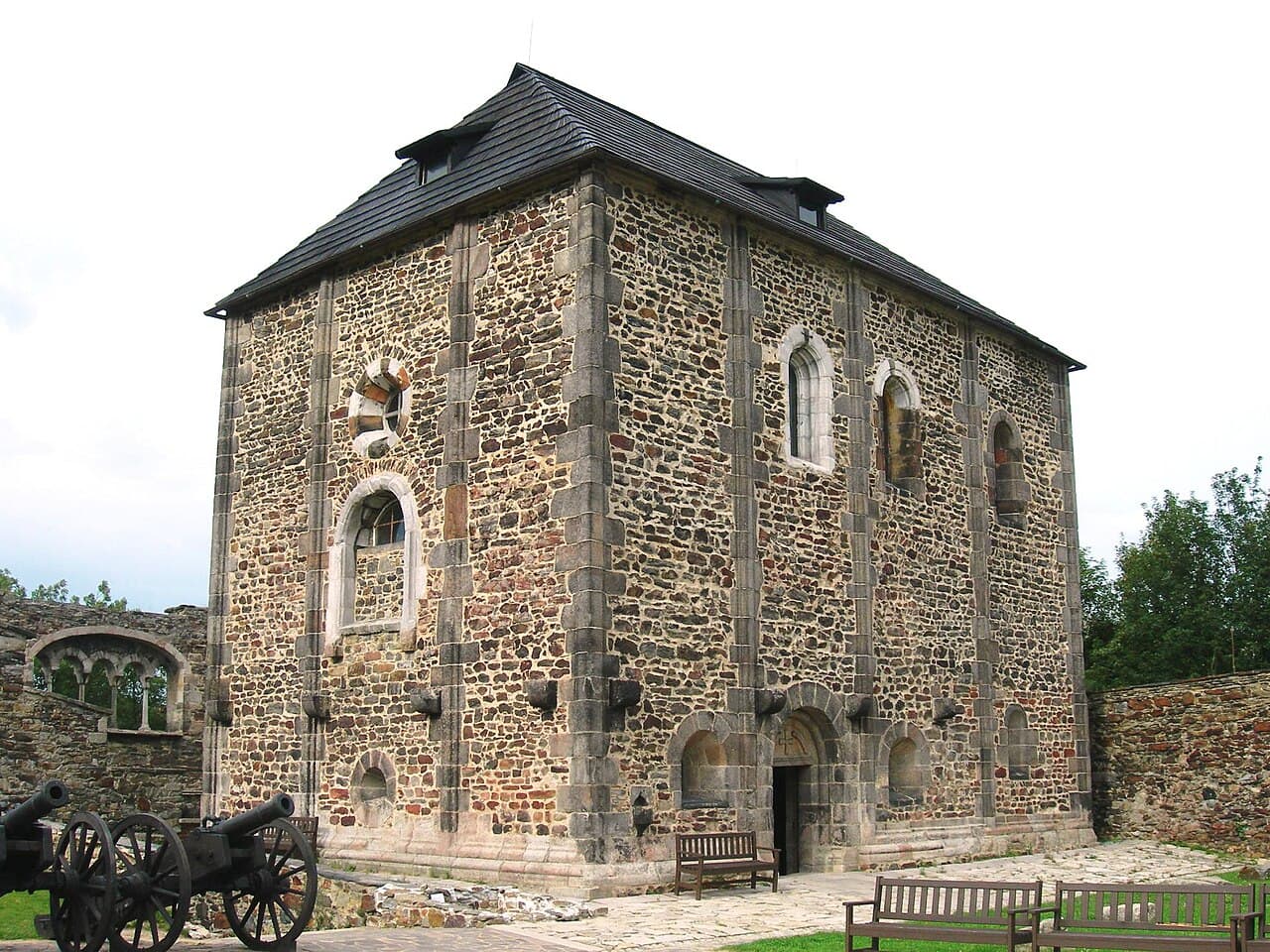
The Black Tower is the oldest surviving structure of the castle and exemplifies medieval military architecture. Built of dark basalt stones arranged in bossage technique, its walls exceed three meters in thickness at the ground level, providing formidable defense. Rising approximately 18.5 meters, the tower functioned as a bergfried and political prison. The uppermost floor, added in the 18th century with rubble stone, contrasts visually with the original basalt masonry.
Cheb's double chapel: religious and imperial symbolism
The castle's double chapel is a rare and architecturally significant feature that underscores the fusion of spiritual and secular power. The lower chapel, dedicated to St. Martin, is built in the Romanesque style with eight bays supported by four granite columns and covered by groin vaults. This space was intended for use by the imperial court and local worshippers.
Above it lies the upper chapel, dedicated to St. Erhard and St. Ursula, reserved exclusively for the imperial family. This sanctuary exhibits a transitional style between late Romanesque and early Gothic architecture, featuring ribbed vaults supported by white marble columns. The double chapel represents a unique architectural ensemble reflecting the castle's high status.
Later medieval and early modern developments
After the decline of the Hohenstaufen dynasty, Cheb Castle passed through the hands of various rulers, including King Ottokar II of Bohemia and the Luxembourg dynasty. Throughout the late Middle Ages, the castle mainly served ceremonial and representational functions. The palace on the northern side housed the imperial hall, which was central to official events.
In 1472, a significant fire damaged parts of the castle, prompting reconstruction and defensive upgrades. The late medieval period also saw the addition of two round towers, Mlýnská and Skalní, in the outer bailey overlooking the river, enhancing the castle's fortifications.
The castle's military importance was renewed during the Thirty Years' War in the 17th century. After the war, the fortifications were modernized with Baroque bastions, completed under Habsburg rule by 1713. These additions transformed Cheb Castle into a fortified citadel, reflecting changes in military technology and strategic needs.
Historical events and cultural significance
A notable event occurred in 1634 within the castle's great hall, where officers loyal to the military leader Albrecht von Wallenstein were assassinated. This incident is famously depicted in literature by 19th-century writer Theodor Fontane, embedding the castle in cultural memory.
By the 19th century, Cheb Castle had lost its military function and gradually fell into neglect. However, it attracted attention from prominent figures such as Johann Wolfgang von Goethe, who visited in 1821 and recorded his impressions. In 1895, the town of Cheb acquired the castle and initiated preservation efforts to protect its historical legacy.
Archaeological discoveries and preservation efforts
Excavations at Cheb Castle have revealed traces of the original Slavic fortifications, including wooden-earth ramparts reinforced with dry-laid stone walls and defensive ditches. The discovery of two Slavic graves with crosses near the site provides tangible links to the early medieval inhabitants and their customs.
Restoration and conservation efforts have been ongoing since the late 19th century, with significant repairs completed in 2007. The castle's masonry has been stabilized to prevent deterioration, and the area beneath the bastion walls has been landscaped into a park, enhancing the site's aesthetic and protective environment.
Today, visitors can explore the castle's courtyard bordered by the palace walls and the double chapel. A modern Staufer stele commemorates the 800th anniversary of the Golden Bull of Eger (1313), linking the castle to its imperial heritage. The site remains a protected national cultural monument, showcasing a rich architectural and historical tapestry spanning from the early medieval period through the Baroque era.
Frequently asked questions (FAQ)
- What is the historical significance of Cheb Castle?
- Cheb Castle is one of the oldest castles in Czechia, originally built in the 12th century and expanded by Emperor Frederick Barbarossa as an imperial palace, reflecting its importance in the Holy Roman Empire.
- Can visitors see the double chapel at Cheb Castle?
- Yes, the castle's unique double chapel, with its Romanesque lower chapel and transitional Gothic upper chapel, is well preserved and accessible to visitors.
- When was Cheb Castle built?
- Cheb Castle was constructed in the early 12th century, around 1120-1125, on the site of a former Slavic settlement.
- Is Cheb Castle open to the public?
- Cheb Castle is managed by the municipality and is accessible to visitors, though specific visiting hours and ticket prices may vary and should be checked in advance.
- What architectural styles are represented at Cheb Castle?
- Cheb Castle primarily features Romanesque architecture with elements of early Gothic visible in the upper chapel, along with later Baroque fortification additions.
Photo gallery

Information
Sources & official resources
Verify the information above using these authoritative references.
Loading map...
Visitor reviews
No reviews yet. Been here? Write the first review and help other travelers!
Write the first reviewVisited this castle? Share your experience
Your review helps other travelers and adds first-hand knowledge to our encyclopedia.