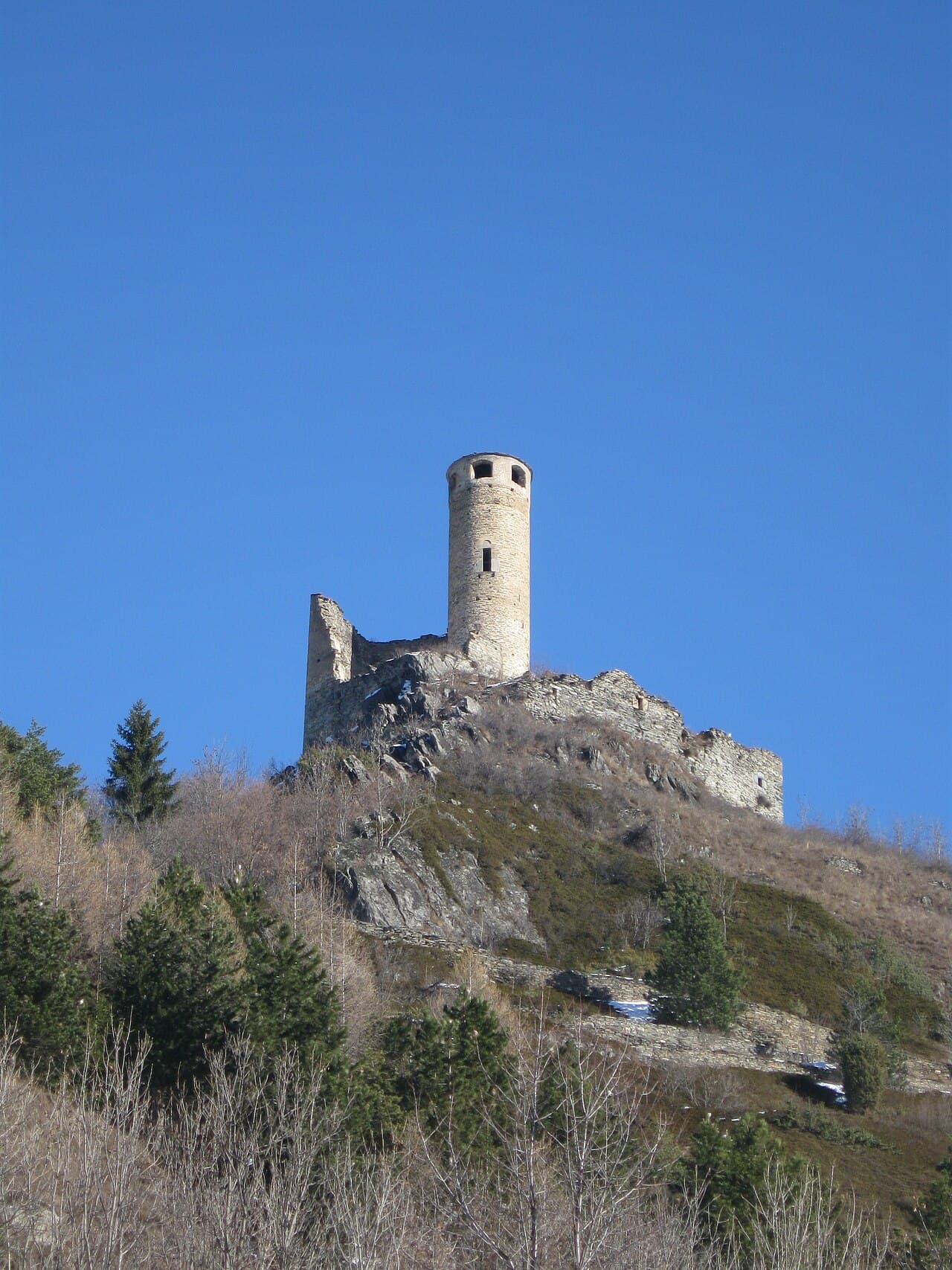
Châtelard Castle, located near the village of La Salle in the Aosta Valley region of Italy, is a striking example of a high medieval hill castle constructed in the early 13th century. Founded around 1243 by Rodolphe Grossi, the bishop of Aosta and later archbishop of Tarantasia, this fortress served as a strategic stronghold overseeing the vital Alpine passage of the Little St. Bernard Pass. Its position allowed control over the surrounding valley and trade routes, making it a key military and administrative site during the medieval period.
Origins and historical context
The castle's construction is closely linked to the House of Savoy, with Rodolphe Grossi acting as a trusted advisor to Peter II, Count of Savoy. The first documentary mention of Châtelard Castle dates to 1248, appearing in a feudal homage that describes its distinctive circular tower and adjoining buildings. This circular tower, or donjon, is architecturally significant as it reflects a brief regional trend favored by Peter II, characterized by robust, rounded keeps designed for improved defense.
In 1269, the castle complex was expanded to include a chapel located to the north of the main structure. This chapel functioned as a religious space for several centuries before being repurposed into a secular room in the 19th century, illustrating changing uses over time.
Military significance and conflicts
Châtelard Castle's strategic importance made it a target during regional conflicts. In September 1285, forces from the Dauphiné launched an assault amid hostilities involving Duke Amadeus V of Savoy, Bishop Robert of Geneva, and Count Amadeus II of Geneva. The castle was plundered during this raid, underscoring the turbulent political landscape of the late 13th century in the Savoyard territories.
By the early 14th century, the castle's role expanded to include commercial privileges granted in 1301 by Amadeus V, which promoted trade activities in the surrounding area. However, the fortress also witnessed contested ownership, notably during armed conflicts between Amadeus V and Amadeus III of Geneva, with the castle passing into the hands of Count Odoardo of Savoy at one point.
Ownership and decline through the centuries
Ownership of Châtelard Castle shifted frequently from the 14th to the 17th centuries, reflecting the complex feudal dynamics of the region. The castle was held by various noble families including the Grossi du Châtelard, the Counts of Savoy, the Quart family, and the d’Avise family. The noble Châtelard line ended tragically in 1691 when the last heir was killed during a French invasion, marking a significant turning point in the castle's history.
The fortress suffered major damage during the French Revolutionary Wars in 1793, when French troops invaded Savoy, severely impacting the castle’s structure. In 1798, the ruins were acquired by the Léaval family, who maintained ownership for over a century before it passed to Élise Donnet and eventually to the Béneyton family, current private owners. The castle remains closed to the public today.
Architectural features and layout
The castle's most prominent feature is its circular donjon, which stands approximately 18 meters high with a diameter exceeding five meters. This tall tower was designed with a high entrance located about 10 meters above ground level, a defensive measure to hinder attackers. The circular design was unusual for its time but reflected the innovative military architecture promoted by Peter II of Savoy.
Attached to the donjon is a square residential building, both enclosed within an irregularly shaped curtain wall adapted to the rocky promontory on which the castle is built. The builders skillfully integrated the natural terrain into the castle’s design, using heavy stones hauled up steep slopes with ropes and draft animals, demonstrating the challenging alpine construction conditions.
While the donjon remains largely intact, much of the surrounding structures, including the residential quarters and the former double curtain walls, survive only as ruins. The 13th-century chapel north of the main complex was later converted into a secular space in 1824, reflecting the castle’s evolving function over time.
Defensive innovations
The high entrance to the donjon is a notable defensive innovation, preventing direct access and forcing attackers to use ladders or siege equipment. The curtain walls provided an additional layer of protection, enclosing the living quarters and creating a defensible courtyard. The castle's position atop a rocky hill further enhanced its defensive capabilities by limiting approaches and providing clear sightlines across the valley.
Surrounding medieval structures
In the vicinity of Châtelard Castle, several other medieval fortified dwellings contribute to the area's historical landscape. These include the Pascal fortified house, the Aragon fortified manor house, Maison Gerbollier near the home of the Ecours family, and the notarial castle in the village of Derby. Together, these structures form a network of medieval fortifications that reflect the region’s feudal and military history.
Current status and cultural significance
Today, Châtelard Castle stands as a ruined hill castle with its imposing donjon still visible above the landscape. Although it is privately owned and not open to the public, the castle remains an important cultural landmark in the Aosta Valley, symbolizing the medieval heritage of the region and the historical influence of the House of Savoy.
The castle’s architectural features provide valuable insight into 13th-century military construction techniques and the adaptation of fortifications to alpine environments. Its history of conflict, changing ownership, and eventual decline illustrate the complex political and social transformations that shaped the Savoyard territories over several centuries.
Preservation efforts have been limited, leaving much of the castle in a state of ruin, but the surviving structures continue to attract scholarly interest and contribute to the understanding of medieval fortifications in northern Italy.
Frequently asked questions (FAQ)
- How do I get to Châtelard Castle?
- To reach Châtelard Castle, you can take a scenic drive through the Aosta Valley, following signs to La Salle. Public transport options include local buses that connect to the nearby towns. The castle is situated on a hill, so be prepared for a short hike to enjoy its stunning views.
- What is the historical significance of Châtelard Castle?
- Châtelard Castle dates back to the 13th century and played a crucial role in the defense of the region against invasions. It served as a noble residence and has been a witness to the rich history of the Aosta Valley. The castle's architecture reflects the medieval military style, making it a significant landmark.
- When was Châtelard Castle built?
- Châtelard Castle was constructed in the early 13th century, around 1225. Its strategic location was chosen to oversee and protect the valley from potential threats. Over the centuries, it has undergone various renovations but retains much of its original medieval charm.
- Can I visit Châtelard Castle during the winter?
- Yes, Châtelard Castle is open to visitors year-round, but accessibility may vary during the winter months due to weather conditions. It's advisable to check the local weather forecast and road conditions before planning your visit. Winter visits can offer a unique perspective of the castle surrounded by snow.
- Why is Châtelard Castle a popular tourist destination?
- Châtelard Castle attracts visitors for its stunning architecture and breathtaking views of the surrounding mountains. Its rich history and picturesque setting make it a perfect spot for photography and exploration. The castle also hosts various cultural events, enhancing its appeal to tourists.
- Is it possible to tour the interior of Châtelard Castle?
- Yes, guided tours of the interior of Châtelard Castle are available, allowing visitors to explore its historical rooms and learn about its significance. Tours provide insights into the castle's architecture and the lives of its former inhabitants. It's recommended to book in advance during peak tourist seasons.
- What are the opening hours for Châtelard Castle?
- Châtelard Castle is typically open to the public from April to October, with varying hours depending on the season. During the summer months, the castle often opens earlier and closes later to accommodate more visitors. Always check the official website for the most current opening hours before your visit.
- What are the ticket prices for visiting Châtelard Castle?
- Ticket prices for Châtelard Castle are generally affordable, with discounts available for children, seniors, and groups. As prices may vary slightly by season or for special events, it's best to check the official website for the latest information. Purchasing tickets in advance can help avoid long lines during busy times.
- What are some nearby attractions to Châtelard Castle?
- Nearby attractions include the charming village of La Salle, the stunning natural landscapes of the Mont Blanc region, and several hiking trails in the Aosta Valley. Visitors can also explore other historical sites and castles in the area. This makes Châtelard Castle an excellent starting point for a day of exploration.
Photo gallery

Photo by Rollopack•Public domain
Information
Loading map...
Visitor reviews
No reviews yet. Been here? Write the first review and help other travelers!
Write the first reviewVisited this castle? Share your experience
Your review helps other travelers and adds first-hand knowledge to our encyclopedia.



