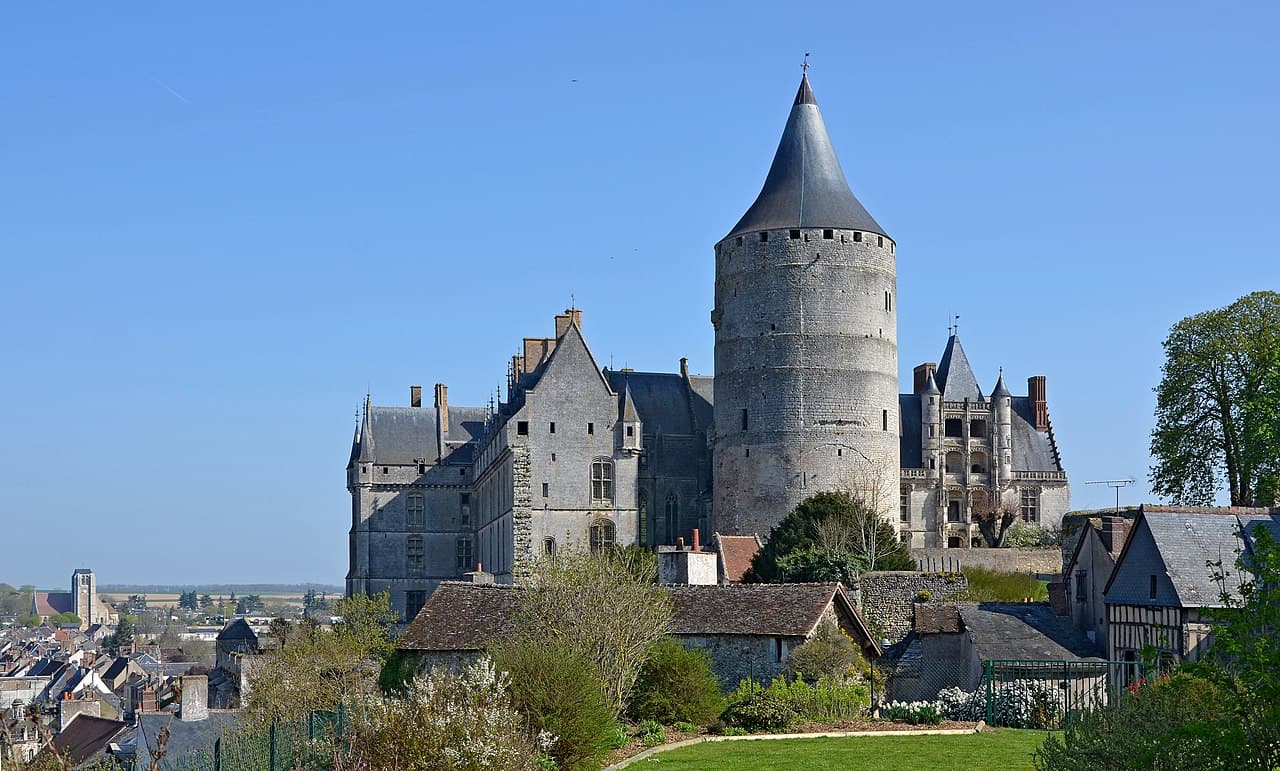
Châteaudun Castle
Châteaudun Castle, or Château de Châteaudun, is a remarkable historic fortress located in the town of Châteaudun in the Eure-et-Loir department of France. Perched on a limestone outcrop overlooking the Loir river, the castle exemplifies the architectural evolution from a medieval stronghold to a Renaissance residence. Its origins date back to the 12th century, making it a significant monument that reflects centuries of French noble history and architectural styles.
The castle's foundation was laid around 1171 by Theobald V, Count of Blois, who constructed the imposing cylindrical keep, a classic feature of medieval military architecture. This keep was likely built on the site of an earlier fortification, emphasizing the strategic importance of the location. The castle remained under the Counts of Blois until 1391, when it was sold to Louis I, Duke of Orléans, brother to King Charles VI of France. Following Louis's assassination in 1407, ownership passed to his son, Charles of Orléans.
The transformative era under Jean de Dunois
In 1439, Charles of Orléans gifted the castle to his half-brother Jean de Dunois, a prominent French military leader known for his role in the Hundred Years' War alongside Joan of Arc. Jean initiated an ambitious reconstruction and expansion of the castle in the Gothic style starting in 1459. This included the construction of the west wing, known as the "Dunois wing," which added residential comfort and grandeur to the fortress.
Jean de Dunois also commissioned the building of the Sainte-Chapelle between 1451 and 1493. The chapel's choir and high chapel were completed between 1451 and 1454, followed by the nave and oratory between 1460 and 1464. This chapel is a notable example of late Gothic religious architecture, featuring intricate stonework and stained glass that reflect the artistic sensibilities of the period.
Expansion and Renaissance influence under the Dukes of Longueville
After Jean de Dunois's death in 1468, his descendants, the Dukes of Longueville, continued the castle's development. François I of Orléans-Longueville began construction of the north wing between 1469 and 1491, further enhancing the castle's residential and defensive capabilities. The upper floors were added in the early 16th century by François II d'Orléans-Longueville and his successors, incorporating Renaissance architectural elements that softened the fortress's medieval austerity.
The castle's main body features a roof in the Gothic style and houses a finely carved staircase from this period, showcasing the craftsmanship and artistic detail characteristic of the transition from medieval to Renaissance design. This blend of styles makes Châteaudun Castle a unique example of architectural evolution over several centuries.
Later history, decline, and restoration
When the Longueville line ended without heirs in 1694, the castle passed to the Dukes of Luynes. By the early 18th century, the castle was partially abandoned but served as a refuge for the townspeople during a devastating fire in 1723. The French Revolution at the end of the 18th century brought further hardship; the castle's chapel was ransacked, and the buildings were repurposed as military barracks.
The 19th century saw renewed interest in the castle's preservation. The 8th Duke of Luynes undertook restoration efforts in 1866, although the castle suffered damage during the Battle of Châteaudun in 1870 when Prussian troops attacked. Later, in 1938, the French state acquired the castle and initiated restoration work to preserve its historical and architectural significance.
However, the castle endured further damage in 1944 when an explosion of the nearby bridge over the Loir caused shockwaves and debris that destabilized the upper parts of the structure. Despite these setbacks, ongoing restoration has allowed Châteaudun Castle to remain a vital cultural landmark.
Architectural highlights and visitor experience
Today, Châteaudun Castle comprises several key components: the original keep, the Sainte-Chapelle, the Dunois wing, and the Longueville wing. Visitors can explore a wealth of interior spaces, including grand halls, chambers, and the finely crafted staircase, which exemplify the castle's rich architectural heritage.
The castle's location on a rocky promontory offers impressive views of the Loir river and the surrounding landscape, emphasizing its historical strategic importance. Its classification as a historic monument since 1918 underscores its cultural significance in France.
Châteaudun Castle is open to the public for a fee, providing an engaging experience for those interested in medieval and Renaissance architecture, French history, and noble heritage. The imposing keep remains a highlight, symbolizing the castle's origins as a fortified stronghold.
Frequently asked questions (FAQ)
- When was Châteaudun Castle originally built?
- Châteaudun Castle was originally founded around 1171 by Theobald V, Count of Blois, who built the massive circular keep on a rocky outcrop.
- What architectural styles are represented in Châteaudun Castle?
- The castle features primarily Gothic architecture with later Renaissance additions, including the Sainte-Chapelle and wings built in the 15th and early 16th centuries.
- Can visitors explore the interior of Châteaudun Castle?
- Yes, visitors can explore numerous interior spaces such as halls, chambers, and the finely carved staircase, which showcase the castle's historical and architectural evolution.
- Is Châteaudun Castle accessible year-round?
- The castle is open daily from 10:00 to 18:00, allowing year-round access except during certain holidays or maintenance periods.
- What is the significance of Jean de Dunois in the castle's history?
- Jean de Dunois, a key figure in the Hundred Years' War, significantly transformed the castle in the 15th century by expanding it in Gothic style and commissioning the Sainte-Chapelle.
Photo gallery

Information
Opening hours
10:00-18:00, daily
Ticket prices
€7 adult, €4 child
Current owner
French state
Website
Visit websiteAddress
Pl. Jehan de Dunois, Châteaudun, France
Sources & official resources
Verify the information above using these authoritative references.
Loading map...
Visitor reviews
No reviews yet. Been here? Write the first review and help other travelers!
Write the first reviewVisited this castle? Share your experience
Your review helps other travelers and adds first-hand knowledge to our encyclopedia.



