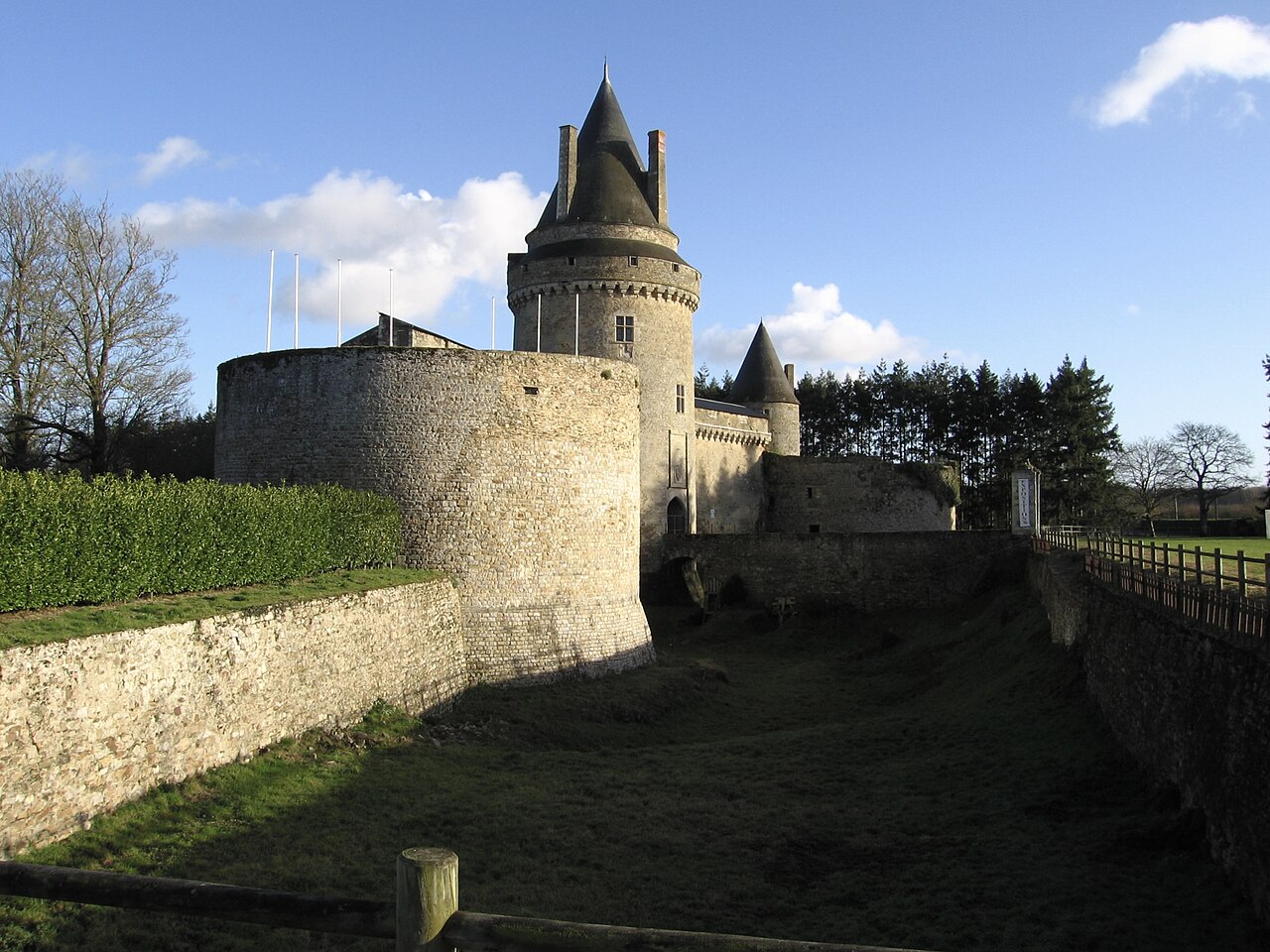
The Château du Goust is a historic hill castle located in the region of Hauts-de-France, France. Although the exact city remains unspecified, the castle is situated within the commune of Malville. The castle's origins trace back to the medieval period as a seigneurie, a feudal lordship that played a significant role in the local governance and military defense of the region.
Early ownership and noble lineage
The earliest recorded ownership of the Château du Goust dates to 1370, when it was held by Jeanne d’Ussé, Dame de Montjean. Following her tenure, the castle passed to Jean de Comenan until around 1400. The fifteenth century saw the property under the control of the Montfort family, a noble lineage that influenced the castle's history significantly. A pivotal moment occurred when Moricette de Montfort married Robert de Brochereul, linking two noble houses. In 1418, the seigneurie was inherited by their daughter, Jeanne Brochereul, titled Dame du Bois de la Roche. Her marriage to Guillaume de Montauban further connected the château to prominent noble families.
Military significance during the french wars of religion
The château gained heightened military importance during the turbulent French Wars of Religion in the late sixteenth century. Jean de Montauban, known as the chevalier du Goust, fortified the castle in 1589 to defend against the Catholic League and Spanish forces. Between 1576 and 1596, he actively resisted these factions, underscoring the château's strategic value. This period marked the castle as a focal point of regional conflict, with a royal garrison stationed there in 1601 to maintain control over the area.
Decline and dismantling under cardinal richelieu
Despite its earlier military role, the château's defensive function was curtailed when Cardinal Richelieu, the influential minister of King Louis XIII, ordered its dismantling around 1627–1628. This was part of Richelieu's policy to reduce the power of fortified noble estates that could oppose the central monarchy. The dismantling significantly altered the château's structure and diminished its role as a military stronghold.
Later ownership and heritage status
By the late seventeenth century, the estate was under the ownership of Mercoeur Bardon, seigneur de Malville, maintaining its connection to local nobility. The château's historical significance was formally recognized in 2008 when it was designated as a protected historic monument in France, ensuring its preservation as part of the national cultural heritage.
Architectural remains and current condition
Detailed information about the château's architectural layout and features remains scarce. Photographs from 2013 provide visual documentation of the site, yet no comprehensive descriptions of its walls, gates, or interior chambers are available. There is no record of significant archaeological discoveries such as inscriptions or artifacts that might clarify its architectural style or construction techniques.
Current reports focus predominantly on the château's historical ownership and military role rather than its physical remains. The site is considered to be in a ruined state, with limited preserved structures. Its value today lies primarily in its documented history and status as a listed monument rather than as a well-preserved architectural example.
Historical context within the region
The Château du Goust's history reflects broader regional dynamics in northern France during the medieval and early modern periods. Its role during the French Wars of Religion highlights the intersection of noble power, religious conflict, and royal authority. The castle's dismantling under Richelieu illustrates the centralization efforts of the French monarchy in the seventeenth century, aimed at curbing the military independence of the nobility.
Feudal lordship and noble alliances
The castle's passage through several noble families, including the d’Ussé, Montfort, Brochereul, and Montauban houses, demonstrates the importance of marriage alliances in consolidating territorial control and influence. These alliances shaped the château's history and its political significance within the region.
Strategic military role
Situated as a hill castle, the Château du Goust occupied a strategic position that allowed control over surrounding lands. Its fortifications under Jean de Montauban were designed to withstand sieges and military incursions during a period marked by intense religious and political strife. The presence of a royal garrison further emphasizes its importance in maintaining regional stability.
Frequently asked questions (FAQ)
- What is the historical significance of Château du Goust?
- Château du Goust is a remarkable example of medieval architecture, dating back to the 12th century. It played a crucial role in the defense of the region during various conflicts and has been a witness to significant historical events throughout French history.
- When was Château du Goust built?
- The construction of Château du Goust began in the early 12th century, with many of its structures reflecting the architectural styles of that period. Over the centuries, it has undergone several renovations and expansions, showcasing the evolution of castle design.
- Can I visit Château du Goust?
- Yes, visitors are welcome to explore Château du Goust. Guided tours are available, allowing you to learn about its rich history and architectural features while enjoying the scenic views of the surrounding landscape.
- What are the opening hours of Château du Goust?
- Château du Goust is typically open to visitors from 10 AM to 6 PM, with extended hours during the summer months. It is advisable to check the official website or contact the castle directly for any seasonal changes or special events that may affect these hours.
- Is it possible to access Château du Goust with limited mobility?
- Château du Goust strives to be accessible to all visitors. However, due to its historical nature, some areas may have limited accessibility. It’s best to contact the castle before your visit to inquire about specific accessibility options and accommodations.
- What is the best time to visit Château du Goust?
- The best time to visit Château du Goust is during the spring and early fall when the weather is mild, and the gardens are in full bloom. Additionally, these seasons tend to be less crowded, allowing for a more enjoyable experience.
- What are the ticket prices for visiting Château du Goust?
- Ticket prices for Château du Goust vary depending on age and group size, typically ranging from €8 to €12 for adults. Discounts may be available for children, students, and seniors, so be sure to check for any available promotions before your visit.
- Are there any nearby attractions to visit while at Château du Goust?
- Yes, there are several nearby attractions worth exploring, including the picturesque village of Goust and the beautiful natural parks in the region. These sites offer additional cultural and recreational experiences, making your visit to Château du Goust even more memorable.
Information
Loading map...
Visitor reviews
No reviews yet. Been here? Write the first review and help other travelers!
Write the first reviewVisited this castle? Share your experience
Your review helps other travelers and adds first-hand knowledge to our encyclopedia.