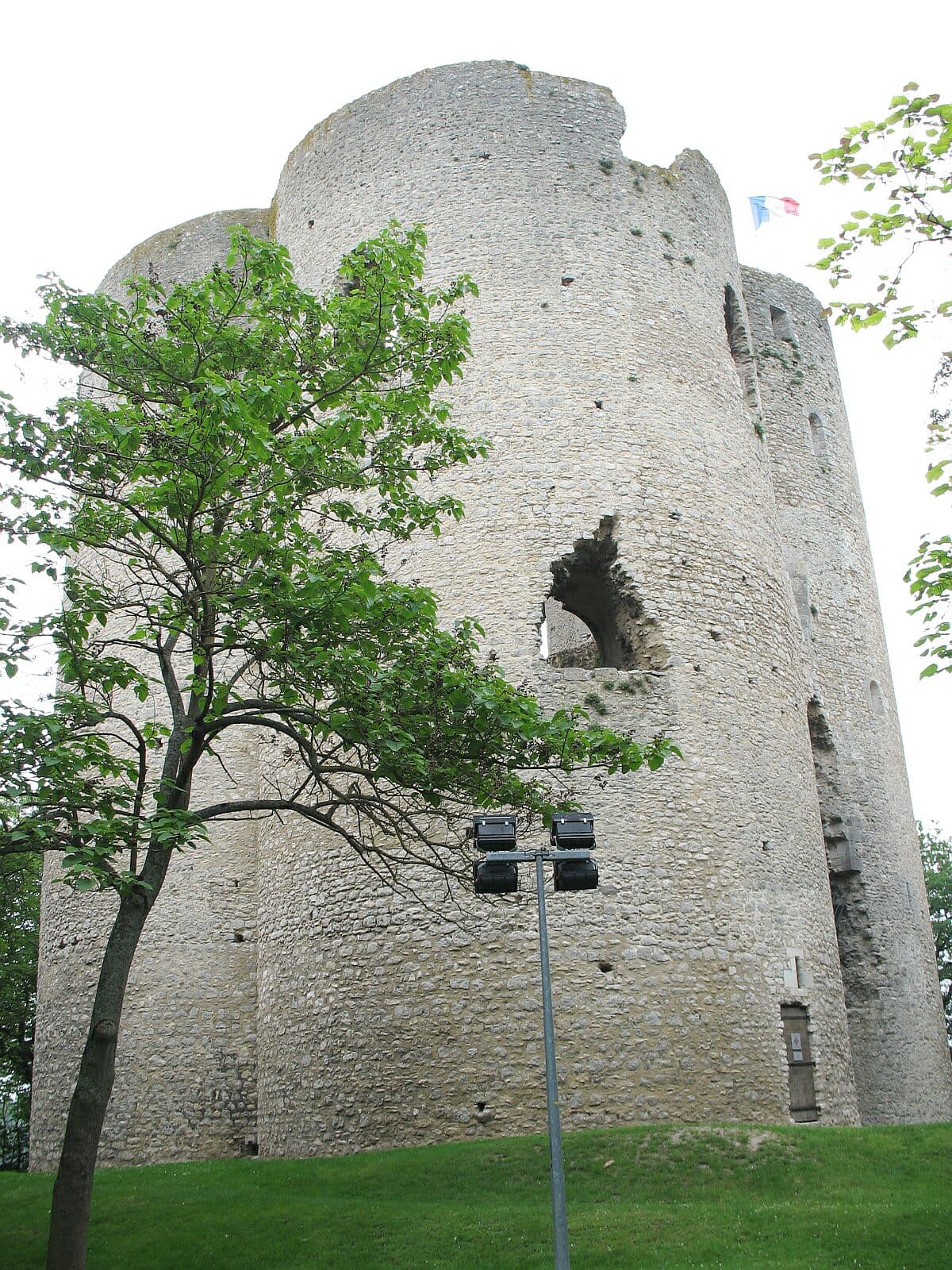
Château d'Étampes
The Château d'Étampes is a significant historic castle located in the town of Étampes, in the Essonne department of France. Its most notable surviving feature is the 12th-century keep known as the Tour de Guinette, a rare example of medieval military architecture that reflects innovative defensive design from the High Medieval period. Originally, the site served as a stronghold in the early 10th century under Robert the Pious, King of France, comprising both a palace and a motte, marking it as an important royal residence and fortification during the early medieval era.
Early origins and royal significance
The castle's origins trace back to the early 10th century, when it was established as a royal stronghold under the reign of Robert the Pious (reigned 996–1031). This early fortification included a palace proper and a motte, typical of early medieval castle construction aimed at asserting royal authority and controlling the surrounding territory. The strategic location in Étampes allowed the castle to oversee the valley and surrounding lands, serving both defensive and administrative functions.
Construction of the 12th-century castle and the tour de guinette
Between 1130 and 1150, the castle underwent significant redevelopment, resulting in the construction of a new fortress that prominently featured the Tour de Guinette, a formidable keep that dominates the site today. This keep is remarkable for its quatrefoil plan, a design resembling a four-leaf clover with four rounded lobes. This architectural innovation was part of a tactical experimentation during the mid-12th century to enhance the defense capabilities of the keep.
The quatrefoil design served multiple defensive purposes: the circular lobes effectively deflected incoming missiles, reducing the impact of siege weaponry. Additionally, this shape allowed defenders stationed at the summit to cover the base of the walls thoroughly, minimizing blind spots or "dead ground" where attackers could approach unseen. The keep rises to approximately 27 meters in height and is divided into four stories, with the first-floor access likely connected to the surrounding enclosure wall.
This innovative architectural form is comparable to other contemporary keeps such as those at Ambleny and nearby Houdan. The design of the Tour de Guinette is also believed to have inspired the construction of Clifford's Tower at York Castle in England, indicating its influence beyond France.
Castle layout and defensive structures
The Tour de Guinette was centrally positioned within the castle complex and was protected by a rectangular curtain wall punctuated by corner towers. This primary wall was itself enclosed by two additional concentric walls, creating multiple layers of defense to protect the keep and the inner bailey. Such a concentric defensive system was advanced for its time, allowing defenders to fall back to inner fortifications if outer walls were breached.
The castle's fortifications included battlements and arrow slits designed to maximize defensive coverage. The presence of multiple walls and towers also provided vantage points for surveillance and archery, essential for repelling sieges during the turbulent medieval period.
Historical events and later modifications
Throughout its history, the Château d'Étampes was extended and modified under various French monarchs, most notably under Philip II of France in the late 12th and early 13th centuries. These enhancements reflected the castle's ongoing strategic importance in the region.
During the Hundred Years War (1337–1453), the castle endured several sieges and military actions, which contributed to its gradual decline. Following these conflicts, the castle was ordered to be destroyed by Henry IV of France to prevent its use by enemies, a common practice to neutralize potential strongholds.
As a result, only the Tour de Guinette remains today, standing as a solitary reminder of the castle's former grandeur and military significance.
Architectural significance and cultural legacy
The Château d'Étampes is an important example of High Medieval military architecture in France. Its quatrefoil keep represents a unique and innovative approach to castle design, emphasizing both defensive strength and tactical advantage. The castle's layout, with its multiple layers of walls and towers, illustrates the evolution of fortification techniques during the 12th century.
Contemporary illustrations, including those found in the Très Riches Heures du duc de Berry, provide valuable visual documentation of the castle's appearance and structure during the medieval period. These images help historians and architects understand the castle's original form and its role within the medieval landscape.
The influence of the Château d'Étampes extends beyond France, as its architectural concepts inspired other European fortifications. The connection to Clifford's Tower in York highlights the cross-cultural exchange of military architectural ideas during the Middle Ages.
Current condition and preservation
Today, the Tour de Guinette remains the principal surviving structure of the Château d'Étampes. It is well preserved and stands as a prominent historical monument in the town of Étampes. The keep's distinctive shape and height make it a notable landmark visible from the surrounding area.
Efforts to maintain and conserve the keep ensure that this rare example of medieval fortification continues to be accessible to the public and serves as a valuable educational resource on medieval architecture and history.
Frequently asked questions (FAQ)
- When was Château d'Étampes originally constructed and by whom?
- The original stronghold at Château d'Étampes dates back to the early 10th century under King Robert the Pious of France. The current castle structure, including the Tour de Guinette, was built between 1130 and 1150.
- What is unique about the architecture of the Tour de Guinette?
- The Tour de Guinette features a rare quatrefoil plan, resembling a four-leaf clover, designed to deflect missiles and allow defenders to cover the base of the walls, enhancing its defensive capabilities.
- Can visitors access the Château d'Étampes today?
- The Tour de Guinette is well preserved and accessible to visitors, serving as a historical monument in Étampes. Specific visiting hours and ticket prices may vary, so checking locally before a visit is recommended.
- How did the Château d'Étampes influence other castles?
- The architectural design of the Tour de Guinette inspired other medieval fortifications, including Clifford's Tower at York Castle in England, demonstrating its significance in European castle architecture.
- What defensive features did Château d'Étampes have?
- The castle included multiple layers of defensive walls, corner towers, and a rectangular curtain wall surrounding the keep, providing strong protection during sieges, especially in the Hundred Years War.
Photo gallery

Photo by CJ DUB•Attribution
Information
Loading map...
Visitor reviews
No reviews yet. Been here? Write the first review and help other travelers!
Write the first reviewVisited this castle? Share your experience
Your review helps other travelers and adds first-hand knowledge to our encyclopedia.



