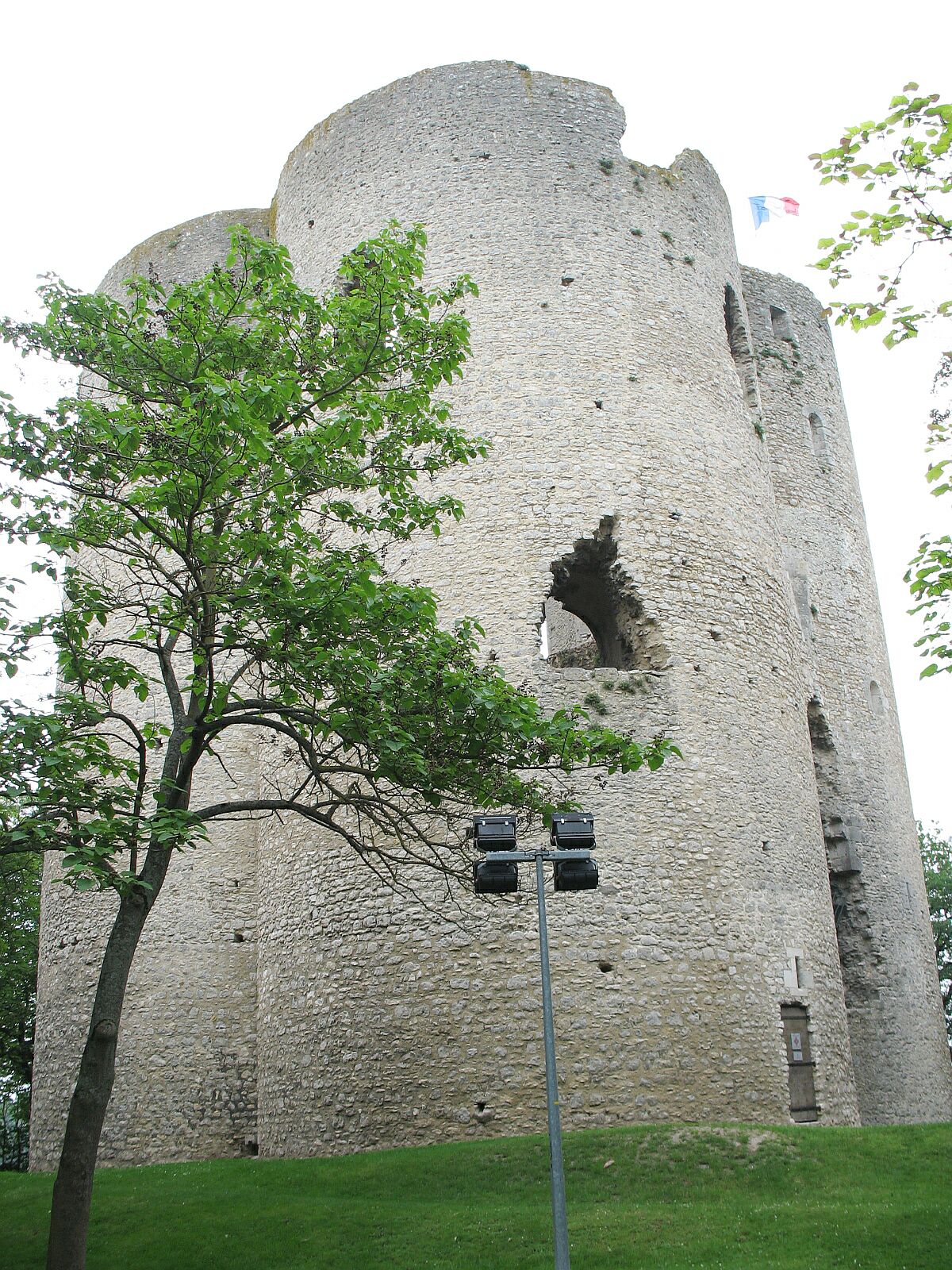
Château de Farcheville
The Château de Farcheville stands as a remarkable example of high medieval castle architecture in northern France, located in Bouville, within the Hauts-de-France region. Constructed primarily in the late 13th and early 14th centuries, this castle reflects the ambitions and status of its original builders, Hugues II and Hugues III, Lords of Farcheville and Bouville, who served as chamberlains to Philip IV of France. The castle's design combines military and residential functions, showcasing distinctive architectural features that are rare for its geographic location.
Construction began around 1290, with the great hall completed in 1291 and the castle chapel consecrated in 1304. These early structures established the castle as a fortified manor house, balancing defense with noble residence. The chapel is particularly notable for its early 14th-century murals and intricately carved wooden ceiling panels depicting angels playing musical instruments, highlighting the artistic and spiritual investment in the site.
Architectural features and military design
The castle is built as a large, rectangular enclosure surrounded by a moat, characteristic of a hill castle despite its location in relatively lowland terrain. Its curtain walls are supported by corner towers and feature a rare northern French example of arched machicolations on buttresses. These machicolations, defensive openings allowing defenders to drop projectiles on attackers, are set upon large pointed arches, a design more typical of the Languedoc region's military architecture. This unique feature suggests a deliberate architectural choice to incorporate southern defensive elements, enhancing the castle's fortification.
The primary entrance is marked by a rectangular keep (donjon) attached to a pavilion from the early 1600s. The keep, along with its spiraling staircase and entrance porch, rises above the rest of the buildings, indicating the castle's original height and defensive profile before damage sustained during the French Revolution. The original drawbridge was removed by the mid-18th century and replaced by a fixed stone bridge at the fortified gatehouse.
Internal layout and functional sectors
The castle's interior was historically divided into two main sectors: a large western cour d'honneur containing principal residential and ceremonial buildings, and an eastern sector dedicated to agricultural and service functions. This division reflects the dual role of the estate as both a noble residence and a working manor with extensive lands.
Within the walls, several medieval buildings remain, including the lordly hall adjacent to the great hall, a tithe barn for storing agricultural levies, a bakery, the consecrated chapel, and the chaplain's house. Over the centuries, various service buildings, stables, a dovecote, and a residential wing underwent modifications, especially between the 16th and 19th centuries, adapting the estate to changing needs.
Historical significance and ownership
After its initial construction by the Bouville family, the castle passed in 1407 to the Châtillon-sur-Loing branch of the Coligny family, a prominent Protestant lineage. The castle endured significant turmoil during the French Wars of Religion, suffering three pillagings between 1567 and 1576. Following this period, extensive repairs were undertaken from 1578 to 1604 to restore the estate.
During the 17th and 18th centuries, the castle changed hands among wealthy judicial families, including the Jappin family and later Vincent Michel Maynon, a high-ranking judicial official. These owners maintained the property as its defensive importance waned. By the late 18th century, the castle's moats were repurposed for agriculture, and the drawbridge was no longer in use.
The French Revolution brought damage to the structure, including the partial demolition of curtain wall arches and battlements. In the 19th century, restoration efforts included the addition of a carriage house designed by Alphonse Adam in 1858 and a major campaign starting in 1899 to reconstruct the curtain wall and battlements, as well as to restore the main façade and build a covered wall walk supported by arcades.
In the 20th century, the castle was officially recognized as a historic monument by 1948, with further preservation work carried out in the 1980s. The estate has since been privately owned, including by film producer Jean Chalopin, who modernized the castle for private events while respecting its heritage.
Cultural and architectural legacy
The Château de Farcheville today offers a layered historical narrative through its preserved medieval and later structures. The chapel remains a highlight with its early 14th-century wall paintings and wooden ceiling carvings, underscoring the castle's cultural and religious significance. The castle's distinctive military features, such as the arched machicolations and fortified curtain walls, combined with its residential and agricultural buildings, illustrate the evolution of a medieval fortified manor adapting through centuries of political, religious, and social change.
The restoration of the chemin de ronde or wall walk around 1900, supported by arcades, reinstates the defensive walkways typical of medieval castles, allowing visitors to experience the castle's fortifications as originally intended. The castle's stone masonry, likely once covered with plaster, adds to its historic character despite the partial loss of this finish.
As a well-preserved example of a high medieval hill castle with unique architectural elements uncommon in northern France, Château de Farcheville stands as a significant heritage site. Its combination of military innovation, noble residence, and agricultural estate offers valuable insight into the complexities of medieval castle design and function in the French context.
Frequently asked questions (FAQ)
- What is the historical significance of Château de Farcheville?
- Château de Farcheville, built in the 14th century, is a stunning example of medieval architecture in France. It played a crucial role in the region's defense during the Hundred Years' War and has seen many historical events unfold over the centuries.
- When was Château de Farcheville constructed?
- The construction of Château de Farcheville began in the late 1300s, with significant expansions and renovations occurring in the following centuries. Its rich history is reflected in its architecture, which combines elements from different periods.
- Can I visit Château de Farcheville?
- Yes, visitors are welcome to explore Château de Farcheville. Guided tours are available, allowing guests to appreciate the castle's history and architecture while learning fascinating stories about its past.
- What are the opening hours for Château de Farcheville?
- Château de Farcheville is open to visitors from Tuesday to Sunday, with guided tours starting at 10 AM and the last tour at 5 PM. It is closed on Mondays and certain public holidays, so it's best to check the official website for specific dates.
- Is it possible to access Château de Farcheville for individuals with disabilities?
- Yes, Château de Farcheville strives to be accessible to all visitors. There are ramps and other facilities in place to assist individuals with mobility challenges, ensuring they can enjoy the castle and its grounds.
- When is the best time to visit Château de Farcheville?
- The best time to visit Château de Farcheville is during the spring and early fall when the weather is mild and pleasant. Additionally, these seasons tend to have fewer crowds, allowing for a more intimate experience of the castle.
- What are the ticket prices for Château de Farcheville?
- Ticket prices for Château de Farcheville vary depending on age and group size. Generally, adult tickets are around €10, while discounts are available for students and children, making it affordable for families and groups.
- What nearby attractions can I visit while at Château de Farcheville?
- While visiting Château de Farcheville, you can explore the picturesque village of Bouville and its charming streets. Additionally, the surrounding countryside offers beautiful hiking trails and other historical sites worth discovering.
Information
Website
Visit websiteSources & official resources
Verify the information above using these authoritative references.
Loading map...
Visitor reviews
No reviews yet. Been here? Write the first review and help other travelers!
Write the first reviewVisited this castle? Share your experience
Your review helps other travelers and adds first-hand knowledge to our encyclopedia.