Château des Baux — France castle

Château des Baux

Château des Baux: historic hill castle in Les Baux-de-Provence
Les Baux-de-Provence, France
Early Medieval (5th–10th c.)
Ruins

The Château des Baux is a remarkable fortified hill castle perched on a rocky outcrop in Les Baux-de-Provence, located in the Bouches-du-Rhône department of southern France. Its origins trace back to the 10th century, making it a significant monument from the early medieval period. This castle not only served as a formidable military stronghold but also as a cultural hub during the Middle Ages, embodying the turbulent history and rich heritage of Provence.

The site of Les Baux-de-Provence itself was inhabited since the Bronze Age, but it was the medieval era that saw the rise of the castle and the village as a strategic and political center. The castle was the ancestral seat of the powerful lords of Baux, who ruled the region for approximately five centuries. The lords played a pivotal role in the regional conflicts that shaped Provence, including the Baussenque Wars of the 12th century, which were succession disputes over the County of Provence.

Historical significance and medieval conflicts

The first recorded mention of the castle, then known as castrum Balcium, dates to 981 AD. Its strategic location provided oversight of vital trade and military routes near the Rhône and Durance rivers. Throughout the Middle Ages, the Château des Baux was a focal point of power struggles and feudal warfare. In the mid-12th century, it was embroiled in the Baussenque Wars (1145–1162), a violent contest for control of Provence.

Later, in the late 14th century, the castle came under the control of Raymond de Turenne, a notable figure who fiercely resisted royal and papal authority. In 1393, the fortress endured a lengthy siege led by Jean de Vienne and allied forces supporting Marie de Blois, the regent of Naples. The siege, involving nearby cities such as Arles and Tarascon, ended without a decisive victory after several months. During this period, Pope Clement VII excommunicated Raymond de Turenne for his rebellious campaigns across Provence.

The castle also witnessed significant social events, such as the marriage of Antoinette de Turenne to the French marshal Boucicaut in the castle chapel, originally dedicated to Sainte-Marie-des-Fontaines and later to Sainte-Catherine in the 15th century.

Transition to royal control and decline

In the early 15th century, the Château des Baux was annexed to the County of Provence in 1426. With the integration of Provence into the Kingdom of France in 1486, the castle’s military importance evolved. By 1528, it was under the administration of the French constable Montmorency. The fortress remained active during the French Wars of Religion (1562–1598), a period marked by internal strife and religious conflict.

The castle’s decline began in the 17th century, culminating in its ordered demolition in 1633 by King Louis XIII as part of efforts to reduce the power of rebellious nobles and secure royal authority. This dismantling left the castle in ruins, marking the end of its military function.

Architectural features and archaeological remains

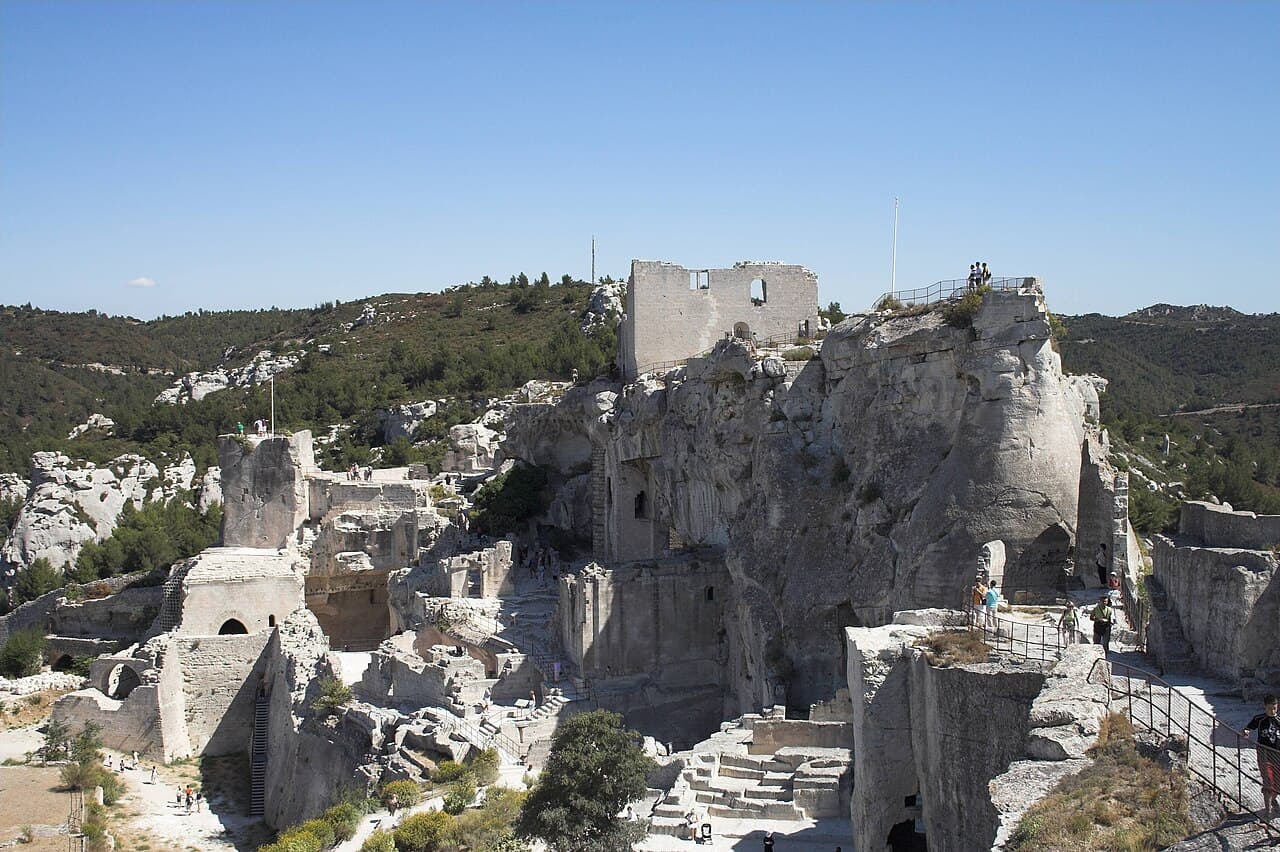
The Château des Baux is a semi-troglodytic fortress that ingeniously incorporates the natural rock formations of the Alpilles hills. Its construction uses local stone and rock, blending defensive structures seamlessly with the terrain. The castle complex is dominated by a rectangular donjon dating from the 13th century, which stands as the best-preserved part of the fortress.

Surrounding the donjon are several key towers, including the Sarrazine Tower, the Paravelle Tower, and the Tour des Bannes (also known as "Cornes" in Provençal). These towers formed integral components of the castle’s defense system, providing vantage points and strongholds against attackers.

The castle chapel, once dedicated to Sainte-Marie-des-Fontaines and later to Sainte-Catherine, reflects the spiritual life within the fortress. At the base of the donjon is a pigeonnier (dovecote), which historically housed pigeons, an important resource for communication and food.

The outer enceinte, a large defensive wall enclosing the castle, remains partially intact. Archaeological excavations have revealed troglodytic rooms carved into the rock, showcasing how the inhabitants adapted the natural landscape for living and defense. These excavations have been ongoing since 1991, focusing on restoring and understanding the northern and central parts of the castle.

Cultural heritage and visitor experience

Today, the Château des Baux is a popular tourist destination, offering visitors a glimpse into medieval life and military architecture. The site features full-scale replicas of medieval siege engines such as trebuchets, ballistae, couillards, bricoles, and battering rams. These replicas are demonstrated several times daily from April to September, providing an engaging and educational experience.

From its elevated position, visitors can enjoy sweeping views over the Provençal countryside, including olive groves, the garrigue shrubland, the Alpilles hills, and on clear days, the distant Mediterranean Sea. This panoramic vista underscores the castle’s historical role as a military lookout and its enduring place in the landscape of Provence.

The castle’s designation as a historic monument since the late 19th century has helped preserve its ruins and promote archaeological research. The restoration efforts have enhanced the site’s accessibility and interpretive value, making Château des Baux a vital cultural landmark that connects visitors to the medieval heritage of southern France.

Frequently asked questions (FAQ)

How do I get to Château des Baux?
Château des Baux is located in the picturesque village of Les Baux-de-Provence, easily accessible by car or public transportation. If traveling by car, ample parking is available near the entrance. Alternatively, regional buses connect the castle with nearby towns, making it convenient for visitors.
What is the historical significance of Château des Baux?
Château des Baux dates back to the 10th century and played a crucial role in the feudal history of Provence. It was once a stronghold for the powerful Baux family and served as a strategic military site during various conflicts. Today, it stands as a testament to the region's medieval past and offers insights into the life of nobility during that era.
When was Château des Baux built?
The origins of Château des Baux can be traced back to the 10th century, although much of the current structure was developed in the 15th century. Over the years, it has undergone numerous renovations and restorations to preserve its historical integrity. Visitors can explore the remnants of its rich history throughout the castle grounds.
Can I take a guided tour of the castle?
Yes, guided tours of Château des Baux are available and highly recommended for a more in-depth understanding of its history and architecture. Knowledgeable guides provide fascinating insights into the castle's past and its significance in the region. Additionally, audio guides are also available for those who prefer to explore at their own pace.
Why is Château des Baux considered an architectural marvel?
Château des Baux is renowned for its impressive medieval architecture, featuring towering ramparts, fortified walls, and spectacular views of the surrounding landscape. The castle's design reflects the strategic military needs of its time, with elements that showcase both defensive capabilities and residential comforts. Its unique location atop a rocky outcrop enhances its architectural significance, making it a must-see for history and architecture enthusiasts.
Is it possible to visit Château des Baux with children?
Absolutely! Château des Baux is family-friendly and offers various activities that engage children, including interactive exhibitions and exploration areas. The castle's vast grounds allow for plenty of space for kids to roam and discover while learning about history. Parents should be aware that some areas may involve steep paths and stairs, so supervision is recommended.
What are the opening hours of Château des Baux?
Château des Baux typically opens daily, with hours varying by season. Generally, the castle opens around 9 AM and closes between 5 PM and 7 PM, depending on the time of year. It’s advisable to check the official website for the most current opening times before your visit.
What are the ticket prices for Château des Baux?
Ticket prices for Château des Baux vary depending on age and whether you choose a guided tour. As of now, general admission is approximately €8 for adults, with discounts available for children, students, and senior citizens. Special family packages and group rates may also be offered, so checking the website for the latest pricing details is recommended.
When is the best time to visit Château des Baux?
The best time to visit Château des Baux is during the spring (April to June) and fall (September to October) when the weather is mild and the crowds are smaller. Summer can be hot and busy, making it less pleasant for some visitors. Visiting early in the morning or later in the afternoon can also enhance your experience by avoiding peak tourist times.
Are there nearby attractions to visit while at Château des Baux?
Yes, the area around Château des Baux is rich in attractions. Visitors can explore the charming village of Les Baux-de-Provence, with its quaint shops and cafes, or visit the nearby Carrieres de Lumieres, an immersive art experience set in a former quarry. The stunning landscapes of the Alpilles Regional Natural Park are also worth exploring for hiking and photography opportunities.

Photo gallery

Château des Baux
Click to view

Photo by ignis•CC BY-SA 3.0

1 photo • Click any image to view in full screen

Information

Hill Castle

Sources & official resources

Verify the information above using these authoritative references.

Loading map...

Visitor reviews

No reviews yet. Been here? Write the first review and help other travelers!

Write the first review

Visited this castle? Share your experience

Your review helps other travelers and adds first-hand knowledge to our encyclopedia.

Write a review

(5/5)

0/2000 characters

Your review will be visible after admin approval

Nearby castles

12.7 km

Castle of Tarascon

Tarascon, France

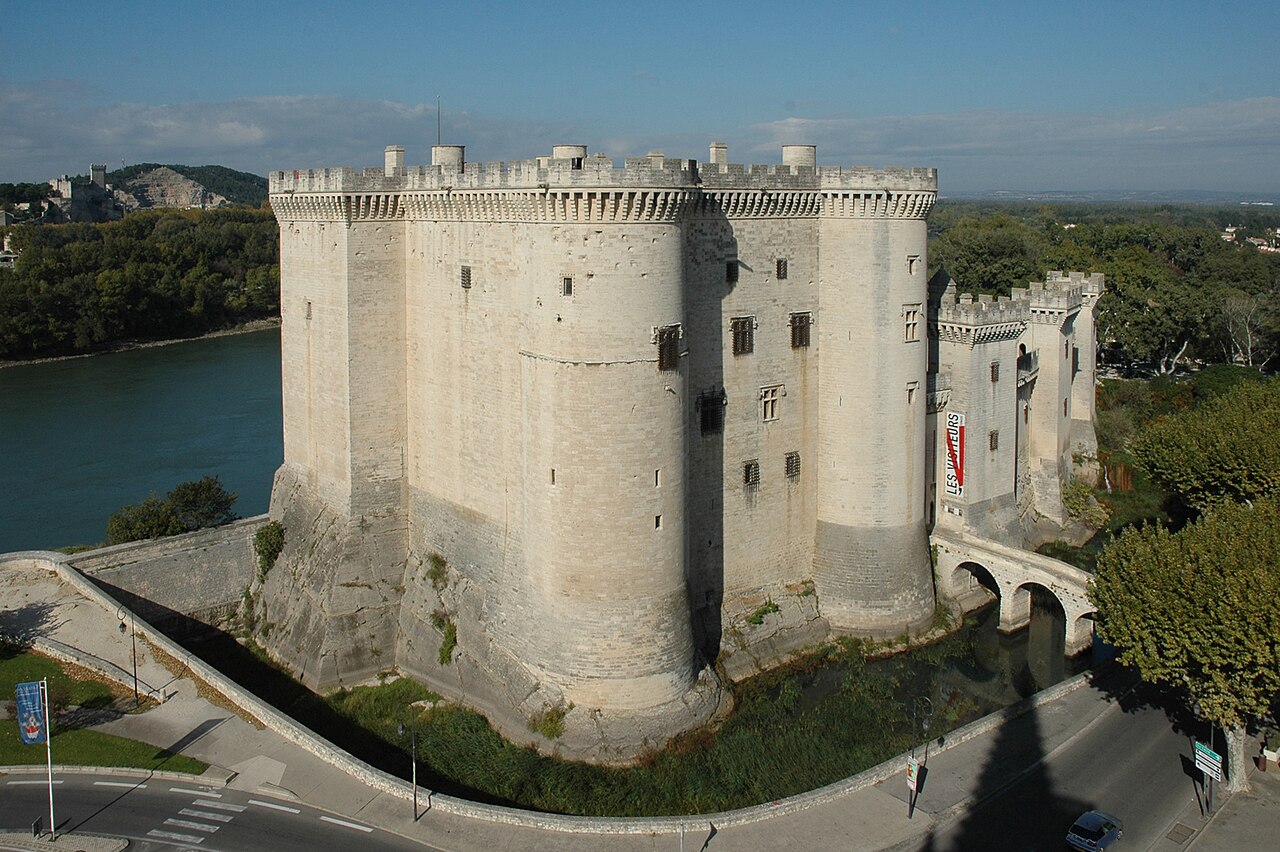
The castle of Tarascon stands as a remarkable example of late medieval military architecture in the Provence region of southern France. Constructed beginning in 1401 under the direction of Louis II of Anjou, the castle was built on the site of a previous fortress that had been destroyed, emphasizing the strategic importance of Tarascon along the Rhône River. This imposing fortress is often known as King Rene's castle, named after Rene I of Naples, who completed its construction in 1449. Historical context and construction The castle's construction was initiated in the early 15th century during a period marked by regional conflicts and the need for strong defensive structures. Louis II of Anjou, Count of Provence and titular King of Naples, commissioned the castle to replace the older fortifications that had been destroyed. After his death, his son Louis III of Anjou continued the work, and it was ultimately finished by his younger brother Rene I of Naples. The castle's completion in 1449 reflects the culmination of decades-long efforts to establish a formidable defensive stronghold in this key location. Strategic location Situated on the banks of the Rhône River, the castle of Tarascon controlled important river crossings and trade routes. Its position allowed it to serve both as a military fortress and a symbol of the Anjou family's power in Provence. The castle's placement also provided natural defensive advantages, with the river protecting one side and the town walls complementing its defenses. Architectural features and design The castle is a prime example of late medieval fortress design, characterized by its robust curtain walls, towers, and moats. It was designed primarily for defense, with thick walls and a compact, rectangular layout that maximized protection and control over the surrounding area. Towers and curtain walls The castle features several round towers at its corners, which were typical of the period and provided excellent vantage points for archers and artillery. The walls connecting these towers are exceptionally thick, designed to withstand sieges and artillery fire. The battlements along the walls allowed defenders to monitor and repel attackers effectively. Moats and gates A wide dry moat surrounds the castle, adding an additional layer of defense by hindering direct assaults on the walls. The main entrance was heavily fortified, with a drawbridge and gatehouse that controlled access to the interior. These defensive features reflect the military priorities of the 15th century and the need to secure the castle against both local uprisings and external threats. Later uses and preservation In the 17th century, the castle's role shifted from a noble fortress to a military prison. This change in function illustrates the evolving nature of such structures as warfare and political power changed over time. The castle remained a prison for centuries until it was acquired by the French state in 1932, marking the beginning of its preservation as a historical monument. Modern preservation efforts Today, the castle of Tarascon is well preserved and open to the public, offering visitors a glimpse into medieval military architecture and the history of the Provence region. Its preservation allows for the study of 15th-century defensive design and the legacy of the Anjou dynasty in southern France. Cultural and historical significance The castle is not only a military monument but also a cultural landmark that reflects the turbulent history of Provence during the late medieval period. Its association with the House of Anjou, particularly with Rene I of Naples, adds to its historical importance. The castle's imposing presence on the Rhône River continues to attract historians, architects, and tourists interested in France's medieval heritage. Visitor experience Visitors to the castle can explore its towers, courtyards, and defensive walls, gaining insight into the life of medieval nobility and soldiers. The castle often hosts exhibitions and cultural events that highlight its rich history and architectural features.

Late Medieval (14th–15th c.)
Details
13.2 km
Tarascon Castle — France castle

Tarascon Castle

Tarascon, France

Tarascon Castle, located on the banks of the Rhone River in the Bouches-du-Rhône department of Provence-Alpes-Côte d'Azur, France, stands as one of the most remarkable and well-preserved medieval fortresses in Europe. This imposing castle, built primarily in the early 15th century between 1400 and 1435, was commissioned by the Counts of Provence-Barcelona and the Dukes of Anjou, who were influential noble patrons with ties to the castles of Angers and Saumur. Its strategic location on a rocky islet overlooking the Rhone made it a monumental sentinel guarding the political border and controlling river traffic. The site originally hosted an earlier castle, likely constructed by Roubaud II, Marquis of Provence, sometime between 994 and 1010. This early fortress was partially destroyed and rebuilt over the centuries. By the mid-13th century, it was occupied by Charles d'Anjou, Count of Provence and brother to King Louis IX of France. His son, Charles II "the Boiteux", expanded the castle further. The fortress played a significant role during the turbulent 14th century, notably during the siege led by the famed military commander Bertrand Du Guesclin in 1368, acting on behalf of Duke Louis d'Anjou. This siege marked a crucial episode in the French ambitions to assert control over Provence. Architectural evolution and construction The current structure of Tarascon Castle was largely rebuilt beginning on November 27, 1400, by Louis II of Anjou, Count of Provence, after his return from Italy. The construction proceeded swiftly but was interrupted, resuming from 1428 to 1435 under the direction of his son, Louis III of Anjou. The castle was designed by the architect Jean Robert, who collaborated with sculptors Simon de Beaujeu and Jacques Morel. The stone materials were quarried from Beaucaire, ensuring the fortress's robust and enduring construction. The castle is composed of two distinct parts: to the north lies the farmyard, which was dedicated to the staff and soldiers, and to the south, the residential dwelling. The fortress features massive towers, thick curtain walls, and a moat that historically added to its defensive capabilities. The castle's drawbridge was replaced with a fixed bridge in the late 15th century, under the reign of King René I, who also made modifications to improve the castle's habitability between 1447 and 1449. During this period, overseen by Jean de Serocourt and Regnault de Serocourt, the captain and lieutenant of Tarascon, a niche was created in the main courtyard displaying busts of King René and Queen Jeanne de Laval, symbolizing their patronage and presence. Historical significance and notable events Tarascon Castle was not only a military stronghold but also a cultural hub during the reign of King René I, who hosted prestigious gatherings and courtly events within its walls. After his death, the castle's use as a royal residence diminished, and it transitioned into a place of detention early on. By 1480, it was already serving as a prison, notably incarcerating a Catalan prisoner who left engraved motifs on the dungeon walls depicting warships and religious symbols. The castle's prison function intensified from the 17th century until 1926, when the prison was definitively closed. During the French Revolution, supporters of Robespierre were executed here, marking the castle's dark chapter in revolutionary history. The transformation into a prison led to structural changes, including the partitioning of rooms into collective and individual dungeons, which caused damage to the original medieval architecture. Restoration and preservation efforts Recognizing the castle's historical and architectural value, restoration efforts began in 1932 under the guidance of architects Henri Antoine Révoil and Jean Camille Formigé, specialists in historical monuments. These restorations aimed to repair the damage inflicted by its prison use, removing partitions, reopening windows, and restoring the castle's medieval appearance. Further extensive restoration work continued from 1940 to 1980, allowing Tarascon Castle to regain much of its original grandeur and structural integrity. Today, the castle remains well preserved and is a prominent cultural landmark in the region. Its terrace offers panoramic views of the Rhone River, the Alpilles mountain range, and the Montagnette hills, attracting visitors interested in medieval architecture, history, and scenic landscapes. Architectural features and layout The castle exemplifies high medieval military architecture with features designed for both defense and residence. Its massive stone walls and towers provided formidable protection against sieges. The layout includes a central courtyard surrounded by living quarters, defensive battlements, and service buildings. The northern farmyard area supported the castle's garrison and staff, while the southern residential section housed the noble family and their guests. The castle's design reflects the transition from purely defensive fortresses to more habitable noble residences, incorporating comfort and aesthetic elements alongside military functionality. The presence of sculptural decorations by Simon de Beaujeu and Jacques Morel adds artistic value to the fortress, blending utility with Renaissance influences emerging in the 15th century. Visiting tarascon castle today Visitors to Tarascon Castle can explore its well-maintained halls, towers, and courtyards, gaining insight into the medieval lifestyle of the Anjou counts and the castle's role in regional history. The site often hosts cultural events and exhibitions that highlight its rich heritage. Its accessibility and preservation make it a key destination for those interested in medieval architecture and French history.

High Medieval (11th–13th c.)
Details
14.1 km

Château de Beaucaire

Beaucaire, France

The Château de Beaucaire is a striking example of a medieval hill castle perched above the Rhône river in the town of Beaucaire, France. Originally constructed in the 11th century, this fortress occupies a strategic rocky spur that commands expansive views of the surrounding landscape. The castle’s remains today reflect centuries of architectural evolution, military significance, and regional history, making it a notable heritage site in southern France. Built upon the site of an earlier Roman settlement, the castle’s location underscores its longstanding importance as a defensive and administrative stronghold. The earliest historical records mention the fortress in the early 13th century, particularly during the Albigensian Crusade and the siege of 1216. The castle was seized by Simon de Montfort’s forces in 1209, illustrating its role in the turbulent conflicts of the Cathar Crusades. Control briefly returned to the local nobility before the castle was integrated into the royal domain under King Louis IX (Saint Louis), who ordered significant reconstruction to fortify the site further. Medieval military architecture and strategic importance The castle’s design reflects the military architectural innovations of the high medieval period. Its most distinctive feature is the triangular donjon (keep), an uncommon shape that sets it apart from the more typical square or circular towers of the era. This keep includes a large hall with lowered ogival vaults that conform to the triangular plan, demonstrating advanced masonry techniques and an emphasis on both defense and residential comfort. Alongside the donjon stands a robust round corner tower, part of the layered defensive system designed to protect the fortress from siege warfare. The castle was originally enclosed by thick stone walls, traces of which remain visible today, outlining the perimeter of the fortress. The elevated position on a rocky outcrop enhanced its defensive capabilities, making it difficult for attackers to approach. Sieges and conflicts Throughout the Hundred Years’ War and other medieval conflicts, Château de Beaucaire endured numerous sieges by various forces, including the English, Burgundians, Italians, and Gascons. Despite these assaults, the fortress maintained its strategic role in regional defense. The use of defensive tactics such as flaming tar to repel siege engines highlights the castle’s active military function during these turbulent centuries. Royal influence and political significance Under King Louis IX, the castle was transformed into a fortified citadel symbolizing royal authority in the region. Notably, in 1251, the castle hosted a treaty that resolved territorial disputes between the city of Avignon and Alphonse of France, Count of Poitiers and Toulouse. This event underscores the castle’s dual role as a military bastion and a venue for political diplomacy. The castle’s military importance declined in the 17th century when Cardinal Richelieu ordered its dismantling in 1632 to prevent it from being used against royal power. This policy led to the partial destruction of the fortress, marking the end of its active defensive use. Architectural and cultural remains Today, Château de Beaucaire stands as a ruined hill castle with significant portions of its walls and towers still intact. The Romanesque chapel dedicated to Saint Louis is a highlight, featuring a well-preserved sculpted tympanum that exemplifies the artistic style of the period. This chapel was recognized as a historic monument in 1846, reflecting its cultural importance. The castle’s main entrance gate, restored and reopened in 2014, offers visitors a glimpse into the fortress’s original defensive layout. Inside the walls, the musée Auguste Jacquet presents archaeological finds from the region, including artifacts dating back over 40,000 years, as well as displays on local popular arts and traditions. Archaeological discoveries Excavations in the 19th century uncovered numerous Roman artifacts beneath the castle, such as funerary steles, a Roman capital, and medieval column fragments. These discoveries highlight the site’s continuous occupation from Roman times through the medieval period, adding layers to its historical narrative. Landscaped gardens and preservation The steep slopes within the former castle walls have been transformed into a landscaped garden and arboretum featuring Mediterranean flora like Aleppo pines and laurel trees. This green space enhances the visitor experience and preserves the castle’s connection to its natural environment. Visiting château de beaucaire today As a well-loved cultural landmark, the Château de Beaucaire offers visitors an opportunity to explore a site rich in history and architectural interest. The ruins provide insight into medieval fortification techniques and the region’s complex past. The combination of military, political, and cultural significance makes it a compelling destination for history enthusiasts and tourists alike. Visitors can walk along the remnants of the walls, ascend the polygonal towers, and visit the chapel and museum to gain a comprehensive understanding of the castle’s role through the centuries. The site’s dramatic position overlooking the Rhône river adds to its allure, providing spectacular views and a tangible connection to France’s medieval heritage.

High Medieval (11th–13th c.)
Details