Château de Terride

Château de Terride: historic hunting lodge and vineyard estate in Hauts-de-France
Puycelsi, Hauts-de-France, France
Post-Renaissance (17th–18th c.)

The Château de Terride is a notable example of a 17th-century hunting lodge located in the commune of Puycelsi, within the Hauts-de-France region of France. Erected beginning in 1652 by the Grenier de Terride family, skilled glassmakers from the Albigeois, the château embodies a unique intersection of noble leisure and artisanal heritage. The family's glassmaking craft was reputedly granted as a special privilege by King Saint Louis in recognition of their contributions during the Crusades, linking the estate's origins to medieval traditions despite its later construction date.

Historical background and family legacy

The château's construction in the mid-17th century reflects the era's architectural trends for noble hunting lodges, designed to serve as retreats within heavily forested areas. The location near the Grésigne forest provided an ideal setting for hunting, a favored pastime of the nobility. Over the centuries, the estate evolved from a leisure property to an agricultural enterprise, particularly focusing on viticulture by the 19th and 20th centuries.

The estate's transformation into a vineyard began formally around 1960, expanding to cover approximately 35 hectares. It remains the only vineyard classified under the Gaillac appellation within the commune of Puycelsi. The current management by descendants Alix David and Romain Gérard continues the tradition of cultivating local grape varieties, maintaining the estate's connection to regional agricultural practices.

Architectural features and estate layout

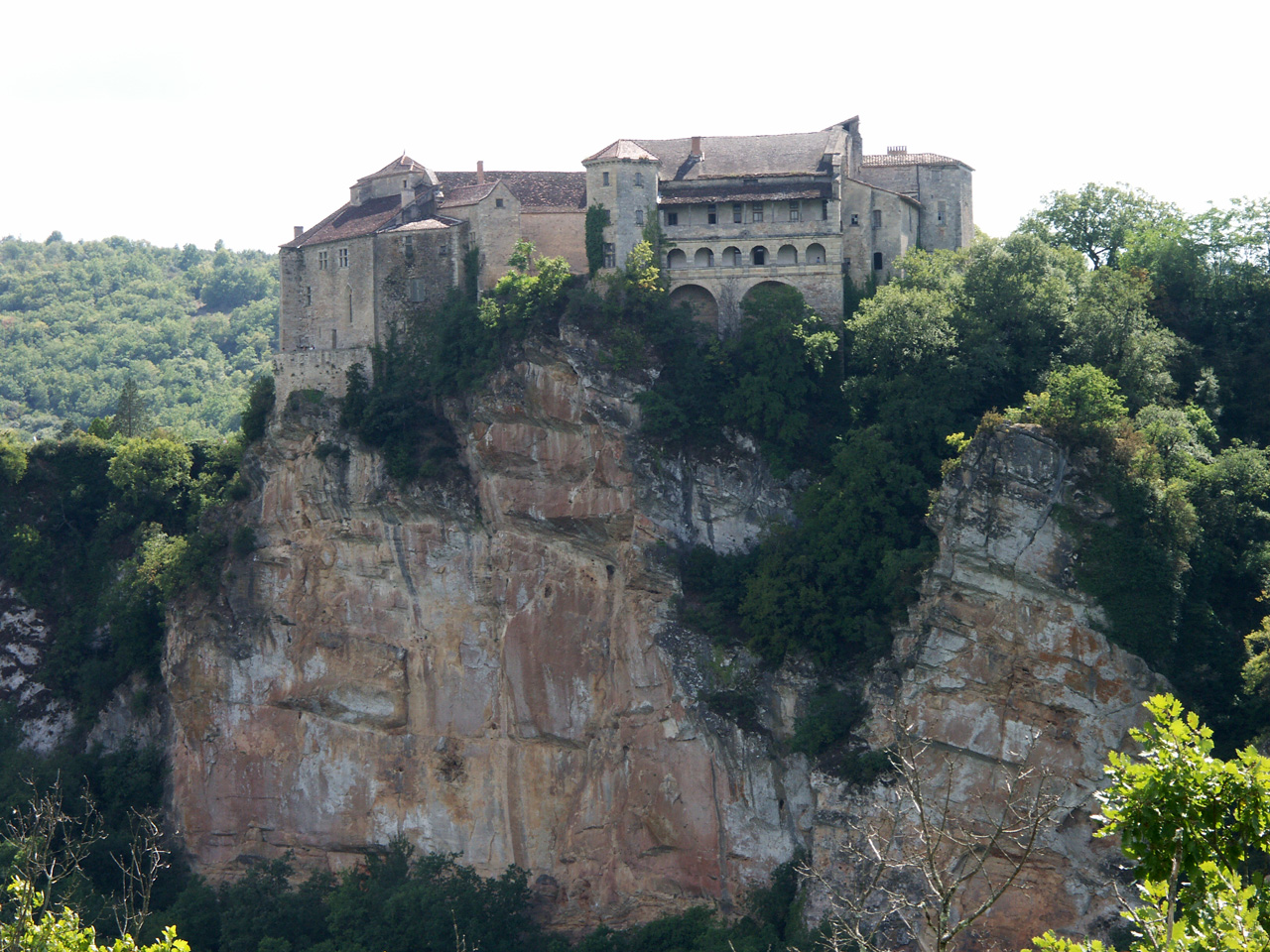
The Château de Terride is characterized by its restrained classical architectural style, typical of 17th-century hunting lodges. The building's design is sober and practical, reflecting its dual function as a noble retreat and a working estate. Situated centrally within a wooded landscape, the château maintains a close relationship with the surrounding Grésigne forest, emphasizing its original purpose linked to hunting.

While the château lacks elaborate decorative elements or documented archaeological artifacts such as inscriptions, staircases, or gates, its architectural simplicity underscores the functional priorities of its builders. The estate's layout integrates the château with extensive vineyards, illustrating a harmonious blend of noble leisure and agricultural productivity.

Vineyards and agricultural evolution

The vineyards surrounding the château are planted with traditional local grape varieties, sustaining the estate's viticultural heritage. Red wines are produced primarily from Braucol and Duras grapes, while white wines come from Loin de l’œil and Mauzac varieties. This diversification reflects the region's rich wine-making traditions and the estate's adaptation to changing economic and cultural landscapes.

Significance and contemporary use

Today, the Château de Terride stands as a testament to the enduring legacy of noble estates in rural France that have successfully transitioned from hunting lodges to centers of agricultural production. Its continued operation as a vineyard underlines the importance of preserving both historical architecture and regional cultural practices.

The estate's connection to the Grenier de Terride family and their glassmaking heritage adds a unique dimension to its historical narrative, linking the château to broader historical themes such as the Crusades and medieval artisan privileges. Although the château itself does not display extensive ornamental features, its historical and agricultural significance make it a noteworthy site within the Hauts-de-France region.

Frequently asked questions (FAQ)

How do I get to Château de Terride?
Château de Terride is located in Puycelsi, France, and can be accessed by car or public transportation. The nearest major city is Toulouse, from which you can take a train to the nearby town of Gaillac and then a bus or taxi to Puycelsi.
What is the historical significance of Château de Terride?
Château de Terride dates back to the 13th century and has played a crucial role in the history of the region. It served as a strategic stronghold during various conflicts, showcasing the architectural styles and defense mechanisms of medieval France.
When was Château de Terride built?
The construction of Château de Terride began in the 13th century, with significant renovations occurring in the following centuries. Its design reflects the evolution of medieval architecture, adapting to the changing needs of its inhabitants over time.
Can I take guided tours of Château de Terride?
Yes, guided tours are available for visitors who wish to learn more about the history and architecture of Château de Terride. These tours are typically led by knowledgeable guides who can provide in-depth insights into the castle's past.
Why is Château de Terride considered an architectural gem?
Château de Terride is renowned for its well-preserved medieval architecture, featuring impressive towers and fortified walls. The blend of Gothic and Renaissance styles makes it a unique example of historical design in the region.
Is it possible to visit Château de Terride year-round?
Château de Terride is open to visitors during specific seasons, typically from spring to autumn. It's best to check the official website for the exact opening hours and seasonal schedules to plan your visit accordingly.
What are the ticket prices for Château de Terride?
Ticket prices for Château de Terride vary depending on age and the type of tour selected. Generally, adult tickets are reasonably priced, with discounts available for students and children.
What is the best time to visit Château de Terride?
The best time to visit Château de Terride is during the spring and fall when the weather is mild and pleasant. These seasons also coincide with fewer crowds, allowing for a more enjoyable and immersive experience.
Are there any nearby attractions to visit?
Yes, there are several attractions near Château de Terride, including the picturesque village of Puycelsi and the beautiful vineyards of Gaillac. These locations offer additional opportunities for sightseeing, dining, and experiencing the local culture.

Information

Hill Castle

Sources & official resources

Verify the information above using these authoritative references.

Loading map...

Visitor reviews

No reviews yet. Been here? Write the first review and help other travelers!

Write the first review

Visited this castle? Share your experience

Your review helps other travelers and adds first-hand knowledge to our encyclopedia.
Write a review

(5/5)

0/2000 characters

Your review will be visible after admin approval

Nearby castles

9.6 km
Castle of Bruniquel — France castle

Castle of Bruniquel

Bruniquel, France

The castle of Bruniquel, often referred to as the Châteaux de Bruniquel due to its unique composition of two distinct castles, stands as a remarkable example of medieval and early modern fortification in southern France. Located in the commune of Bruniquel in the Tarn-et-Garonne department within the Occitanie region, this historic site is perched dramatically on a cliff overlooking the confluence of the Aveyron and Vère rivers, rising approximately 90 meters above the valley floor. Its strategic position has made it a significant military and residential complex since antiquity. The site originally hosted a Roman castrum, underscoring its longstanding military importance. According to legend, the first fortress on this site was constructed in the 6th century by the Merovingian Queen Brunehaut (also known as Brunhilda), who is said to have established the "château vieux" or "old castle," locally called castel Biel. This early foundation laid the groundwork for the complex defensive structures that would evolve over the centuries. Historical evolution and ownership The castle's history is deeply intertwined with the regional power struggles of medieval France. By the 10th century, the site was under the control of the Abbey of Saint-Géraud d’Aurillac and served to protect vital trade and military routes between the Quercy and Albigeois regions. Around 1050, Bruniquel became a viscounty under a branch of the viscounts of Toulouse, marking its importance as a feudal stronghold. In 1176, the castle was seized by the Counts of Toulouse from the Trencavel family, who had previously held the site. The current "château vieux" was constructed in the 13th century on the ruins of the original fortress, incorporating robust defensive features typical of the high medieval period. This castle remained in the hands of the Counts of Toulouse and later the viscounts of Bruniquel. In the late 15th century, between 1485 and 1510, a second castle known as the "château jeune" or "young castle" was built by Maffre de Comminges-Couserans. This construction resulted from a division of the estate between two rival branches of the Comminges family. For approximately three centuries, the two castles were owned by opposing family factions, with the "château vieux" held by Catholics and the "château jeune" by Protestants, reflecting the religious tensions of the period. The two properties were reunited in 1780 when Louis Rigal d’Ouvrier, the viscount of the "château vieux," purchased the "château jeune." The castles were officially recognized as historic monuments in 1840, highlighting their cultural and architectural significance. Since 1987, the local municipality has owned the site and has undertaken extensive restoration efforts, particularly focusing on the "château jeune." Architectural features and modifications The château vieux The "château vieux" retains significant elements from its original 12th-century construction, including a prominent square donjon known as the Tour Brunehaut, named after the legendary queen. This keep served as a formidable defensive tower and symbol of feudal authority. The castle complex also includes residential buildings dating from the 13th century, featuring vaulted rooms and thick defensive walls. A notable architectural highlight is the Renaissance gallery with six arcades that overlooks the river valley, showcasing the blend of medieval fortification with later stylistic influences. The knights’ hall, once a central space for gatherings and ceremonies, bears scars from the religious wars that affected the region. Over the 18th and 19th centuries, the château vieux underwent various remodeling efforts, adapting its interiors and facades to changing tastes and needs. The château jeune Constructed between 1485 and 1510, the "château jeune" stands above the older castle, commanding views over the confluence of the Aveyron and Vère rivers. This castle was remodeled during the Baroque period, which introduced elegant decorative elements and refined architectural details. The château jeune features a Renaissance gallery with six arcades, similar to the older castle, reflecting the architectural trends of the late 15th and early 16th centuries. Interior modifications include window openings added in the 17th and 18th centuries and a sculpted door installed in 1683 at the staircase entrance, indicative of the evolving aesthetic preferences. Among the castle’s unique features is a 17th-century kitchen equipped with a rare nine-hole stove, an early precursor to modern cooking appliances. The reception hall was also remodeled in the same century, and a chapel within the castle was converted into a kitchen, demonstrating adaptive reuse of space. A chimney from the château jeune was relocated in the 19th century to the dining room of the Château de Lastour in Réalville, highlighting the exchange of architectural elements between noble residences. Military architecture and defenses The Castle of Bruniquel exemplifies the evolution of military architecture from the early medieval period through the Renaissance and Baroque eras. The site’s natural defensive advantages, perched on a high cliff overlooking two rivers, were enhanced by thick stone walls, ramparts, and fortified towers. The layout of the two castles in a tiered arrangement allowed for layered defense, with the "château jeune" positioned to dominate the older structure below. Defensive features include battlements, arrow slits, and reinforced gates designed to withstand sieges and assaults common in medieval warfare. Throughout its history, the castle saw alterations to its fortifications in response to advancements in military technology and changing political circumstances. The protections extended by a 2025 decree underscore the site's continued importance as a heritage monument preserving the legacy of medieval and early modern fortifications. Cultural significance and modern use The Castle of Bruniquel holds a prominent place in regional history and culture. It was the residence of Guillaume de Tudèle, a chronicler of the Albigensian Crusade, linking the site to significant medieval conflicts. The castle also played a role in the religious divisions of France, with its dual ownership reflecting Catholic and Protestant factions. In modern times, the castle gained wider recognition as a filming location for the 1975 film Le Vieux Fusil, directed by Robert Enrico and starring Romy Schneider and Philippe Noiret. The installation of a modern well in the courtyard for the film is a testament to the castle’s ongoing cultural relevance. Today, the castle is open to the public from March to mid-November, inviting visitors to explore its rich history, impressive architecture, and stunning natural setting. Classified as a historic monument since 1840, the site continues to attract scholars, tourists, and heritage enthusiasts, offering a vivid window into the medieval and early modern periods of French history.

High Medieval (11th–13th c.)
Details
12.6 km

Château de Penne

Penne, France

Château de Penne stands as a remarkable example of medieval military architecture, perched dramatically on a rocky ridge overlooking the winding Aveyron River in the commune of Penne, France. Its origins trace back to the Early Medieval period, with the first mention dating from 825 AD. This hill castle played a crucial strategic role throughout the Middle Ages, controlling the borders of the provinces of Albigeois, Quercy, and Rouergue. The fortress's elevated position atop a cliff provided natural defenses that were expertly integrated into its design, making it a formidable stronghold during numerous conflicts. Historical significance and medieval context The earliest recorded reference to the castle dates to 825 AD during the reign of Pepin, King of Aquitaine, highlighting its longstanding importance in regional power dynamics. The first documented lord was Geoffroi, noted in 1096 in connection with Raymond, Count of Toulouse. Throughout the Middle Ages, Château de Penne was a focal point of military and political activity, witnessing the turbulence of the Albigensian Crusade, the Hundred Years' War, and the French Wars of Religion. Role in the Albigensian Crusade and regional power struggles In the early 13th century, the castle was caught in the crossfire of the Albigensian Crusade, a campaign launched to eradicate the Cathar heresy. In 1176, the Counts of Toulouse seized the fortress from the Trencavel family, and in 1223, it was captured by Amaury de Montfort, son of Simon de Montfort, a key crusader leader. However, Cathar sympathizers soon reclaimed it, demonstrating the castle's contested status. The Treaty of Meaux (1229) forced the surrender of the castle to royal authority, with Alphonse de Poitiers, Count of Toulouse, taking possession. He fortified the castle further and used it as a center for administration, cementing its role in regional governance. Conflicts during the Hundred Years' War and later decline The castle's strategic importance continued during the Hundred Years' War (1337-1453), changing hands multiple times between the English and French. In 1365, it was seized by a Gascon captain named Mongat for the English, recaptured by the French in 1374, and then occupied again by the English from 1384 until 1451. Following this prolonged conflict, the fortress's military significance waned. It suffered partial destruction during the French Wars of Religion (1562–1598) and was ultimately dismantled in 1586. The castle was then abandoned for approximately four centuries. Architectural features and layout Château de Penne is renowned for its adaptation to the rugged terrain of the ridge it occupies. The site extends about 150 meters in length but narrows to as little as 8 meters in places, elevated more than 120 meters above the river below. The natural topography was skillfully incorporated into the castle's defenses, enhancing its impregnable character. Gatehouse and defensive structures The castle’s only entrance is located at the narrowest point of the ridge and is protected by a well-preserved gatehouse (châtelet). This defensive complex comprises two towers: a circular tower dating from the 13th century and a larger, uniquely shaped spur tower added in the 14th century. These towers form a formidable barrier, completely blocking passage along the ridge. Within the gatehouse, visitors can find an assommoir, a small defensive chamber designed to repel attackers attempting to breach the gate. The circular tower's ground floor houses an almost intact room with an arrow slit, illustrating the castle's defensive capabilities and medieval construction techniques. The donjon and enceinte The dominant feature of the castle is the donjon (keep), a heavily fortified tower that served as both a last refuge and a residence for the lord. Surrounding the donjon was an irregular stone enceinte (curtain wall), pierced with narrow openings for archers. Although much of the curtain wall has deteriorated, surviving fragments provide insight into the castle's formidable defensive design. The castle's role in local community and administration Below the fortress lies the village of Penne, nestled in a hollow at the base of the rocky ridge. The castle and village formed an integrated fortified community that controlled the surrounding region economically and militarily. Under Alphonse de Poitiers, the castle not only served as a military bastion but also as a center for county administration, where important records were stored and privileges for inhabitants confirmed. Modern preservation and public access After centuries of neglect, Château de Penne was recognized for its cultural and historical value in the 20th century. It was designated a historic monument on May 2, 1902. Restoration efforts began in earnest in the 1980s following its purchase by Me Breuil, a lawyer dedicated to conservation. In 2006, architect Axel Letellier acquired the site and undertook extensive restoration and stabilization work, enabling public access by 2010. Today, visitors can explore the impressive ruins, including the donjon, gatehouse, ramparts, and a small chapel. The castle remains a powerful symbol of medieval fortification and regional history, offering panoramic views of the Aveyron valley and a tangible connection to France's complex medieval past.

Early Medieval (5th–10th c.)
Details
13.4 km

Château de Mayragues

Castelnau-de-Montmiral, France

Château de Mayragues is a remarkable example of high medieval fortified architecture nestled in the picturesque landscape of Castelnau-de-Montmiral, within the historic region known as the Bastides Albigeoises in southern France. Constructed originally in the 12th century, this château encapsulates centuries of architectural evolution and regional heritage, standing as a testament to the defensive and residential needs of medieval nobility. Architectural features and construction The château is primarily built from the light-coloured local limestone, a material typical of the region, which gives the structure its distinctive pale appearance. One of the château's most striking features is its half-timbered, overhanging gallery that surrounds the top of the building. This gallery not only provided defensive advantages but also served as a covered walkway and vantage point over the surrounding lands. The use of half-timbering is somewhat rare in fortified castles, making Château de Mayragues an important example of regional architectural adaptation. Another unique architectural element is the pigeon loft (colombier), which stands on four stone columns. This structure is typical of the Languedoc region and reflects the importance of pigeon keeping in medieval France, both for food and as a symbol of status. The pigeon loft is recognized as a historic monument alongside the château itself. Historical context and evolution While the château's origins date back to the 12th century, its development extended into the 17th century, reflecting changing needs from purely defensive purposes to more residential and agricultural functions. The château was part of a network of fortifications protecting the bastides, which were fortified towns established during the medieval period to assert control and promote settlement in the region. Over the centuries, the château has witnessed various phases of occupation and modification, adapting to the social and political changes in the region. Its survival through turbulent times highlights its strategic importance and the resilience of its construction. Restoration and preservation efforts Beginning in the late 20th century, the château and its pigeon loft underwent an extensive 35-year restoration program. This project focused on using traditional materials such as stone, wood, lime, and sand to maintain authenticity and preserve the château's historical integrity. The restoration was recognized in 1998 with the prestigious Grand Prix of the Vieilles Maisons Françaises, underscoring the quality and dedication involved in the conservation efforts. Surroundings and current use The château is surrounded by a bio-dynamic vineyard cultivated since 1999, which contributes to the estate's unique character. The vineyard, along with formal box parterres, woods, and fields of sunflowers and corn, create a scenic and tranquil environment that enhances the château's appeal. The half-timbered gallery has been adapted to provide guest bedrooms for a bed and breakfast, offering visitors an immersive experience in a historic setting with panoramic views of the countryside. The estate hosts summer concerts in front of the château, a tradition that has continued for over two decades, blending cultural activities with the heritage site. Visiting Château de Mayragues Visitors to Château de Mayragues can explore the winery, sample the estate's bio-dynamic wines, and enjoy the peaceful gardens. The château serves as a gateway to discovering the Bastides Albigeoises, a region rich in medieval history and architecture. The combination of historical architecture, agricultural tradition, and cultural events makes Château de Mayragues a distinctive destination in southern France.

High Medieval (11th–13th c.)
Details

