
Castle of Bruniquel
The castle of Bruniquel, often referred to as the Châteaux de Bruniquel due to its unique composition of two distinct castles, stands as a remarkable example of medieval and early modern fortification in southern France. Located in the commune of Bruniquel in the Tarn-et-Garonne department within the Occitanie region, this historic site is perched dramatically on a cliff overlooking the confluence of the Aveyron and Vère rivers, rising approximately 90 meters above the valley floor. Its strategic position has made it a significant military and residential complex since antiquity.
The site originally hosted a Roman castrum, underscoring its longstanding military importance. According to legend, the first fortress on this site was constructed in the 6th century by the Merovingian Queen Brunehaut (also known as Brunhilda), who is said to have established the "château vieux" or "old castle," locally called castel Biel. This early foundation laid the groundwork for the complex defensive structures that would evolve over the centuries.
Historical evolution and ownership
The castle's history is deeply intertwined with the regional power struggles of medieval France. By the 10th century, the site was under the control of the Abbey of Saint-Géraud d’Aurillac and served to protect vital trade and military routes between the Quercy and Albigeois regions. Around 1050, Bruniquel became a viscounty under a branch of the viscounts of Toulouse, marking its importance as a feudal stronghold.
In 1176, the castle was seized by the Counts of Toulouse from the Trencavel family, who had previously held the site. The current "château vieux" was constructed in the 13th century on the ruins of the original fortress, incorporating robust defensive features typical of the high medieval period. This castle remained in the hands of the Counts of Toulouse and later the viscounts of Bruniquel.
In the late 15th century, between 1485 and 1510, a second castle known as the "château jeune" or "young castle" was built by Maffre de Comminges-Couserans. This construction resulted from a division of the estate between two rival branches of the Comminges family. For approximately three centuries, the two castles were owned by opposing family factions, with the "château vieux" held by Catholics and the "château jeune" by Protestants, reflecting the religious tensions of the period.
The two properties were reunited in 1780 when Louis Rigal d’Ouvrier, the viscount of the "château vieux," purchased the "château jeune." The castles were officially recognized as historic monuments in 1840, highlighting their cultural and architectural significance. Since 1987, the local municipality has owned the site and has undertaken extensive restoration efforts, particularly focusing on the "château jeune."
Architectural features and modifications
The château vieux
The "château vieux" retains significant elements from its original 12th-century construction, including a prominent square donjon known as the Tour Brunehaut, named after the legendary queen. This keep served as a formidable defensive tower and symbol of feudal authority. The castle complex also includes residential buildings dating from the 13th century, featuring vaulted rooms and thick defensive walls.
A notable architectural highlight is the Renaissance gallery with six arcades that overlooks the river valley, showcasing the blend of medieval fortification with later stylistic influences. The knights’ hall, once a central space for gatherings and ceremonies, bears scars from the religious wars that affected the region. Over the 18th and 19th centuries, the château vieux underwent various remodeling efforts, adapting its interiors and facades to changing tastes and needs.
The château jeune
Constructed between 1485 and 1510, the "château jeune" stands above the older castle, commanding views over the confluence of the Aveyron and Vère rivers. This castle was remodeled during the Baroque period, which introduced elegant decorative elements and refined architectural details.
The château jeune features a Renaissance gallery with six arcades, similar to the older castle, reflecting the architectural trends of the late 15th and early 16th centuries. Interior modifications include window openings added in the 17th and 18th centuries and a sculpted door installed in 1683 at the staircase entrance, indicative of the evolving aesthetic preferences.
Among the castle’s unique features is a 17th-century kitchen equipped with a rare nine-hole stove, an early precursor to modern cooking appliances. The reception hall was also remodeled in the same century, and a chapel within the castle was converted into a kitchen, demonstrating adaptive reuse of space. A chimney from the château jeune was relocated in the 19th century to the dining room of the Château de Lastour in Réalville, highlighting the exchange of architectural elements between noble residences.
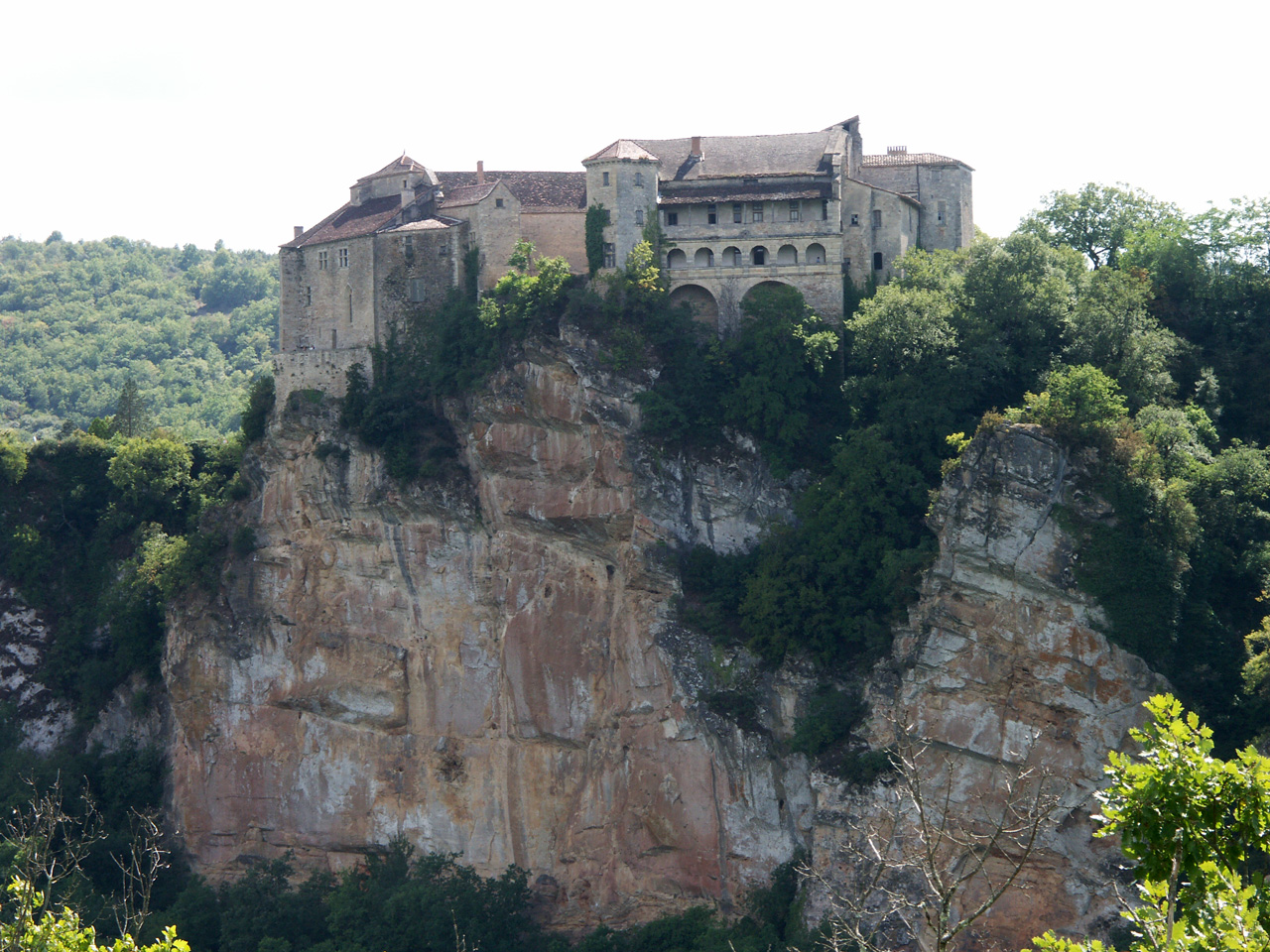
Photo by Julien 31 • CC BY-SA 3.0
Military architecture and defenses
The Castle of Bruniquel exemplifies the evolution of military architecture from the early medieval period through the Renaissance and Baroque eras. The site’s natural defensive advantages, perched on a high cliff overlooking two rivers, were enhanced by thick stone walls, ramparts, and fortified towers.
The layout of the two castles in a tiered arrangement allowed for layered defense, with the "château jeune" positioned to dominate the older structure below. Defensive features include battlements, arrow slits, and reinforced gates designed to withstand sieges and assaults common in medieval warfare.
Throughout its history, the castle saw alterations to its fortifications in response to advancements in military technology and changing political circumstances. The protections extended by a 2025 decree underscore the site's continued importance as a heritage monument preserving the legacy of medieval and early modern fortifications.
Cultural significance and modern use
The Castle of Bruniquel holds a prominent place in regional history and culture. It was the residence of Guillaume de Tudèle, a chronicler of the Albigensian Crusade, linking the site to significant medieval conflicts. The castle also played a role in the religious divisions of France, with its dual ownership reflecting Catholic and Protestant factions.
In modern times, the castle gained wider recognition as a filming location for the 1975 film Le Vieux Fusil, directed by Robert Enrico and starring Romy Schneider and Philippe Noiret. The installation of a modern well in the courtyard for the film is a testament to the castle’s ongoing cultural relevance.
Today, the castle is open to the public from March to mid-November, inviting visitors to explore its rich history, impressive architecture, and stunning natural setting. Classified as a historic monument since 1840, the site continues to attract scholars, tourists, and heritage enthusiasts, offering a vivid window into the medieval and early modern periods of French history.
Frequently asked questions (FAQ)
- How do I get to the Castle of Bruniquel?
- The Castle of Bruniquel is located in the picturesque village of Bruniquel, France. You can reach it by car, with ample parking available nearby, or by taking a train to the closest station and then a short taxi ride to the castle.
- What is the historical significance of the Castle of Bruniquel?
- The Castle of Bruniquel dates back to the 12th century and played a crucial role in the region during the Middle Ages. Its strategic location offered protection and power to its occupants, making it a significant landmark in the history of the Midi-Pyrénées.
- When was the Castle of Bruniquel last restored?
- The Castle of Bruniquel underwent major restoration work that was completed in the late 20th century. These efforts aimed to preserve its unique architectural features and ensure that visitors can enjoy its rich history.
- Can I take guided tours of the Castle of Bruniquel?
- Yes, guided tours are available for visitors who wish to learn more about the castle's history and architecture. These tours are led by knowledgeable guides who provide insights into the castle's past and its significance in the region.
- Why is the architecture of the Castle of Bruniquel unique?
- The architecture of the Castle of Bruniquel is characterized by its impressive stonework, medieval fortifications, and stunning views of the surrounding landscape. Its blend of defensive structures and residential areas reflects the dual purpose of castles during the Middle Ages.
- Is it possible to visit the castle year-round?
- Yes, the Castle of Bruniquel is open to visitors throughout the year, although opening hours may vary by season. It's best to check the official website or contact the castle for the most up-to-date information on visiting hours.
- What are the ticket prices for visiting the Castle of Bruniquel?
- Ticket prices for the Castle of Bruniquel are quite affordable, with discounts available for students and seniors. Children under a certain age often enter for free, making it an accessible option for families.
- When is the best time to visit the Castle of Bruniquel?
- The best time to visit the Castle of Bruniquel is during the spring and early autumn when the weather is pleasant, and the surrounding countryside is in full bloom. Visiting during these seasons also allows you to enjoy fewer crowds and a more intimate experience.
- Are there any nearby attractions to explore after visiting the castle?
- Yes, there are several nearby attractions to explore, including the charming village of Bruniquel itself and the beautiful landscapes of the Aveyron Valley. Additionally, visitors can enjoy hiking trails and local wineries that showcase the region's culture and natural beauty.
Photo gallery

Information
Website
Visit websiteSources & official resources
Verify the information above using these authoritative references.
Loading map...
Visitor reviews
No reviews yet. Been here? Write the first review and help other travelers!
Write the first reviewVisited this castle? Share your experience
Your review helps other travelers and adds first-hand knowledge to our encyclopedia.