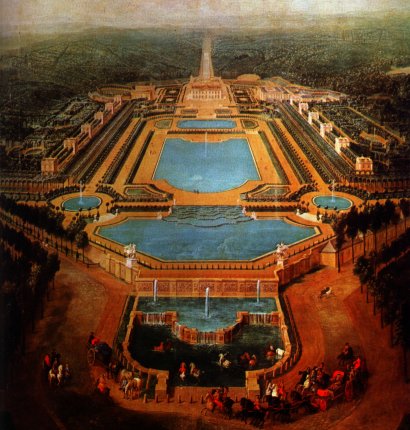
Château de Saint-Germain-en-Laye
Château de Saint-Germain-en-Laye is a significant historic royal palace located in Saint-Germain-en-Laye, France. Today, it serves as the home of the National Museum of Archaeology, showcasing a vast collection of artifacts from the Paleolithic era through the Merovingian period. The castle's origins trace back to the early 12th century, with its first construction commissioned by King Louis VI around 1122. Over the centuries, the château underwent numerous expansions and reconstructions, reflecting the evolving architectural styles and royal ambitions of France.
Medieval origins and gothic chapel
The original fortress was expanded in the 1230s by Louis IX (Saint Louis), who added the chapelle Saint Louis, a masterpiece of the Rayonnant phase of French Gothic architecture. This chapel is notable for its innovative design that prefigured the famous Sainte-Chapelle in Paris. Architect Pierre de Montreuil designed the chapel with a single nave ending in a chevet, featuring walls almost entirely filled with tall, slender stained-glass windows supported by large exterior buttresses. The vault's ogives rest on columns placed behind a low arcade, allowing an open interior free of heavy supports. This design was enabled by the pierre armée technique, which incorporated metal reinforcements within the stone walls for stability. The west façade boasts a large Gothic rose window in the distinctive rayonnant Gothic style.
In 1238, the chapel received a relic of the Crown of Thorns from Baldwin II of Constantinople, which was temporarily housed here until the Sainte-Chapelle in Paris was consecrated in 1248. The medieval castle was largely destroyed by fire during the Hundred Years' War in 1346, when it was burned by the Black Prince. Only the Gothic chapel survived from this early phase.
Reconstruction and renaissance transformation
Following the destruction, King Charles V rebuilt the castle in the 1360s on the original foundations. The most substantial transformation occurred in the 16th century when Francis I initiated a Renaissance-style reconstruction around 1539. This marked the beginning of the château's evolution into a grand Renaissance palace. Later, Henry II commissioned the construction of a new adjacent château, known as the Château Neuf, designed by the architect Philibert de l'Orme. The new structure was positioned on a crest overlooking the Seine and was surrounded by terraces and formal gardens designed under the guidance of Étienne du Pérac.
The gardens and italian influence
The gardens of Saint-Germain-en-Laye were among the earliest in France to introduce the Italian Renaissance garden style. They featured a strict symmetry with axial layouts, patterned parterres, gravel walks, fountains, and formally planted bosquets. This style laid the foundation for the later development of the French formal garden tradition. The parterres, designed by Claude Mollet in 1595 for Henry IV, exemplify the transition from medieval garden designs to the more geometric and controlled Renaissance approach.
Louis xiv and the baroque era
Louis XIV, born at Saint-Germain-en-Laye in 1638, further shaped the château and its grounds. He preferred the older Château Vieux and abandoned the Château Neuf, which was demolished in the 1660s. Between 1663 and 1682, Louis XIV's architects, including Louis Le Vau, Jules Hardouin-Mansart, and the renowned landscaper André Le Nôtre, remodeled the château and its gardens. Le Nôtre's work included a 2.4-kilometer-long stone terrace offering sweeping views over the Seine valley and Paris, enhancing the château's grandeur and visual impact.
Jacobite exile and later history
After the Glorious Revolution of 1688, the château became the exile residence of King James II of England. He lived there for thirteen years, and his daughter, Louise-Marie Stuart, was born at the château in 1692. The château served as a center for Jacobite supporters until the French Revolution. The British Jacobite presence diminished after the death of the Duke de Noailles in 1766, and the last Stuart court member died in 1778. The château was confiscated by the revolutionary government in 1793, ending its role as a Jacobite refuge.
19th century restoration and museum establishment
In the 19th century, Napoleon I repurposed the château as a cavalry officers' training school. Later, Napoleon III commissioned a major restoration under architect Eugène Millet beginning in 1862. The château was transformed into the Musée des Antiquités Nationales in 1867, dedicated to France's archaeological heritage. Restoration efforts continued under Auguste Lafollye and Honoré Daumet, who aimed to restore the château's Renaissance character, particularly the style of Francis I.
20th century events and current status
On September 10, 1919, the Treaty of Saint-Germain-en-Laye was signed here, formally ending hostilities between the Allies and Austria after World War I. During the German occupation of France in World War II, the château served as the headquarters of the German Army. In 2005, the museum was renamed the Musée d'Archéologie Nationale, continuing to display extensive collections of archaeological artifacts from prehistoric to early medieval France.
Architectural significance
The château exemplifies a blend of medieval Gothic and Renaissance architectural styles, with significant contributions from prominent architects and landscapers across centuries. Its surviving Gothic chapel is a rare example of early Rayonnant Gothic architecture outside Paris. The Renaissance elements, including the terraces and gardens, reflect the adoption and adaptation of Italian Renaissance principles in French royal architecture. The château's evolution illustrates the changing functions and tastes of French monarchy from fortress to palace to cultural institution.
Visitor information
Today, the château is well preserved and open to the public as a museum. Visitors can explore its historic halls, the Gothic chapel, and the extensive archaeological collections. The gardens and terraces offer panoramic views of the Seine valley and Paris skyline, making it a notable destination for both history enthusiasts and tourists interested in French heritage and architecture.
Frequently asked questions (FAQ)
- What is the historical significance of Château de Saint-Germain-en-Laye?
- Château de Saint-Germain-en-Laye was a royal residence with origins in the 12th century and features important Gothic and Renaissance architecture. It also served as the birthplace of Louis XIV and the exile residence of King James II of England.
- Can I visit the gardens and terraces at Château de Saint-Germain-en-Laye?
- Yes, the château's gardens and terraces, redesigned by André Le Nôtre, are open to visitors and offer panoramic views over the Seine valley and Paris.
- When was the château converted into a museum?
- The château was transformed into the National Museum of Archaeology in 1867, showcasing France's archaeological heritage from prehistoric to early medieval times.
- Is the Gothic chapel at the château accessible to visitors?
- Yes, the chapelle Saint Louis, a rare example of Rayonnant Gothic architecture, is part of the museum and can be visited as part of the château tour.
- What are the opening hours and ticket prices for visiting Château de Saint-Germain-en-Laye?
- The château is open daily from 10:00 to 18:00. Tickets cost €7 for adults, €5 for reduced admission, and entry is free for visitors under 18.
Information
Opening hours
10:00-18:00, daily
Ticket prices
€7 adult, €5 reduced, free under 18
Current owner
National Museum of Archaeology
Address
Place Charles de Gaulle, 78100 Saint-Germain-en-Laye, France
Loading map...
Visitor reviews
No reviews yet. Been here? Write the first review and help other travelers!
Write the first reviewVisited this castle? Share your experience
Your review helps other travelers and adds first-hand knowledge to our encyclopedia.