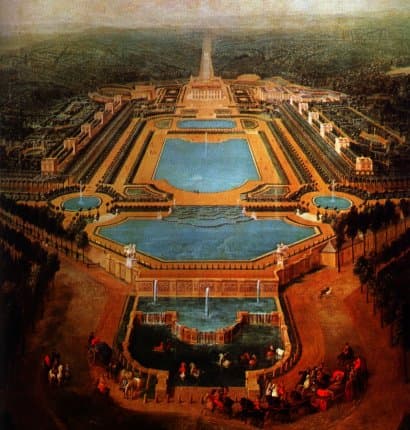
Château de Marly
The Château de Marly was a distinctive French royal residence constructed in the 17th century during the reign of Louis XIV. Located in what is now Marly-le-Roi, a commune on the northern edge of the royal park west of the Palace of Versailles, the château served as a private retreat away from the formal court life of Versailles. Unlike the grand scale of Versailles, Marly offered a more intimate setting with small pavilions and simplified protocol, reflecting the king's desire for privacy and relaxation.
Architectural design and layout
The château complex was notable for its innovative architectural arrangement. Designed by Jules Hardouin-Mansart, the chief architect of Louis XIV, Marly consisted of twelve pavilions built in matching pairs. These pavilions flanked a series of central water features, including formal sheets of water connected by ornamental cascades. This water system was both decorative and functional, fed by a sophisticated hydraulic "machine" that also supplied water to Versailles. The use of water as a central element in the layout was a pioneering feature in French garden and palace design of the Renaissance and Baroque periods.
The hydraulic machine
The hydraulic system at Marly was a remarkable engineering feat of its time. It pumped water from the nearby Seine River to supply the fountains and cascades at both Marly and Versailles. This machine was an essential component of the estate's design, symbolizing the king's power over nature and technology. Unfortunately, the hydraulic machine was dismantled following the château's decline in the early 19th century.
Historical context and royal use
Louis XIV, known as the Sun King, used Château de Marly as a place to escape the rigid etiquette and large crowds of Versailles. The smaller scale of Marly allowed the king to entertain a select group of courtiers in a more relaxed atmosphere. Invitations to Marly were highly coveted, as the limited space meant fewer guests and less formal protocol. This exclusivity fostered intense competition among courtiers for access to the king's private retreat.
The château's location near Versailles made it convenient for the king to move between his grand palace and his intimate getaway. The design of Marly reflected the evolving tastes of the French monarchy in the late 17th century, emphasizing comfort, privacy, and controlled social interaction.
Decline and legacy
After the French Revolution, the château was sold to a private owner around 1800. The new owner attempted to convert the estate into a factory, but the venture failed. As a result, the château was demolished in 1806, leaving only the foundations and remnants of the original structures. The site today is classified as archaeological ruins, with the notable remains of the pavillon du Roi at the top of the slope in Marly park.
In 1807, Napoleon Bonaparte repurchased the estate, and it has since remained under state ownership. The park surrounding the ruins is accessible to the public, offering a glimpse into the history of this royal retreat.
Château de Marly in cultural memory
The château's legacy extends into modern culture, inspiring namesakes such as the French niche perfume house Parfums de Marly. This brand draws on the château's association with luxury, exclusivity, and French heritage.
Despite its physical absence, Château de Marly remains an important symbol of the Sun King's reign and the architectural innovation of the late Renaissance period in France. Its design principles influenced later developments in French garden and palace architecture.
Frequently asked questions (FAQ)
- How do I visit the Château de Marly ruins?
- The Château de Marly ruins are located in Marly-le-Roi, Île-de-France, and are accessible to the public as part of the Marly park. Visitors can explore the foundations and the pavillon du Roi remains during park opening hours, which are generally from dawn to dusk.
- What was the purpose of Château de Marly?
- Château de Marly served as a private royal retreat for Louis XIV, providing a smaller, more intimate setting away from the formal court life of Versailles. It was designed for relaxation and exclusive gatherings of select courtiers.
- Why was Château de Marly demolished?
- After the French Revolution, the château was sold to a private owner who attempted to convert it into a factory. The venture failed, leading to the château's demolition in 1806. Only the foundations and some remains survive today.
- What architectural style is Château de Marly?
- Château de Marly was designed in the Renaissance style with Baroque influences, featuring symmetrical pavilions and elaborate water features. The design was by Jules Hardouin-Mansart, a key architect of the period.
- Is there anything left to see at Château de Marly?
- Visitors can see the archaeological ruins, including the foundation of the pavillon du Roi and the layout of the twelve pavilions. The surrounding park also preserves the historic landscape and water features' traces.
Photo gallery

Photo by Pierre-Denis Martin•Public domain
Information
Current owner
State
Loading map...
Visitor reviews
No reviews yet. Been here? Write the first review and help other travelers!
Write the first reviewVisited this castle? Share your experience
Your review helps other travelers and adds first-hand knowledge to our encyclopedia.



