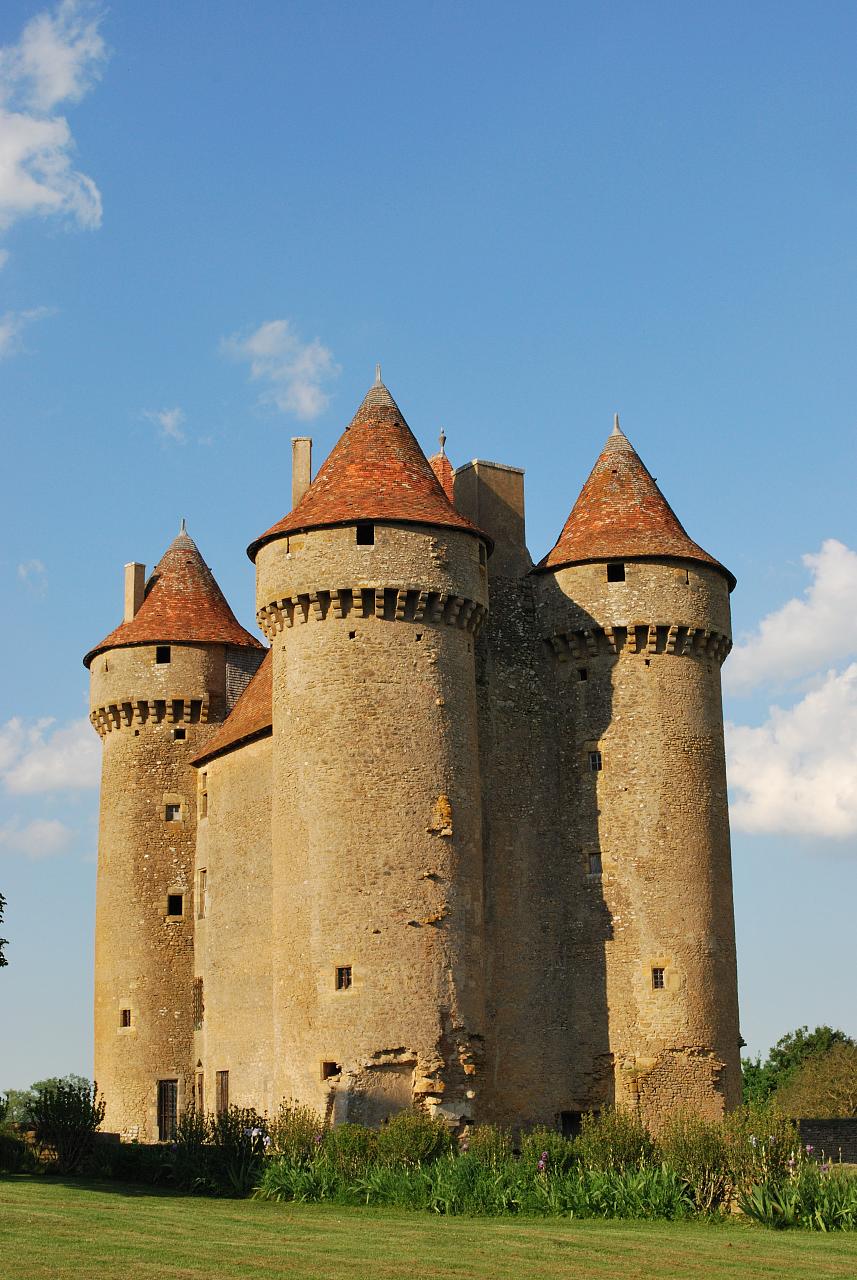
Château de Saint-Chartier
The Château de Saint-Chartier stands as a remarkable example of a medieval fortress in France, embodying centuries of architectural evolution and noble history. Located in the commune of Saint-Chartier, this castle traces its origins to the early 12th century, with its first mention in 1102 during a visit by Archbishop Léodegaire of Bourges to Adelardus Villebaldus, then lord of Saint-Chartier. The castle's strategic position and robust construction reflect the feudal power dynamics and defensive needs of the period.
Constructed primarily as a hill castle, the fortress was built by local nobility and served as a stronghold and residence. Over the centuries, it witnessed significant historical events and ownership changes, notably in the late 12th century when it passed through marriage to the Chauvigny family, allied with the English crown through King Richard the Lionheart. This transition marked the beginning of several centuries of stewardship by the Chauvigny lineage.
Medieval origins and early history
The castle's early history is closely tied to the feudal lords of the region. The initial structure was likely a fortified residence designed to assert control over the surrounding lands and protect against rival factions. The mention of Archbishop Léodegaire's visit in 1102 provides a valuable historical anchor, indicating the castle's established presence and importance in the early medieval period.
During the 12th century, the castle's role expanded beyond mere defense to include social and political functions. The marriage alliance that brought the castle under the control of André de Chauvigny, a supporter of the English crown, illustrates the complex allegiances during the period of the Angevin Empire and the Plantagenet influence in France.
Architectural development through the centuries
13th-century additions and the jeu de paume gallery
The 13th century saw significant enhancements to the castle's structure, including the addition of a gallery known as the "jeu de paume". This covered gallery was an early form of an indoor court for playing an ancestral version of tennis, highlighting the castle's role not only as a military fortress but also as a center of leisure and noble culture. The gallery is distinguished by its nineteen monolithic stone columns, each crowned with capitals that support wooden arches, creating a unique architectural ensemble that remains preserved in situ within the castle grounds.
14th and 15th-century fortifications and remodeling
In the 14th century, the central keep of the castle was rebuilt, reinforcing its defensive capabilities amid the turbulent periods of medieval warfare, including the Hundred Years' War. The 15th century brought further remodeling, particularly of the main residential building and the surrounding curtain walls. The curtain walls, forming an L-shape along the north and east sides, were fortified with towers at the corners, two of which still retain the corbels that once supported wall-walks used by defenders.
Changes in use and ownership in the modern era
By the late 18th century, during the reign of Louis XVI, parts of the castle were adapted for new uses, including conversion into stables, reflecting changing functional needs as military threats diminished. The castle later came under the ownership of Count Aimé Jacques Marie Constant de Moreton de Chabrillan, chamberlain to Napoleon, linking the site to the Napoleonic era.
The Restoration period after Napoleon's fall saw neglect and partial ruin of the castle, a fate common to many aristocratic residences in post-revolutionary France. This decline was somewhat reversed in the mid-19th century when Alexandre Ier Naud, a textile merchant, acquired the estate and commissioned the construction of the Barbault Chapel between 1864 and 1865, adding a significant funerary architectural element to the grounds.
19th-century restoration efforts
Restoration efforts from 1873 to 1880, led by Victorine Naud and Michel Germain with the architect Alfred Dauvergne, revitalized the castle's structure. These works, supported by Monseigneur Trioche, aimed to preserve the castle's historical fabric while adapting it for contemporary use. The use of Roman cement in the chimneys and walls contributed to the durability of these restorations, with the material demonstrating remarkable resistance to weathering over more than three decades.
20th-century challenges and preservation
The castle suffered a significant setback in the early 20th century when a fire damaged several towers, partially destroying the fortress's silhouette. Despite this, preservation efforts persisted, culminating in the castle's classification as a French Monument Historique in 1989. This designation recognized the site's cultural and historical significance and provided legal protection for its conservation.
From 1976 to 2008, the castle gained renewed cultural relevance by hosting the Rencontres Internationales de Luthiers et Maîtres Sonneurs, an international festival celebrating makers of stringed instruments and traditional musicians. This event highlighted the castle's role as a living cultural venue before its relocation and subsequent restoration efforts after 2009 under new ownership.
Architectural features and surviving elements
The Château de Saint-Chartier today presents the remains of a large rectangular main building approximately 41 meters long and 6 meters wide, constructed mainly from masonry with load-bearing walls in the Gothic style. The original defensive layout included four corner towers around an interior courtyard; however, the northern tower was removed in the 19th century and replaced by a terrace on the southern facade.
The well-preserved curtain walls form an L-shape along the north and east sides, reinforced by corner towers, some retaining corbels for former wall-walks. These elements evoke the layout of a fortified medieval residence, combining military and domestic functions.
Inside the main building, a ground-floor dining room features a prominent fireplace mantel bearing the coat of arms of Marguerite de Chauvigny, linking the interior decoration to the noble family's heritage. The chimneys and walls, constructed with durable Roman cement, have withstood the test of time, maintaining structural integrity despite centuries of exposure.
The jeu de paume gallery remains a distinctive architectural and cultural feature, with its stone columns and wooden arches offering insight into medieval leisure activities and architectural ingenuity.
The Barbault Chapel, built in the mid-19th century, adds a layer of funerary architecture within the landscaped park, reflecting the 19th-century revival and personalization of the estate.
The castle in its natural and cultural landscape
Set within the natural area known as Boischaut Sud, the castle's ruins blend with the surrounding landscape of central France, offering a tangible connection to the region's medieval past and noble lineage. The site exemplifies the adaptation of a medieval fortress through centuries of changing political, social, and cultural contexts.
Today, the Château de Saint-Chartier stands as a testament to the resilience of medieval architecture and the layered history of French nobility, inviting visitors to explore its enduring legacy through its preserved structures and evocative ruins.
Frequently asked questions (FAQ)
- What is the historical significance of Château de Saint-Chartier?
- Château de Saint-Chartier is a remarkable example of medieval architecture, reflecting the feudal history of France. It has played a pivotal role in various historical events and has been a residence for notable figures throughout the centuries, offering visitors insight into the region's rich past.
- When was Château de Saint-Chartier built?
- The origins of Château de Saint-Chartier date back to the 15th century, making it a fascinating site for those interested in medieval history. Its construction reflects the architectural styles and defensive strategies of the era, serving as a stronghold during tumultuous times.
- Can I visit Château de Saint-Chartier?
- Yes, Château de Saint-Chartier is open to visitors, allowing you to explore its historic grounds and learn about its storied past. Guided tours are often available, providing in-depth information about the castle's architecture and history.
- What are the opening hours for Château de Saint-Chartier?
- Château de Saint-Chartier typically opens to the public from April to October, with varying hours depending on the season. It’s best to check the official website for the most current opening times before your visit.
- Is it possible to access Château de Saint-Chartier with mobility challenges?
- While Château de Saint-Chartier strives to be accessible to all visitors, some areas may pose challenges due to the castle's historic architecture. It's recommended to contact the site in advance to inquire about specific accessibility options available during your visit.
- What is the best time to visit Château de Saint-Chartier?
- The best time to visit Château de Saint-Chartier is during the spring and early autumn when the weather is mild, and the gardens are in full bloom. These seasons often provide a more enjoyable experience with fewer crowds and beautiful scenery.
- Are there nearby attractions to visit while at Château de Saint-Chartier?
- Yes, the region surrounding Château de Saint-Chartier offers several attractions, including picturesque villages and scenic hiking trails. Visitors can also explore local markets and enjoy the rich culinary offerings of the area, making for a delightful day trip.
- What are the ticket prices for visiting Château de Saint-Chartier?
- Ticket prices for Château de Saint-Chartier vary depending on the type of tour and any special exhibitions. Discounts may be available for students, seniors, and groups, so it’s advisable to check the official website for the latest pricing information.
Information
Website
Visit websiteSources & official resources
Verify the information above using these authoritative references.
Loading map...
Visitor reviews
No reviews yet. Been here? Write the first review and help other travelers!
Write the first reviewVisited this castle? Share your experience
Your review helps other travelers and adds first-hand knowledge to our encyclopedia.