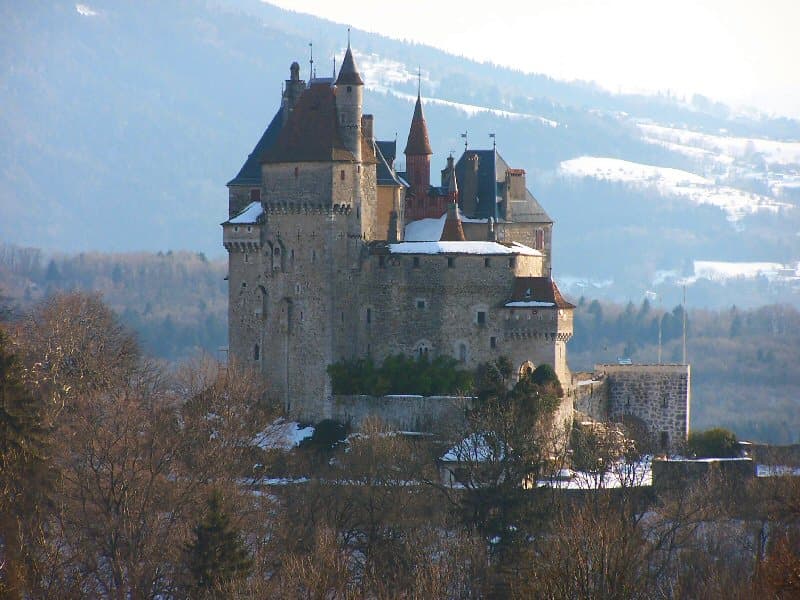
Château de Menthon-Saint-Bernard
The Château de Menthon-Saint-Bernard is a remarkable example of a hill castle that has stood watch over the region near Lake Annecy in France for over a millennium. Its origins date back to the early Middle Ages, around 923 AD, when a wooden watchtower was first erected on a rocky promontory approximately 600 meters above the village of Menthon-Saint-Bernard. This strategic location allowed its early occupants to control vital communication routes, including a Roman road and lake traffic, underscoring the site's military and administrative importance from the outset.
The castle is intimately linked to the noble de Menthon family, whose documented presence began around 1180. Over the centuries, the family rose from local lords to barons and counts, maintaining ownership of the castle for more than eight centuries. This continuity is rare and adds to the château's cultural and historical significance. One of the most notable figures born here is Saint Bernard of Menthon (circa 1008), who founded the Great St. Bernard Hospice, a vital refuge for travelers crossing the Alps. The castle chapel honors his legacy, blending the site’s martial and spiritual heritage.
Medieval origins and strategic significance
The initial construction phase focused on defense and surveillance. The earliest fortifications were wooden, designed to monitor the surrounding territory and protect the local population. By the 12th and 13th centuries, the castle had been reconstructed in stone, featuring a complex layout adapted to the natural contours of its rocky foundation. The fortress includes three imposing medieval stone towers: the "Tour des Armes" on the northeastern summit, with its irregular quadrangular plan and round stair turret; a large residential tower to the south; and the "Tour du Lac" guarding the main western entrance.
These towers are connected by fortified curtain walls with battlements, some dating back to the 12th century, showcasing the castle's evolution from a military stronghold to a noble residence. The main entrance is protected by a 15th-century iron-studded door with a grilled peephole and a machicolation above, allowing defenders to repel attackers effectively.
Defensive architecture and layout
The castle’s position on a rocky spur provided natural defense advantages, complemented by man-made fortifications. The compact inner courtyard is surrounded by residential buildings leaning inward from the curtain walls, creating a secure and intimate living space. The four-story structure contains 105 rooms, balancing defensive needs with residential comfort. The medieval kitchen, now called the Pilgrims’ Hall, dates from the 15th century and served as a resting place for pilgrims en route to major religious sites such as Rome and Santiago de Compostela.
Renaissance and 18th-century transformation
In the Renaissance and into the 18th century, the castle underwent significant modifications under Bernard VI de Menthon. These changes shifted the fortress’s focus from purely military functions to a comfortable noble residence. Bright and spacious apartments were added, offering panoramic views of Lake Annecy. The architectural style softened, reflecting the tastes and social status of the de Menthon family during this period.
Interior decoration and furnishings
The interior decoration largely dates from the 18th and 19th centuries, with furnishings that preserve earlier historical elements. Flemish tapestries and a 15th-century wooden statue of Christ in the chapel highlight the castle’s rich artistic heritage. The chapel, originally dedicated to Saint Veran and documented since 1262, was expanded in the late 19th or early 20th century to honor Saint Bernard of Menthon. It features a half-dome choir vault fresco depicting the saint’s spiritual battle and houses a reliquary containing one of his molars.
The Countess’s bedroom showcases architectural details from the 15th and 16th centuries, including a painted beam ceiling from the 13th century, alongside 18th-century furniture crafted by the renowned Hache family of Grenoble. The Great Salon, also known as the Music Room, and the lake-facing dining room were remodeled in the 19th century with neo-Gothic elements, including a monumental fireplace adorned with the de Menthon family coat of arms and portraits of family members.
19th-century neo-gothic renovation and romanticism
The 19th century brought extensive remodeling inspired by the neo-Gothic style, under the direction of architect Charles Suisse, a student of the influential Viollet-le-Duc. This renovation introduced decorative turrets, half-timbered galleries surrounding the courtyard, and other romantic elements that blended medieval military architecture with picturesque aesthetics. These enhancements reflect the 19th-century fascination with medieval heritage and the romantic movement’s influence on castle restoration.
Library and cultural treasures
A notable feature of the castle is its library, established in the mid-19th century within the lower part of the residential tower. It houses approximately 12,000 volumes predating the French Revolution, including medieval parchment manuscripts, incunabula, and a Book of Hours dated 1415. The finely carved wooden woodwork depicts scenes from the life of Saint Bernard, emphasizing the spiritual and cultural significance of the castle’s heritage.
Historical events and continuous ownership
The castle has witnessed turbulent historical moments, including a raid in 1793 by insurgents during the French Revolution, who sought to seize arms. Despite such upheavals, the de Menthon family retained ownership, preserving the castle’s legacy and ensuring its continuous occupation for over eight centuries. The château also hosted notable figures such as Bishop Félix Dupanloup during the Second Empire, reflecting its ongoing social and religious importance.
Today, the Château de Menthon-Saint-Bernard stands as a well-preserved monument that illustrates the evolution of French noble residences from medieval fortresses to romantic historic homes. Its architectural diversity, rich furnishings, and cultural treasures make it a significant heritage site, attracting visitors interested in history, architecture, and the legacy of Saint Bernard of Menthon.
Frequently asked questions (FAQ)
- How do I get to Château de Menthon-Saint-Bernard?
- Château de Menthon-Saint-Bernard is easily accessible by car and public transport. If you're driving, the castle is located just off the D909 road, and there is parking available nearby. For public transport, you can take a train to Annecy and then a bus to Menthon-Saint-Bernard.
- What is the historical significance of Château de Menthon-Saint-Bernard?
- Château de Menthon-Saint-Bernard dates back to the 13th century and is a prime example of medieval architecture in the region. It has been home to the Menthon family for centuries and played a significant role in local history, including defense against invasions. The castle is also linked to the legend of Saint Bernard of Menthon, who founded the Great St. Bernard Pass.
- When was Château de Menthon-Saint-Bernard built?
- The construction of Château de Menthon-Saint-Bernard began in the 13th century, with various modifications and expansions made over the centuries. The castle showcases a blend of medieval and Renaissance architectural styles. It remains one of the best-preserved castles in the Annecy region.
- Can I visit Château de Menthon-Saint-Bernard?
- Yes, visitors are welcome to explore Château de Menthon-Saint-Bernard during its open hours. Guided tours are available, allowing you to discover the castle's rich history and stunning architecture. Be sure to check the official website for any seasonal events or special tours.
- Why is Château de Menthon-Saint-Bernard a popular tourist destination?
- Château de Menthon-Saint-Bernard is popular due to its picturesque setting on the shores of Lake Annecy and its fascinating history. The breathtaking views from the castle and its unique architectural features make it a favorite among photographers and history enthusiasts alike. Additionally, the surrounding area offers a variety of outdoor activities, enhancing the overall visitor experience.
- Is it possible to host events at Château de Menthon-Saint-Bernard?
- Yes, Château de Menthon-Saint-Bernard can be rented for private events such as weddings, corporate gatherings, and special celebrations. The castle provides a stunning backdrop for any occasion, with both indoor and outdoor spaces available for use. For more information on event hosting, it is best to contact the castle administration directly.
- What are the opening hours for Château de Menthon-Saint-Bernard?
- The opening hours for Château de Menthon-Saint-Bernard vary by season, typically operating from March to November. During the peak summer months, the castle may have extended hours to accommodate visitors. Always check the official website for the most current information on opening hours and any special closures.
- What are the ticket prices for visiting Château de Menthon-Saint-Bernard?
- Ticket prices for Château de Menthon-Saint-Bernard are generally affordable, with discounts available for children and students. Guided tours may have an additional fee, but they provide valuable insights into the castle's history. It is advisable to purchase tickets in advance during peak tourist seasons to ensure availability.
- What nearby attractions can I visit while at Château de Menthon-Saint-Bernard?
- While visiting Château de Menthon-Saint-Bernard, you can also explore the beautiful Lake Annecy, famous for its clear waters and stunning mountain views. The charming village of Menthon-Saint-Bernard offers quaint shops and restaurants. Additionally, the nearby town of Annecy boasts a lovely old town and vibrant markets, making it a great complement to your castle visit.
Photo gallery

Information
Website
Visit websiteSources & official resources
Verify the information above using these authoritative references.
Loading map...
Visitor reviews
No reviews yet. Been here? Write the first review and help other travelers!
Write the first reviewVisited this castle? Share your experience
Your review helps other travelers and adds first-hand knowledge to our encyclopedia.



