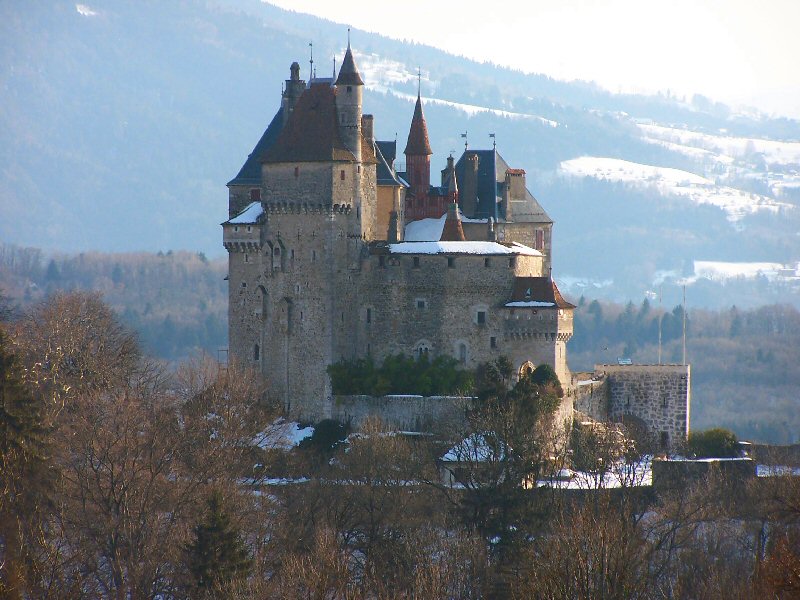
Château de Duingt
The Château de Duingt is a striking medieval hill castle ruin located in the municipality of Duingt, France, overlooking the western shore of Lake Annecy. Its origins trace back to the early 12th century, with the earliest documentation dating between 1103 and 1148 under the name Castrum Duini. This fortress played a vital role in the feudal landscape of the region, strategically positioned on a rocky outcrop that commanded views over the village of Duingt and controlled a key Roman-era secondary road linking Geneva and Moûtiers. The castle's location was critical for monitoring and defending this important route, reflecting its military and administrative significance during the High and Late Medieval periods.
Medieval origins and strategic importance
Originally, the castle belonged to the Duin family, vassals under the authority of the Counts of Geneva. As a fortified site, Château de Duingt was part of a wider defensive network that included the nearby Château de Châteauvieux. Together, these fortresses secured the region and maintained control over local territories. The castle functioned not only as a military bastion but also as the administrative center of a comital châtellenie, a local jurisdiction jointly managed by the Count of Geneva and the resident lord. This governance structure highlights the castle's dual role in defense and regional administration during the medieval era.
Ownership transitions and noble lineage
In 1296, the castle passed into the hands of Amédée II, Count of Geneva, fully integrating the fortress into his domains. This status continued until 1401, when the Dukes of Savoy assumed control, marking a significant political shift in the region. The 15th century saw the castle change ownership multiple times, including acquisition by Perrin d’Antioche in 1451. Later, the property was held by notable noble families such as the Savoy descendants, including Janus of Savoy and Louise de Savoie, as well as the Luxembourg family. Subsequent owners included the Genevois-Nemours, Monthoux, Montpiton, and de Sales families, who maintained possession until the upheavals of the French Revolution.
The castle during the french revolution and later history
During the revolutionary period, the château was declared national property and auctioned in 1796 to Jean Berthet. The 19th century brought new ownership under Baron Scipion Ruphy in 1833, and later the estate entered the possession of Comte Henri de la Barge de Certeau through marriage. Despite the political and social changes, the castle's noble associations persisted, reflecting its enduring status as a symbol of local heritage and aristocratic lineage.
Architectural features and surviving remains
Today, the Château de Duingt survives primarily as a ruin, offering valuable insights into medieval fortification design. The most prominent feature is a ruined octagonal tower perched on the cliff above the village. This tower, constructed of stone, served both defensive and observation purposes. Architecturally unique, its exterior presents a hexagonal shape, while the interior is circular, an uncommon design choice that may have enhanced its defensive capabilities. The exact construction date of this tower is uncertain, but architectural studies suggest its exterior form was reshaped during the 14th or 15th century as part of defensive upgrades.
Interior design and defensive elements
Inside the tower, a spiral staircase connects multiple floors, facilitating vertical movement and defense. This feature indicates the tower was designed not only as a lookout but also as a living space for defenders or lords. Surrounding the tower are fragments of the original enceinte—the defensive walls that once enclosed the castle. These remnants provide evidence of the castle’s perimeter defenses and its role as a fortified stronghold.
Gatehouse and chapel remains
The castle's gatehouse faced toward Talloires, controlling access to the fortress and serving as a critical point of defense. Near the gatehouse stood a castle chapel, which originally served the spiritual needs of the inhabitants. This chapel was significant enough to function as the original parish church before religious services were transferred in 1344 to a location near the present village cemetery. These religious structures underscore the castle’s multifaceted role, encompassing military, administrative, and spiritual functions within the community it governed.
The châtellenie and local governance
The châtellenie administered from Château de Duingt included numerous villages and hamlets, with appointed châtelains overseeing local administration, fiscal duties, and maintenance of the castle and its lands. Documentation from the 14th to 17th centuries reveals a well-organized system of governance centered on the castle, highlighting its importance beyond mere military utility. This administrative role contributed to the castle’s longevity and significance in regional history.
Cultural heritage and tourism today
While the Château de Duingt remains in a state of ruin, it continues to attract visitors interested in medieval architecture, feudal history, and scenic views of Lake Annecy. The castle's dramatic cliffside setting and distinctive tower offer a tangible connection to the region’s past. Efforts to preserve the ruins and interpret their historical context contribute to the cultural heritage of the area, making Château de Duingt a valuable site for both education and tourism.
Information
Website
Visit websiteSources & official resources
Verify the information above using these authoritative references.
Loading map...
Visitor reviews
No reviews yet. Been here? Write the first review and help other travelers!
Write the first reviewVisited this castle? Share your experience
Your review helps other travelers and adds first-hand knowledge to our encyclopedia.