Château de Madrid
The Château de Madrid was a prominent Renaissance castle located in Neuilly-sur-Seine, on the western edge of the Bois de Boulogne, just outside Paris. Constructed in the early 16th century, it represented an ambitious architectural project blending French and Italian Renaissance styles. Though once a grand royal residence, the château fell into decline during the 17th and 18th centuries and was largely demolished by the 1790s, leaving only archaeological ruins today.
Historical background and royal significance
The Château de Madrid was commissioned by Francis I of France, who reigned from 1515 to 1547 and was a key patron of Renaissance art and architecture in France. The castle's name, "Madrid," is believed to reference Francis I's captivity in Spain, symbolizing his connection to the Spanish court. Built as a lavish royal residence, the château served as a symbol of the monarch's power and the cultural exchange between France and Italy during the Renaissance.
In the centuries following its construction, the château was used intermittently by French royalty, but its importance diminished with the rise of other royal residences such as the Palace of Versailles. By the late 17th century, the castle was neglected, and its upkeep became unsustainable. The political upheavals of the French Revolution sealed its fate, leading to its near-total demolition in the 1790s.
Architectural features and style
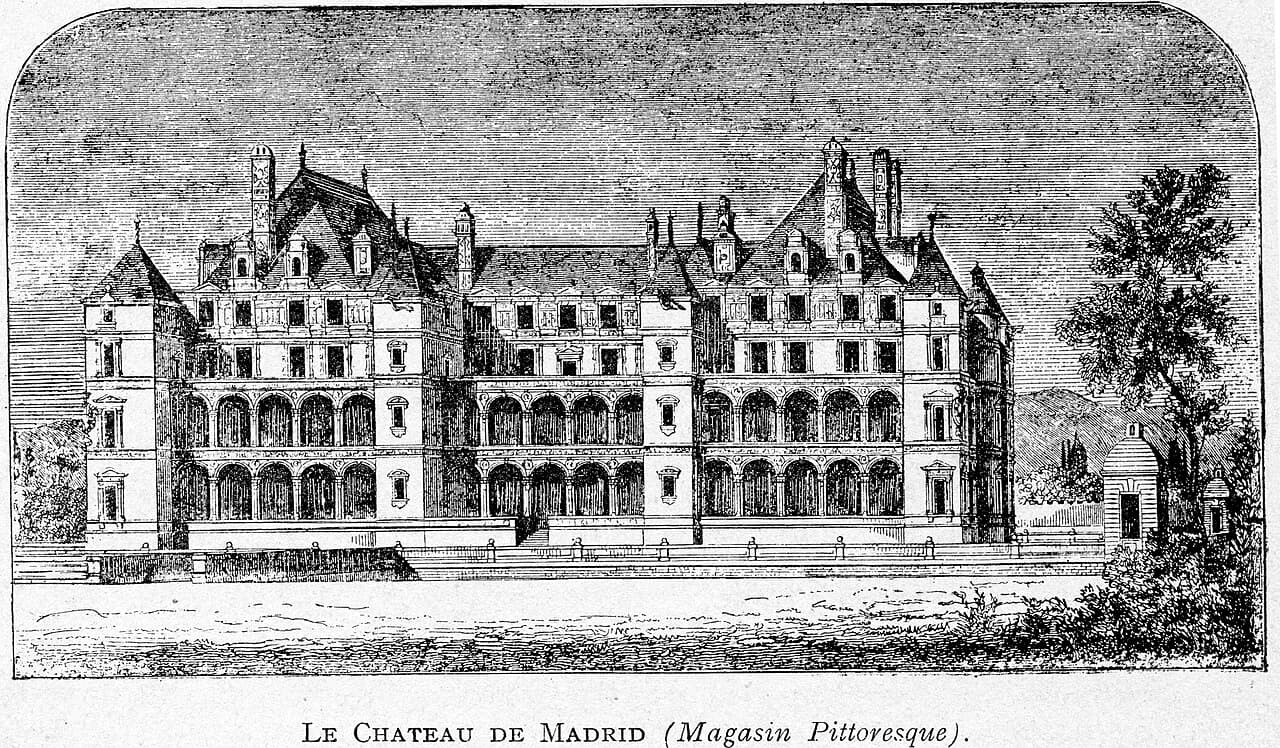
The château was an example of early French Renaissance architecture, incorporating elements inspired by Italian palaces and châteaux. It featured an extensive layout with multiple wings, courtyards, and decorative façades richly adorned with sculptural details. The building's design combined traditional medieval castle elements with Renaissance innovations such as large windows, ornamental stonework, and classical motifs.
One of the château's distinctive features was its elaborate façade, which included high relief sculptures and intricate carvings. The castle also had several towers and pavilions that enhanced its imposing silhouette. The use of symmetry and proportion reflected Renaissance ideals, contrasting with the fortress-like appearance of medieval castles.
Interior and decorative arts
Inside, the château housed lavishly decorated rooms with frescoes, tapestries, and fine woodwork. The interiors were designed to showcase the wealth and sophistication of the French crown, featuring richly appointed chambers, grand halls, and private apartments. Although much of the interior decoration has been lost due to demolition and decay, historical records indicate the château was a center for artistic patronage during its prime.
Decline and demolition
From the late 17th century onwards, the Château de Madrid suffered from neglect as French royalty preferred other palaces. Its location outside Paris became less strategic, and maintenance costs were prohibitive. During the French Revolution, many royal properties were confiscated and destroyed as symbols of the ancien régime. The château was dismantled piece by piece in the 1790s, and today only archaeological remains attest to its former grandeur.
Archaeological remains and legacy
Today, the site of the Château de Madrid is an archaeological ruin with limited visible structures. Excavations have uncovered foundations and fragments of the original walls and decorative elements. These remains provide valuable insight into early Renaissance architecture in France and the ambitions of Francis I's reign.
Though the château no longer stands, its historical significance endures as a testament to the cultural and political shifts of the French Renaissance. It also illustrates the transition from fortified medieval castles to more elegant Renaissance palaces emphasizing comfort and style.
Visiting the site
The château's former location is within the modern city of Neuilly-sur-Seine, near Paris, but there is no public castle structure to visit. The site is primarily of interest to historians and archaeologists. Visitors can explore the surrounding area, including the Bois de Boulogne, a large urban park offering recreational spaces and natural beauty.
Frequently asked questions (FAQ)
- What is Château de Madrid known for?
- Château de Madrid is renowned for its stunning Renaissance architecture and rich historical significance. Built in the 16th century, it served as a royal residence and showcases the opulence of the French monarchy during that era.
- When was Château de Madrid constructed?
- Construction of Château de Madrid began in 1528 and was completed in 1532. It was commissioned by King Francis I as a hunting lodge and later transformed into a grand palace.
- How do I get to Château de Madrid?
- Château de Madrid is located near the town of Saint-Germain-en-Laye, just west of Paris. Visitors can reach it by taking the RER A train to Saint-Germain-en-Laye station, followed by a short walk to the castle.
- What are the opening hours for Château de Madrid?
- Château de Madrid is typically open to visitors from 10 AM to 6 PM, with last entry at 5 PM. However, it's advisable to check the official website for seasonal hours and any special holiday closures.
- Can I purchase tickets in advance?
- Yes, tickets for Château de Madrid can be purchased in advance online. This is recommended, especially during peak tourist seasons, to avoid long lines and ensure entry.
- Is it possible to access Château de Madrid with limited mobility?
- Château de Madrid is committed to accessibility and offers facilities for visitors with limited mobility. Wheelchair access is available to certain areas of the castle, and staff are on hand to assist as needed.
- When is the best time to visit Château de Madrid?
- The best time to visit Château de Madrid is during the spring and early fall when the weather is mild and the gardens are in full bloom. Visiting during weekdays can also help avoid large crowds.
- What nearby attractions should I visit while at Château de Madrid?
- While visiting Château de Madrid, consider exploring the nearby Saint-Germain-en-Laye town, known for its charming streets and the impressive Saint-Germain-en-Laye Castle. The beautiful Parc du Château is also worth a stroll, offering lovely views of the surrounding area.
- What are the ticket prices for Château de Madrid?
- Ticket prices for Château de Madrid vary, with discounts available for students, seniors, and children. It's best to check the official website for the latest pricing information and any available family packages.
Photo gallery

Photo by illustrateur inconnu, scan by Havang(nl)•Public domain
Information
Loading map...
Visitor reviews
No reviews yet. Been here? Write the first review and help other travelers!
Write the first reviewVisited this castle? Share your experience
Your review helps other travelers and adds first-hand knowledge to our encyclopedia.