Fort Mont-Valérien
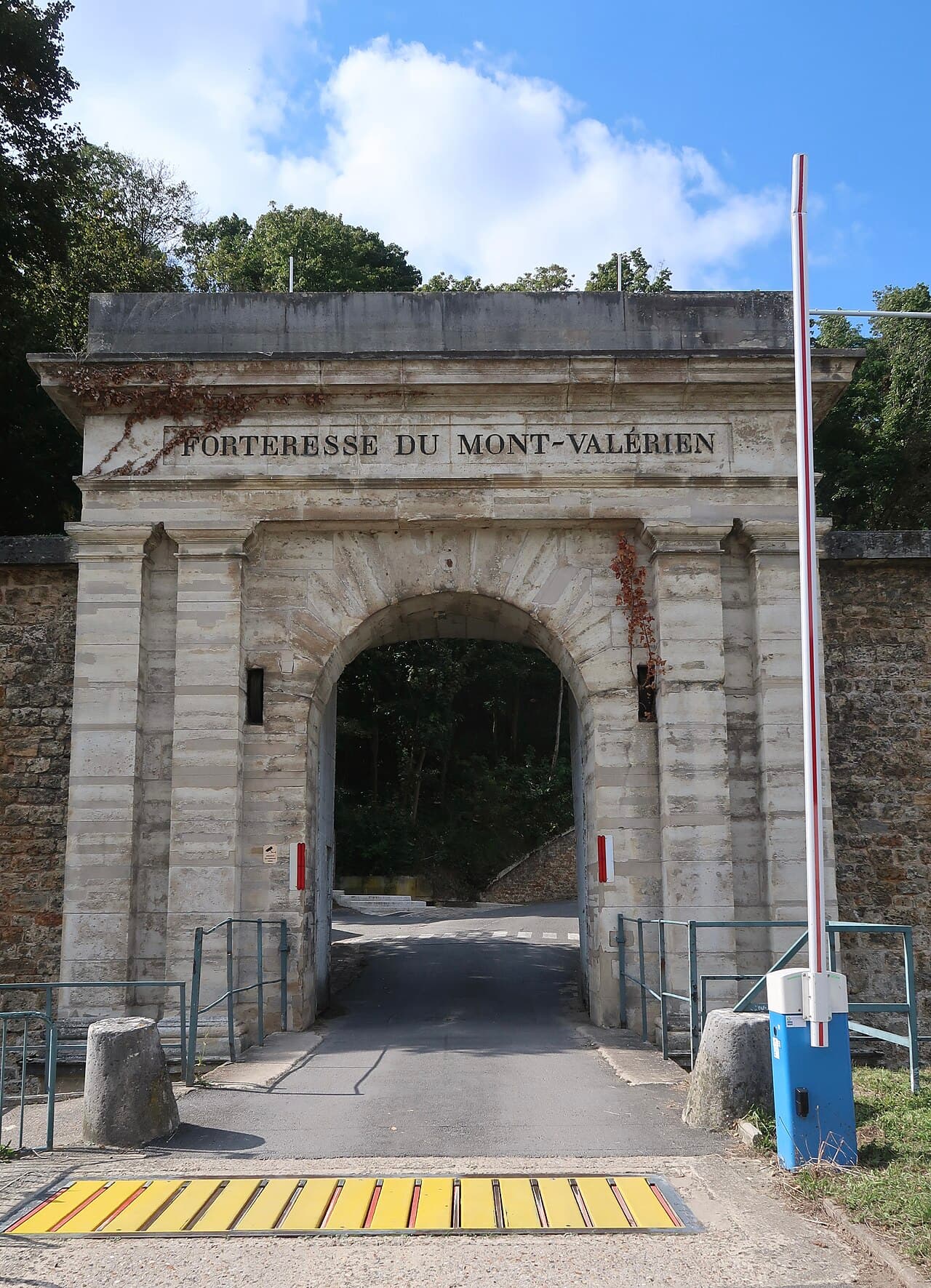
Fort Mont-Valérien is a prominent bastioned fortress located in Suresnes, a western suburb of Paris, France. Constructed in 1841 as part of the city's extensive ring of modern fortifications, this fortress was strategically positioned to overlook the Bois de Boulogne and the Seine River, providing a commanding defensive advantage over the approaches to Paris.
Construction and architectural features
The fortress was designed following the principles of 19th-century military architecture, incorporating bastioned defenses that were state-of-the-art for the period. Its layout includes thick stone walls, angular bastions for improved fields of fire, and internal barracks and magazines built to withstand prolonged artillery bombardment. The fort's elevated position on Mont-Valérien hill enhanced its defensive capabilities, enabling it to serve as a formidable obstacle against invading forces.
Role in the franco-prussian war
Fort Mont-Valérien played a crucial role during the Franco-Prussian War (1870-1871), serving as one of the strongest fortresses defending Paris. It endured sustained artillery bombardments over several months, demonstrating remarkable resilience. The fortress's eventual surrender on 17 January 1871 was a significant term in the armistice negotiated between the Government of National Defense and Otto von Bismarck. This surrender allowed German forces to occupy the strongest part of Paris's defenses in exchange for vital food supplies to the starving city.
Notable historical events and figures
In 1898, Colonel Henry, an intelligence officer involved in the infamous Dreyfus Affair, was imprisoned at Mont-Valérien. The day after his confinement, he committed suicide by cutting his throat with a razor, taking with him key secrets related to the affair.
Fort mont-valérien during world war ii
During the Second World War, from 1940 to 1944, the fortress was repurposed by the Nazi occupiers as a prison and execution site. Prisoners, including many members of the French Resistance, were brought to Mont-Valérien, temporarily held in a disused chapel, and then executed in a nearby clearing approximately 100 meters away. Over 1,000 hostages and resistance fighters were executed here. The victims' remains were subsequently buried in various cemeteries around Paris.
Memorialization and legacy
After the liberation of Paris, the site was consecrated as a national memorial by Charles de Gaulle on 18 June 1945. The area in front of the memorial has been named Square Abbé Franz Stock, honoring the priest who ministered to condemned prisoners during the German occupation. Stock's diaries record 863 executions at Mont-Valérien, underscoring the site's grim role during the war.
American military cemetery
In addition to its French historical significance, Fort Mont-Valérien hosts an American military cemetery that serves as the final resting place for 1,541 American soldiers who died in France during the First World War. This cemetery adds an international dimension to the fortress's commemorative landscape.
Current status and public access
Today, Fort Mont-Valérien stands as a well-preserved bastioned fortress and a poignant national memorial dedicated to the memory of those who fought and died in defense of France. The site is accessible to the public, offering visitors insight into its layered history through preserved structures and commemorative spaces.
Photo gallery

Information
Loading map...
Visitor reviews
No reviews yet. Been here? Write the first review and help other travelers!
Write the first reviewVisited this castle? Share your experience
Your review helps other travelers and adds first-hand knowledge to our encyclopedia.