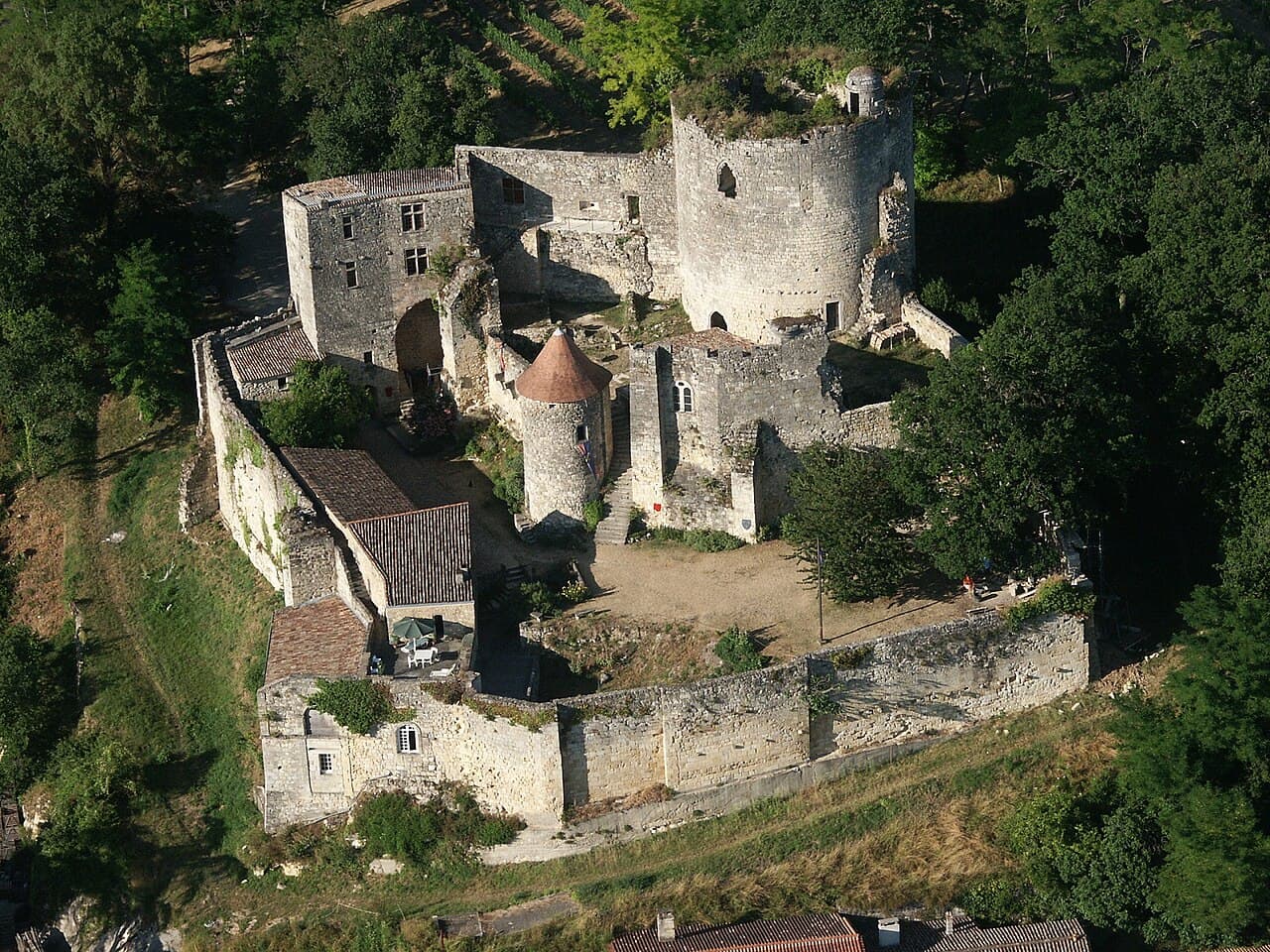
Château de Langoiran
Château de Langoiran is a significant medieval fortress situated in the commune of Langoiran, within the historic region of Aquitaine, France. Constructed in the 13th century by the noble Seguin d’Escoussans family, the castle occupies a strategic position on a plateau overlooking the Garonne Valley. This vantage point provided both military advantage and control over the surrounding lands, making it a key stronghold in the region during the High Medieval period.
The castle’s most remarkable architectural feature is its massive cylindrical donjon, which is among the largest in France by diameter and wall thickness. This imposing tower dominates the landscape and offers panoramic views extending up to 50 kilometers across the valley. The donjon’s robust construction and commanding height reflect the defensive priorities of medieval fortifications, designed to withstand sieges and assert lordly power.
Historical lineage and political significance
The origins of Château de Langoiran trace back to the early feudal era, with the seignory mentioned as early as the 11th century. It was initially established by the Escoussans family, who were vassals to the lords of Benauges. The castle rose in prominence through strategic marriages and political alliances, notably when Amanieu d’Albret married Mabille Seguin d’Escoussans in 1345. This union brought the castle under the influence of the powerful Albret family, aligning it with the English crown during the turbulent Hundred Years’ War.
Throughout the 14th and 15th centuries, the lords of Langoiran were often loyal to the English kings who held the Duchy of Aquitaine. However, allegiances shifted during the protracted conflict between France and England, exemplified by figures such as Bérard d’Albret, who switched loyalty to the French crown late in life. The castle's ownership passed to the Montferrand family in the late 14th century, who retained it until the early 17th century. Notable members include Bertrand III de Montferrand and his son Pierre II, whose execution in 1453 coincided with the French reconquest of Bordeaux and the castle's temporary confiscation by King Charles VII.
Architectural features and defensive elements
The donjon and its interior
The donjon of Château de Langoiran is a cylindrical tower constructed in the 14th century, notable for its exceptional size and defensive capabilities. It is positioned on a steep slope, enhancing its natural defenses. A semicircular ditch protects the most vulnerable side, connecting natural barriers formed by a valley and a ravine on the other sides. This combination of natural and man-made defenses exemplifies medieval military architecture.
Inside, the donjon contains three octagonal rooms arranged vertically over two vaulted floors, connected by a spiral staircase that remains intact. The first vaulted floor rises to approximately eight meters at its keystone and features remnants of decorative ceramic tiles with heraldic floral and geometric motifs linked to the Seguin d’Escoussans family. The vault ribs display coats of arms from various noble families, illustrating the castle’s complex history of ownership.
The ground floor served as a guardroom, equipped with a large fireplace and a stone sink set into an arrow slit, designed for defensive purposes. The first floor contains cruciform arrow slits beneath decorative niches and two surviving frescoes depicting Saint Michael weighing souls and Saint Peter with the keys to paradise, reflecting the religious symbolism integrated into the castle’s design.
The upper floor functioned as the lord’s living quarters, featuring a large Gothic trilobed window added in the late 14th century. Stone benches and a rare Gothic-style fireplace are built into the walls. Later renovations in the 16th century introduced a new fireplace and enlarged window openings to improve comfort and light.
Outer fortifications and ancillary structures
The castle complex extends beyond the donjon into two courtyards arranged on a stepped layout. These courtyards are enclosed by strong defensive walls intersecting at near right angles, with outer ends connected to the defensive ditch system. A 16th-century tower equipped with gunports demonstrates adaptations to evolving military technology, particularly the introduction of firearms.
A chapel within the castle grounds served religious functions for the lordship, underscoring the dual military and spiritual roles of such medieval fortresses. The castle’s layout and structures reflect centuries of architectural evolution from the High Medieval through the Renaissance periods.
Conflicts, decline, and modern history
Château de Langoiran was repeatedly involved in regional conflicts, including the Hundred Years’ War, the French Wars of Religion, and the Fronde rebellion of the 17th century. During the Fronde, the castle was seized and partially destroyed by forces loyal to the Duke of Épernon, including the deliberate burning and explosion of the donjon.
Following these events, the castle fell into disrepair, passing through various noble families such as the Jumilhac family, who managed it through local agents. Its decline continued through the 18th and 19th centuries until it was recognized as a historic monument in 1892.
In the 20th century, the castle gained renewed historical significance when it served as a meeting place for the French Resistance during World War II. In August 1944, leaders convened at Château de Langoiran to sign the surrender of Bordeaux, linking the medieval fortress to modern history.
Current status and cultural importance
Today, Château de Langoiran stands as a partially preserved ruin, with ongoing restoration efforts led by the association Les Amis du château de Langoiran since the 1970s. The castle remains a popular site for visitors interested in medieval architecture and regional history.
The surrounding estate encompasses 23 hectares of vineyards producing Cadillac and Côtes de Bordeaux wines, maintaining the site's longstanding agricultural tradition. The castle’s commanding position and impressive donjon continue to attract tourists, scholars, and wine enthusiasts alike.
Château de Langoiran exemplifies the layered history of Aquitaine’s medieval fortifications, reflecting the complex political, military, and cultural developments of southwestern France from the Middle Ages through the modern era.
Frequently asked questions (FAQ)
- How do I visit Château de Langoiran and what can I expect?
- Visitors can explore the castle ruins, including the impressive donjon and courtyards. The site offers panoramic views of the Garonne Valley. Guided tours and informational panels provide historical context.
- What is the historical significance of Château de Langoiran?
- The castle played a key role in the Hundred Years’ War and regional power struggles between France and England. It was owned by prominent families such as Escoussans, Albret, and Montferrand.
- When was the castle built and what architectural style does it represent?
- Château de Langoiran was built in the 13th century, primarily reflecting High Medieval military architecture with later Renaissance modifications.
- Is the donjon accessible to visitors?
- Yes, the donjon is accessible and features a spiral staircase leading to vaulted rooms with historic frescoes and architectural details.
- Are there any special events or activities at Château de Langoiran?
- The castle hosts occasional cultural events and historical reenactments. The surrounding vineyards also offer wine tastings and tours.
- What are the opening hours and ticket prices?
- Opening hours and ticket prices vary seasonally; visitors should check the official website or local tourist information for current details.
Photo gallery

Information
Website
Visit websiteSources & official resources
Verify the information above using these authoritative references.
Loading map...
Visitor reviews
No reviews yet. Been here? Write the first review and help other travelers!
Write the first reviewVisited this castle? Share your experience
Your review helps other travelers and adds first-hand knowledge to our encyclopedia.



