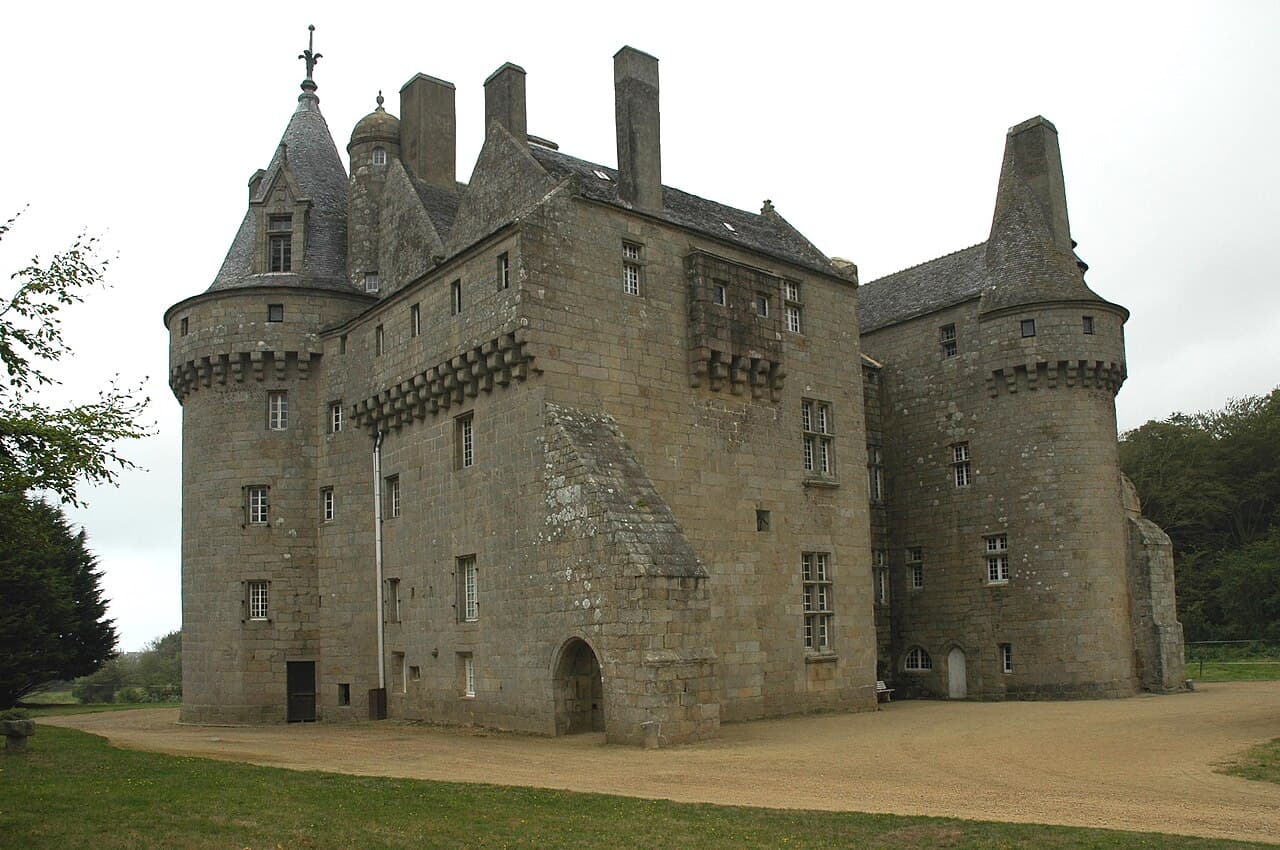
Château de Kérouzéré
Château de Kérouzéré stands as a remarkable example of a Breton manor castle constructed primarily of granite during the 15th century. Located in the municipality of Sibiril, France, this fortress was built between 1425 and 1458 for Jean and Yves de Kérouzéré, prominent nobles and seneschals serving the dukes of Brittany. Its strategic position visible from the sea made it a critical defensive site against English incursions during the turbulent Late Medieval period.
The castle’s origins trace back to an earlier stronghold from the mid-13th century, initially held by Yvon de Kerouzéré, a knight known for his participation in the Seventh Crusade in 1248. This early fortress laid the groundwork for the imposing granite structure that dominates the landscape today.
Architectural features and defensive design
Château de Kérouzéré is characterized by its square-shaped fortress plan, reinforced by four round corner towers originally, of which three remain intact. The walls are constructed from thick granite blocks measuring approximately 4.2 meters thick, demonstrating a robust design intended to withstand sieges and artillery attacks. The castle’s exterior is crowned with classic crenellations and machicolations, defensive architectural features that allowed defenders to observe and repel attackers effectively.
The towers and curtain walls incorporate arrow slits specifically designed for fauconneaux, small artillery pieces or crossbows, highlighting the castle’s adaptation to evolving medieval warfare technologies. The watchman’s tower offers commanding views over the sea, providing early warning of approaching enemies and reinforcing the castle’s maritime strategic importance.
Main building and interior layout
The principal residential building follows an L-shaped plan with two main stories and an attic floor. The western section preserves the original 15th-century tower, notable for the chapel window above it, indicating the presence of a dedicated religious space within the fortress. The chapel itself is partly embedded within the thick walls and partly extends outward as a masonry projection on the southern façade.
Inside, the castle features four superimposed halls. The lowest hall is situated near the main entrance, while the uppermost hall is located beneath the roof, granting access to a covered wall-walk—a protected walkway along the curtain walls used by defenders. These halls served both defensive and residential functions, accommodating the castle’s occupants and their needs.
The interior decoration includes 17th-century wall paintings and heraldic symbols, such as the painted armorial decorations of Pierre de Boiséon on a kersantite stone surface within the great hall. These artistic elements provide insight into the castle’s noble heritage and the status of its owners.
Historical significance and events
Constructed during a period of regional conflict, Château de Kérouzéré was built under the authority of the dukes of Brittany, specifically for Jean II de Kérouzéré, an important official serving Duke Jean V. The castle’s defensive capabilities were tested during the French Wars of Religion in the late 16th century.
In 1590, the castle endured a significant siege by forces of the Catholic League. This assault resulted in severe damage, including the destruction of the southeast tower and part of the southern defensive wall. Repairs were undertaken around 1600, financed by compensation from King Henri IV in recognition of the loyalty and courageous defense mounted by Pierre de Boiséon, then owner of the castle.
The castle remained in noble hands through centuries, passing by inheritance and marriage through families such as the Kérouzéré and Boiséon lineages. Since 1912, the estate has been managed by the de la Lande de Calan family, who have continued preservation efforts.
Notably, the castle survived the French Revolution without confiscation, as the owner at the time voluntarily surrendered feudal documents to revolutionary authorities in 1793, demonstrating compliance and safeguarding the property.
Grounds and auxiliary structures
The castle’s defensive moat, once surrounding the fortress, was filled in during the 17th century as defensive needs evolved. Vestiges of the moat remained until recent centuries, but the landscape was altered further in the 19th century when the surrounding pond was drained.
The estate includes several auxiliary buildings dating from the same era as the castle. A notable feature is the 15th-century dovecote, used historically for housing pigeons for food and communication. Other functional structures include a fountain, well, washhouse, and farm buildings, which supported the self-sufficiency of the medieval household.
The grounds extend into a park with an irregular garden laid out in 1940. This garden features a prominent avenue lined with plane trees, alongside rhododendrons, hydrangeas, and camellias. The northern boundary of the estate opens onto the sea, maintaining the castle’s historic maritime connection and strategic importance.
Restoration and preservation
The castle has undergone various restoration efforts, including the 19th-century restoration of the northwest tower’s roof. The family owners have maintained the property, preserving its historical and architectural integrity. Since its classification as a protected historic monument in 1883, Château de Kérouzéré has been recognized for its cultural significance and medieval heritage.
Today, visitors can explore key features such as the armoury, chapel, stairs, covered wall-walk, and the watchman’s tower with panoramic views over the sea. The castle remains a vivid testament to the region’s medieval past and the evolution of Breton defensive architecture.
Photo gallery

Information
Website
Visit websiteSources & official resources
Verify the information above using these authoritative references.
Loading map...
Visitor reviews
No reviews yet. Been here? Write the first review and help other travelers!
Write the first reviewVisited this castle? Share your experience
Your review helps other travelers and adds first-hand knowledge to our encyclopedia.



