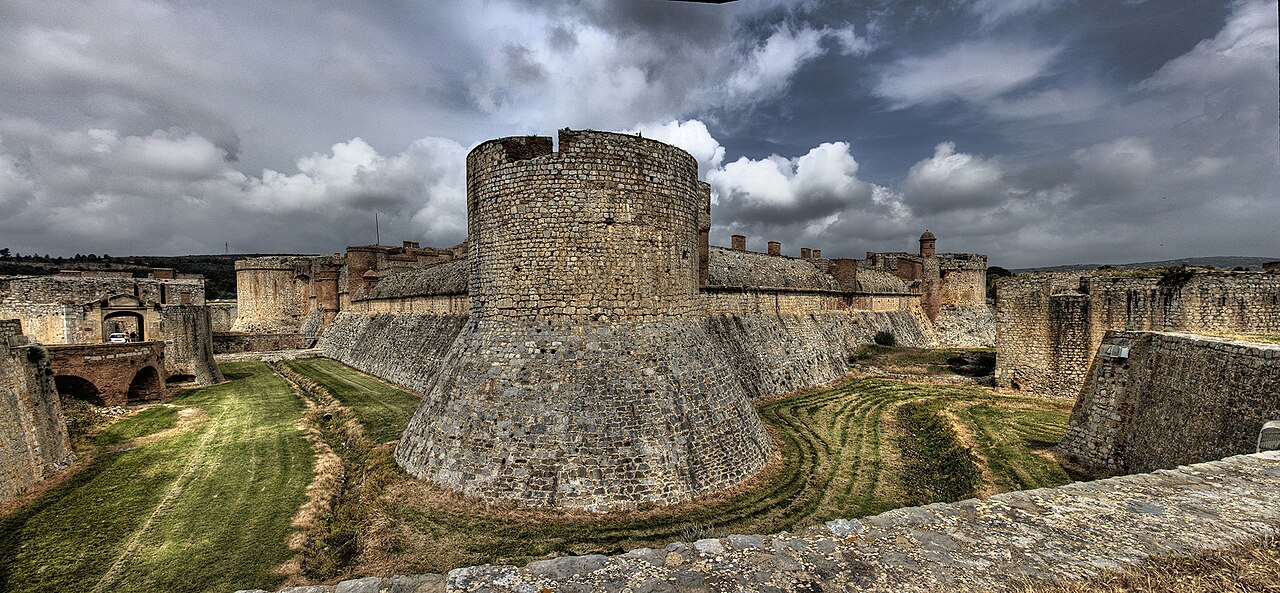
Château de Fitou
The Château de Fitou is a historic hill castle located above the village of Fitou in southern France, offering commanding views over the Leucate ponds and the nearby Mediterranean Sea. Its origins remain somewhat obscure, but the site’s strategic importance is evident from early records and possible Roman occupation. This castle has witnessed centuries of military conflict, religious upheaval, and social change, reflecting the turbulent history of the region.
Early history and strategic significance
The site of the Château de Fitou may have originally hosted a Roman villa, indicating the area's long-standing importance due to its elevated position and proximity to the sea. The first documented historical mention dates to a will from 990 AD, where the Viscountess of Narbonne bequeathed an estate called Fictorius to Ermengaud of Narbonne. This estate covered over 3,000 hectares, extending to the border near Salses, and laid the foundation for the feudal domain that would include the castle.
The Perpignan family later held seigneurial rights over Fitou, granting them authority to confer titles and privileges to their vassals, thereby establishing their dominion in the area. The castle's elevated position made it a natural stronghold, serving as a defensive bastion and symbol of feudal power.
Medieval conflicts and religious shifts
Throughout the Middle Ages, the Château de Fitou was repeatedly involved in military actions, enduring sieges and damage from fires. It played a role during the suppression of the Cathar movement in the 13th century. Following the fall of Montségur, the Lord of Niort, a former Cathar adherent, renounced his heresy and took residence at the castle, marking a significant religious and social transformation at the site.
17th-century warfare and decline
In the early 1600s, the castle's strategic position again brought it into the spotlight during the conflict between France and Spain. In 1635, Spanish forces launched a two-pronged attack on Fitou. Despite its fortifications, the castle's defenders surrendered, and the Spanish occupied the castle, village, and nearby manor known as the Cabannes de Fitou.
The Aragon family were the last feudal lords to occupy the castle until the French Revolution of 1789 ended their tenure. Subsequently, the castle fell into neglect and suffered further damage. In 1843, it was plundered and set on fire, after which official orders authorized its destruction. Its stones were quarried for local building projects, leaving the castle in ruins.
Restoration and modern uses
Restoration efforts began in 1972 when Mr. and Mrs. Gaillot, private antiquarians, undertook the task of partially reconstructing the castle. Their work focused on stabilizing the ruins and approximating the original form without detailed replication of architectural features. The castle was adapted for various uses, including functioning as a nightclub and later a museum. After its sale in 2015, the castle was closed to the public.
The French government recognized the castle's cultural and historical value by listing it as a historic monument in 1948. Additionally, the natural environment around the castle has been protected since 1942, preserving the landscape that has shaped the castle's history.
Architectural remains and site description
The Château de Fitou occupies an elevated site of approximately 1,000 square meters, strategically positioned to oversee the village, the Leucate ponds, and the sea. While detailed architectural plans are lacking, the castle's remains reveal the impact of repeated sieges and fires. Much of the original masonry was dismantled and repurposed for local construction following official demolition orders in the 19th century.
Restoration has resulted in a structure that blends original fragments with reconstructed elements, emphasizing the castle's historical footprint rather than precise architectural accuracy. Although specific details about the defensive walls, towers, and gates are scarce, the castle's fortifications were significant enough to influence military campaigns, particularly during the 17th-century Spanish invasion.
Today, the Château de Fitou stands as a monument to centuries of regional conflict and change. Its ruins and the surrounding protected landscape continue to attract interest for their historical and cultural significance.
Visitor information and cultural significance
While currently closed to the public following its sale in 2015, the Château de Fitou remains an important heritage site within the Hauts-de-France region. Its designation as a historic monument ensures ongoing recognition and potential future preservation efforts. The castle's commanding position and rich history make it a noteworthy example of medieval and early modern fortifications in southern France.
Frequently asked questions (FAQ)
- When was the Château de Fitou originally built?
- The exact construction date of Château de Fitou is unknown, but its origins likely date back to the early medieval period, with the first documented mention in 990 AD.
- What historical events affected the Château de Fitou?
- The castle experienced sieges during the Cathar suppression in the 13th century, was involved in 17th-century conflicts between France and Spain, and suffered damage during the French Revolution and later.
- Is the Château de Fitou open to visitors today?
- As of its last sale in 2015, the Château de Fitou is closed to the public, with no regular visiting hours currently available.
- What restoration efforts have been made on the castle?
- Restoration began in 1972 by private antiquarians who partially reconstructed the castle to stabilize its ruins, blending original remains with new elements.
- Why is the Château de Fitou historically significant?
- The castle's long history, strategic hilltop location, and role in regional conflicts and religious shifts highlight its importance in southern France's medieval and early modern history.
Information
Loading map...
Visitor reviews
No reviews yet. Been here? Write the first review and help other travelers!
Write the first reviewVisited this castle? Share your experience
Your review helps other travelers and adds first-hand knowledge to our encyclopedia.